

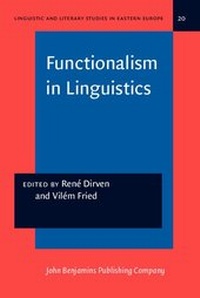
Functionalism in Linguistics
1st Edition
Published on 1. January 1987
XVIII, 489 pages
978-90-272-8248-4 (ISBN)
Description

This volume offers a variety of viewpoints on the functional approach to the study of language. After an exposition of the Prague School functionalism, and Dik's and Halliday's functional approaches, it presents a wider area of text-linguistic, psycholinguistic, sociolinguistic, theoretical, descriptive and applied issues from a functional point of view, testifying of the very wide-spread and in-depth impact of functionalist thought on the present-day linguistic scene.
More details
Other editions
Additional editions
Rene Dirven | Vilem Fried
Functionalism in Linguistics
Book
01/1987
John Benjamins Publishing Co
€162.18
Shipment within 10-15 days
Content
- FUNCTIONALISM IN LINGUISTICS
- Editorial page
- Title page
- Copyright page
- List of Authors
- Table of contents
- BY WAY OF INTRODUCTION
- Dedication
- References
- I. 'FUNCTIONAL LINGUISTICS OF PRAGUE' AND OTHER FUNCTIONAL APPROACHES
- 1. ON PRAGUE SCHOOL FUNCTIONALISM IN LINGUISTICS
- 1. Introduction
- 2. Different meanings of function. The roots of the functionalist approach.
- 3. Functional principle in contemporary science
- 4. The functional approach in the Prague School: different ways and domains of its employment
- 4.1 The methodological device "From functions to the means of communication and expression
- 4.2. External functions of language (and/or of utterances). Functional Stylistics
- 4.3. Functions of units on different linguistic levels (internal functions)
- 4.3.1. Phonology
- 4.3.1.1. Phonological features in respect to language functions
- 4.3.1.2 The phonology of sentence (utterance)
- 4.3.2. The other linguistic levels. 'Function' vs. 'meaning' of linguistic units
- 4.4. Other uses of the term functional
- 4.4.1. The functional load of linguistic elements
- 4.4.2. The functional sentence (utterance) perspective
- 4.5. The functional interpretation of language development
- 5. Other functional approaches in linguistics
- Notes
- References
- 2. M.A.K. HALLIDAY'S FUNCTIONAL GRAMMAR AND THE PRAGUE SCHOOL
- 0. Introduction
- 1. The functionalism of Halliday
- 1.1. System
- 1.1.1. Systemic grammar
- 1.1.2. Sociosemantic networks
- 1.2. Metafunction
- 1.2.1. Halliday's metafunctional interpretation of system networks
- 1.2.2. The correlation between metafunctions and register variables
- 1.2.3. A functional approach to language development
- 1.2.4. A comparison with the Prague School
- 1.2.5. Some critical comments
- 2. Some descriptive achievements of Halliday and the Prague School
- 2.1. A three-level approach to syntax
- 2.1.1 Danes
- 2.1.2. Halliday
- 2.1.3. Comparison between Halliday and Danes
- 2.2. FSP versus Halliday's thematic and information structure
- 3. Conclusion
- Notes
- References
- 3. SOME PRINCIPLES OF FUNCTIONAL GRAMMAR
- 0. Introduction
- 1. The senses of 'functional'
- 2. The functional view of natural language
- 3. The status of functional relations
- 4. Practical applicability
- 5. The organization of a Functional Grammar
- 5.1. Predicates and predicate-frames
- 5.2 Terms and term formation
- 5.3. Syntactic function assignment
- 5.4. Pragmatic function assignment
- 5.5. Fully specified predications
- 5.6. Expression rules
- 6. Conclusion
- References
- 4. S.C. DIK'S FUNCTIONAL GRAMMAR: A PILGRIMAGE TO PRAGUE?
- 0. Introduction
- 1. A Functional View of Language
- 1.1 Language as an Instrument
- 1.2 Implications of the Functional View of Languge
- 2. A Functional Analysis of the Sentence
- 2.1 The Incorporation of the Hearer into the Linguistic Description
- 2.2 The "Functional Sentence Perspective" in PS
- 2.3 FG and the Information Structure of the Sentence
- 3. Summary and Conclusion
- Notes
- References
- II. THE THEME-RHEME (TOPIC-COMMENT) ISSUE IN THE PRAGUIAN TRADITION
- 5. ON THE DELIMITATION OF THE THEME IN FUNCTIONAL SENTENCE PERSPECTIVE
- 0. Introduction
- 1. Main points dealt with in my previous research
- 2. Exploration of Mathesius's conception of theme
- 3. Features and circumstances to be taken into account for the delimitation of theme
- 3.1 Context dependence
- 3.2 Less dynamic context-independent information
- 3.3 Low degrees of CD
- 3.4 The boundary between the thematic and the non-thematic section of the sentence
- 3.5 The foundation-laying function
- 3.6 Aboutness
- 3.7 The syntactic and formal features of the theme
- 3.8 A functional and structural (systemic) view of the theme
- 3.9 The intonational features of the theme
- 4. Summing up
- Notes
- References
- 6. CONSTITUTIVE, INFORMATIVE AND TRANSFORMATIVE MODELS IN MODERN ENGLISH TEXTS AND SENTENCES
- 1. The concept of 'linguistic text' in Prague School Linguistics
- 2. Theme-rheme structure and the subset of sentence constituents
- 3. Conclusion
- References
- 7. PRAGUE FUNCTIONALISM AND TOPIC VS. FOCUS
- 1. The three basic features of functionalism
- 1.1. Linguistic units, levels and hierarchies
- 1.2. Language as a functioning system, adopted to its communicative role
- 1.3. Mutual relationship between the three basic features
- 2. Illustration of the adaptation of the structure of a sentence to its functioning in discourse
- 2.1 Examples
- 2.2. On what basis are topic and focus to be defined?
- 2.3. How is TFA conveyed?
- 3. Conclusion
- Notes
- References
- 8. FUNCTIONAL SENTENCE PERSPECTIVE AND INTENSIONAL LOGIC
- 0. Introduction
- 1. Principles and assumptions of intensional logic
- 2. Different constructions, same proposition
- 3. Different FSP, different constructions
- 4. Different FSP, different constructions, different propositions
- 5. Overt and covert semantic difference
- 6. Conclusion
- References
- III. FUNCTIONALISM AS A PSYCHOLINGUISTIC ISSUE
- 9. A FUNCTIONALIST APPROACH TO THE ACQUISITION OF GRAMMAR
- 1. Functions and means in topicalization and commenting
- 1.1. Introduction: Autonomous vs. functionalist approach
- 1.2. Defining topic and comment
- 1.3. Topicalization: Why and how
- 1.4. Commenting: Why and how
- 2. Evidence from early child language
- 2.1. Longitudinal evidence
- 2.1.1. Subject and word order
- 2.1.2. Other grammatical devices associated with topic-comment
- 2.2. Experimental Evidence
- 3. Conclusion
- References
- 10. FUNCTIONAL SENTENCE PERSPECTIVE IN DISCOURSE AND LANGUAGE ACQUISITION
- 1. Functional sentence perspective and discourse
- 1.0 Problems of method and terminology
- 1.1 Functional sentence perspective: some basic notions
- 1.2 Pragmatic constraints on given and new information
- 1.2.0 Introduction
- 1.2.1 Identifiability
- 1.2.2 Informativity
- 1.3 Discourse relevant mutual knowledge and its sources
- 1.4 Sentential themes and topic frames
- 2. A functional approach to child language
- 2.1 Community membership and the social foundations of DRMK
- 2.2 Informativity and variability: Given and New in one-word utterances
- 2.3 Syntax and the expansion of the rhematic function
- 2.4 Discourse and the development of anaphoric devices
- 3. Conclusion
- Notes
- References
- 11. PROCESSING STRATEGIES: A PSYCHOLINGUISTIC NEOFUNCTIONALISM?
- 1. Introduction
- 2. Processing Strategies
- 3. Summary
- References
- IV. FUNCTIONALISM IN GENERAL LINGUISTICS
- 12. THE OVERESTIMATION OF FUNCTIONALISM
- 0. Introduction: An ideological rift in linguistic theory
- 1. Functional explanations of sound change
- 1.1. Chain shifts
- 1.2. Constraints on sound change.
- 1.3. Near-mergers
- 2. Constraints on phonological variation.
- 2.1. Simplification of English final clusters.
- 2.2. The aspiration and deletion of Spanish /s/.
- 2.3. The perfect (s) of Ladakhi
- 3. Syntactic variation
- 4. Overview
- Notes
- References
- 13. FUNCTION AND STRUCTURE IN LINGUISTIC DESCRIPTIONS
- 0. Introduction
- 1. Retrospective
- 1.1 Structure without function: distributional linguistics
- 1.2 Criteria of functional relevance
- 2. Functional Analysis
- 2.1 Functions in mathematics and logic
- 2.2 Linguistic function
- 3. The twofold patterning of utterances
- 3.1 Phonological units: distinctive value
- 3.2 Grammatical units: semantic value
- 3.2.1 Content-entities
- 3.2.2 Distributional patterning
- 3.2.3 A functional approach
- 3.2.4 'Having meaning'
- 4. Presuppositions and extensions of functional analysis
- 4.1 Difference of meaning
- 4.2 Pre-theoretical explanation
- 4.3 Linguistic description beyond the sentence
- 4.4 Teleological interpretation
- Notes
- REFERENCES
- 14. COMMUNICATION AND EXPRESSIVITY
- 1. The expressive function
- 2. Layers of expressivity
- 3. Modes of expressing
- 4. Expressivity as mode vécu
- 4.1 Emotions and expressions
- 4.2. Markedness
- 4.3. Semiotic status
- 4.4. Pragmatic meaning
- 4.4.1. Diagnostic problems
- 4.5. The interpersonal meaning function
- 5. In a social perspective
- Notes
- References
- 15. FUNCTIONS OF INTONATION
- 1. Introduction
- 2. Functions of intonation as a phenomenon sui generis
- 3. Global subfunctions of intonation seen in relation to other language units
- 4. Functions of intonation as part of general language functions
- 5. The quest for a dominant function of intonation
- Notes
- References
- 16. WRITTEN LANGUAGE SEEN FROM THE FUNCTIONALIST ANGLE
- 1. Increasing interest in written language
- 2. The development of Praguian views of written language
- 3. Correspondences between the spoken and the written norm of language
- 4. Queries raised against the autonomy of the written norm and their refutation
- 4.1 A written norm not a language universal
- 4.2. The non-existence of graphemic distinctive features
- 4.3 Objections drawing on mistaken analogy with facts of music
- 5. Functionalist conception of written norm providing deeper insight into facts of language
- Notes
- References
- V. FUNCTIONALISM IN LINGUISTIC DESCRIPTION
- 17. WORD-FORMATION AND POETIC LANGUAGE: NON-LEXICALIZED NOMINAL COMPOUNDS IN THE POETRY OF KEVIN CROSSLEY-HOLLAND
- 1. An interactionist view of poetic language
- 2. Acceptable and unacceptable compounds
- 3. Metaphor
- 4. Foregrounding and the "Minimax Principle
- 5. Ambiguity
- Notes
- References
- 18. ON ACCEPTABLE VIOLATIONS OF PARALLELISM CONSTRAINTS
- 0. Introduction: the data
- 1. Analytical approaches to HCCs: examination and evaluation
- 1.1. The parenthetical analysis
- 1.2. The dummy 'and' analysis
- 1.3. The right node raising-string coordination analysis
- 1.4. The coordination-reduction/expansion approach
- 2. The Focus Constraint
- 3. Summary and conclusions
- Notes
- References
- 19. A CASE OF SYNTACTIC MIMICRY
- Notes
- References
- 20. FUNCTIONALISM IN CONTRASTIVE ANALYSIS AND TRANSLATION STUDIES
- 0. Introduction
- 1. A necessary basis for contrastive anallysis
- 2. Translation as a basis of contrastive analysis
- 3. A model of contrastive analysis
- 4. Differences of langue and translation theory and practice
- 5. Functions of parole in translation
- References
- INDEX OF NAMES
