

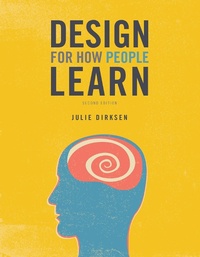
Design for How People Learn
2nd Edition
Published on 17. November 2015
304 pages
978-0-13-421008-7 (ISBN)
Description

Products, technologies, and workplaces change so quickly today that everyone is continually learning. Many of us are also teaching, even when it's not in our job descriptions. Whether it's giving a presentation, writing documentation, or creating a website or blog, we need and want to share our knowledge with other people. But if you've ever fallen asleep over a boring textbook, or fast-forwarded through a tedious e-learning exercise, you know that creating a great learning experience is harder than it seems.
In Design For How People Learn, Second Edition, you'll discover how to use the key principles behind learning, memory, and attention to create materials that enable your audience to both gain and retain the knowledge and skills you're sharing. Updated to cover new insights and research into how we learn and remember, this new edition includes new techniques for using social media for learning as well as two brand new chapters on designing for habit and best practices for evaluating learning, such as how and when to use tests. Using accessible visual metaphors and concrete methods and examples, Design For How People Learn, Second Edition will teach you how to leverage the fundamental concepts of instructional design both to improve your own learning and to engage your audience.
In Design For How People Learn, Second Edition, you'll discover how to use the key principles behind learning, memory, and attention to create materials that enable your audience to both gain and retain the knowledge and skills you're sharing. Updated to cover new insights and research into how we learn and remember, this new edition includes new techniques for using social media for learning as well as two brand new chapters on designing for habit and best practices for evaluating learning, such as how and when to use tests. Using accessible visual metaphors and concrete methods and examples, Design For How People Learn, Second Edition will teach you how to leverage the fundamental concepts of instructional design both to improve your own learning and to engage your audience.
More details
Series
Edition
2nd edition
Language
English
Place of publication
United States
Publishing group
Pearson Education (US)
Target group
Professional and scholarly
File size
38,72 MB
ISBN-13
978-0-13-421008-7 (9780134210087)
Copyright in bibliographic data and cover images is held by Nielsen Book Services Limited or by the publishers or by their respective licensors: all rights reserved.
Schweitzer Classification
Other editions
Additional editions
Julie Dirksen
Design for How People Learn
Book
12/2015
2nd Edition
New Riders
€41.49
Shipment within 15-20 days
Content
Chapter 1: Where do we start?
Chapter 2: Who are your learners?
Chapter 3: What is the goal?
Chapter 4: How do we remember?
Chapter 5: How do you get their attention?
Chapter 6: Design for knowledge
Chapter 7: Design for skills
Chapter 8: Design for habit - NEW!
Chapter 9: Design for motivation
Chapter 10: Design for environment
Chapter 11: Evaluating learning - NEW!
Chapter 2: Who are your learners?
Chapter 3: What is the goal?
Chapter 4: How do we remember?
Chapter 5: How do you get their attention?
Chapter 6: Design for knowledge
Chapter 7: Design for skills
Chapter 8: Design for habit - NEW!
Chapter 9: Design for motivation
Chapter 10: Design for environment
Chapter 11: Evaluating learning - NEW!
