

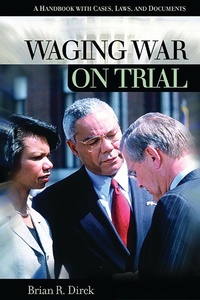
Waging War on Trial
A Handbook with Cases, Laws, and Documents
1st Edition
Published on 25. June 2003
360 pages
978-1-57607-949-2 (ISBN)
Description

A thought-provoking and engaging guide to the legal, moral, and political issues that arise when the United States goes to war.
From the American Revolution to the Bush administration's new type of war on terror, Waging War on Trial views warfare from a legal, social, cultural, and political standpoint. Included are homefront debates during major hostilities, "brushfire" incidents, and how the events of September 11th have shaped our domestic wartime policy.
The battle continues today as the President and Congress debate over who begins and ends military operations. Concerns about civil liberties, the draft, and internal security are as relevant today as during the Civil War. Questions arise on how dissenters and minorities are treated and if America can legally control the behavior of our soldiers. It's an intricate interplay between war and America's institutions.
From the American Revolution to the Bush administration's new type of war on terror, Waging War on Trial views warfare from a legal, social, cultural, and political standpoint. Included are homefront debates during major hostilities, "brushfire" incidents, and how the events of September 11th have shaped our domestic wartime policy.
The battle continues today as the President and Congress debate over who begins and ends military operations. Concerns about civil liberties, the draft, and internal security are as relevant today as during the Civil War. Questions arise on how dissenters and minorities are treated and if America can legally control the behavior of our soldiers. It's an intricate interplay between war and America's institutions.
More details
Series
Edition
1. Auflage
Language
English
Place of publication
New York
United States
Publishing group
Bloomsbury Publishing Plc
Target group
Interest Age: From 7 to 17 years
File size
2,28 MB
ISBN-13
978-1-57607-949-2 (9781576079492)
Copyright in bibliographic data and cover images is held by Nielsen Book Services Limited or by the publishers or by their respective licensors: all rights reserved.
Schweitzer Classification
Other editions
Additional editions
Book
06/2003
ABC-CLIO
€87.70
Shipment within 3-4 weeks
Content
- Cover
- Waging War on Trial
- Contents
- Series Foreword
- Preface and Acknowledgments
- Part One
- 1 Introduction
- Chaotic Nature of War
- The Laws of War, the War of Laws
- Law versus War
- Who Declares War, the President or Congress?
- Treatment of Dissenters, Enemy Aliens, and Draft Resisters
- Battlefield Behavior and Military Justice
- Conclusion
- References and Further Reading
- 2 Historical Background
- War and the Constitution
- War and the Constitution before the Civil War
- Civil War: The Law's First Real Test
- Imperialism and a World War
- Law, the Constitution, and the "Good War"
- Korea, Vietnam, and War by Presidential Fiat
- Congress's Pendulum: The Gulf of Tonkin Resolution and the War Powers Act of 1973
- After Vietnam: Exorcised Demons?
- References and Further Reading
- 3 Cases
- The "Least Dangerous Branch": The Supreme Court and American War Making
- Defining the New Roles: The Court and War Making in the Early National Era
- The Civil War: Libertarian Idealism versus Wartime Pragmatism
- Reconstruction and ex parte Milligan
- World War I and Justice Holmes's Conscience
- World War II
- After World War II: Traditions
- The Court and War in the Nuclear Age
- Youngstown and the "Imperial Presidency"
- Expanding Wartime Dissent
- Reining in Military Justice: The Military Court of Appeals and the My Lai Atrocities
- Law and War: Whither the Supreme Court?
- References and Further Reading
- 4 Impact and Legacy
- Met on a Battlefield, of Sorts
- The War Powers Issue: Who's in Charge?
- Wartime Civil Liberties and Military Justice
- The Pending War with Iraq
- Law and War in the Terrorism Era: Old Wine in New Bottles?
- References and Further Reading
- Part Two
- Documents
- Constitutional Language about War
- What Is a "War"?
- Controlling the Wartime Economy
- Clear and Present Danger: Schenck v. United States
- The Retreat from Schenck: Abrams v. United States
- Slowing the Imperial Presidency: Youngstown
- Modern Times: The Gulf War and the War on Terrorism
- Key People, Laws, and Concepts
- Chronology
- Table of Cases
- Annotated Bibliography
- Index
- About the Author
