

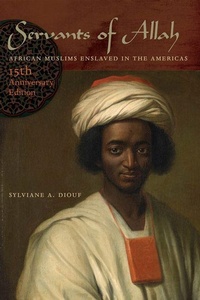
Servants of Allah
African Muslims Enslaved in the Americas
2nd Edition
Published on 4. October 2013
277 pages
978-1-4798-4447-0 (ISBN)
Description

Illuminates how African Muslims drew on Islam while enslaved, and how their faith ultimately played a role in the African Disapora
Servants of Allah presents a history of African Muslims, following them from West Africa to the Americas. Although many assume that what Muslim faith they brought with them to the Americas was quickly absorbed into the new Christian milieu, as Sylviane A. Diouf demonstrates in this meticulously-researched, groundbreaking volume, Islam flourished during slavery on a large scale. She details how, even while enslaved, many Muslims managed to follow most of the precepts of their religion. Literate, urban, and well-traveled, they drew on their organization, solidarity and the strength of their beliefs to play a major part in the most well-known slave uprisings. But for all their accomplishments and contributions to the history and cultures of the African Diaspora, the Muslims have been largely ignored. Servants of Allah-a Choice 1999 Outstanding Academic Title-illuminates the role of Islam in the lives of both individual practitioners and communities, and shows that though the religion did not survive in the Americas in its orthodox form, its mark can be found in certain religions, traditions, and artistic creations of people of African descent. This 15th anniversary edition has been updated to include new materials and analysis, a review of developments in the field, prospects for new research, and new illustrations.
Servants of Allah presents a history of African Muslims, following them from West Africa to the Americas. Although many assume that what Muslim faith they brought with them to the Americas was quickly absorbed into the new Christian milieu, as Sylviane A. Diouf demonstrates in this meticulously-researched, groundbreaking volume, Islam flourished during slavery on a large scale. She details how, even while enslaved, many Muslims managed to follow most of the precepts of their religion. Literate, urban, and well-traveled, they drew on their organization, solidarity and the strength of their beliefs to play a major part in the most well-known slave uprisings. But for all their accomplishments and contributions to the history and cultures of the African Diaspora, the Muslims have been largely ignored. Servants of Allah-a Choice 1999 Outstanding Academic Title-illuminates the role of Islam in the lives of both individual practitioners and communities, and shows that though the religion did not survive in the Americas in its orthodox form, its mark can be found in certain religions, traditions, and artistic creations of people of African descent. This 15th anniversary edition has been updated to include new materials and analysis, a review of developments in the field, prospects for new research, and new illustrations.
Reviews / Votes
"Servants of Allah opens a new door on the African Diaspora and provides readers with even more insight into Islam, as well as enslaved Africans. Diouf's study greatly enhances current literature on the Diaspora." - Jason Zappe (Copley News Service Dec '98) "Servants of Allah is constructed in a highly classical manner: the sobriety of its analysis lets the facts speak for themselves, with a minimum of editorializing; it is structured logically and symmetrically in a manner that illuminates the nodal point of the Muslim's distinctiveness within the slave system, namely, their mastery of writing....Servants of Allah has a wealth of arguments that provoke reflection and that will not leave the reader indifferent or lacking in references for further reading" (Quarterly Black Review) "Sylviane Diouf'sServants of Allah is a welcome contribution to our understanding of a critical moment in the African Diaspora. Her focus is the collective experience of African Muslims enslaved in the New World. Diouf's premise is that Muslims maintained their religious and cultural integrity, indeed their identity, in the face of daunting oddsThe author's insight into Islamic almsgiving in the form of saraka cakes in the Georgia Sea islands is intriguing. The section on Muslim dress in the third chapter is well presented. Perhaps the most fascinating parts of the work concern the probability that Muslim holy books were transferred from the Old World to the New via networks of black sailors and that the blues are most likely informed by the musical creativity of West African Muslims." (Journal of Southern History) "Sylviane A. Diouf's book makes a major contribution by focusing on Muslim participation in the slave trade and Muslims' impacts on the Americas...Diouf presents a convincing and original picture of the life of enslaved Muslims, who, she claims, remained primarily servants of Allah than subjects of Christian masters...The chapter on resistance and revolts is especially interesting. According to the author, Muslims, as a result of their literacy and military skills, played essential roles in the Haitian Revolution and the early-nineteenth-century revolts in Bahia. Diouf's well-written and interesting book opens new avenues of inquiry and research. It will interest and perhaps inspire students of the African diaspora and slavery in the Americas." (Journal of American History)More details
Edition
2nd New edition
Language
English
Place of publication
New York
United States
Target group
Professional and scholarly
Edition type
New edition
File size
4,26 MB
ISBN-13
978-1-4798-4447-0 (9781479844470)
Copyright in bibliographic data and cover images is held by Nielsen Book Services Limited or by the publishers or by their respective licensors: all rights reserved.
Schweitzer Classification
Other editions
Additional editions
Book
10/2013
2nd Edition
New York University Press
€34.00
Shipment within 10-20 days
Person
Sylviane A. Diouf is an award-winning historian of the African Diaspora. She is the author of Slavery's Exiles: The Story of the American Maroons and Servants of Allah: African Muslims Enslaved in the Americas-named Choice Outstanding Academic Book in 1999-both with NYU Press. Her book Dreams of Africa in Alabama: The Slave Ship Clotilda and the Story of the Last Africans Brought to America received the 2007 Wesley-Logan Prize of the American Historical Association, the 2009 Sulzby Award of the Alabama Historical Association and was a finalist for the 2008 Hurston/Wright Legacy Award. She is the editor of Fighting the Slave Trade: West African Strategies and the co-editor of In Motion: The African-American Migration Experience. A recipient of the Rosa Parks Award, the Dr. Betty Shabazz Achievement Award, and the Pen and Brush Achievement Award, Diouf is a Curator at the Schomburg Center for Research in Black Culture of the New York Public Library.
Content
- Cover
- Contents
- Acknowledgments
- Introduction to the 15th Anniversary Edition
- 1 African Muslims, Christian Europeans, and the Transatlantic Slave Trade
- 2 Upholding the Five Pillars of Islam in a Hostile World
- 3 The Muslim Community
- 4 Literacy: A Distinction and a Danger
- 5 Resistance, Revolts, and Returns to Africa
- 6 The Muslim Legacy
- Notes
- Select Bibliography
- Index
- A
- B
- C
- D
- E
- F
- G
- H
- I
- J
- K
- L
- M
- N
- O
- P
- Q
- R
- S
- T
- U
- V
- W
- Y
- Z
- About the Author
