

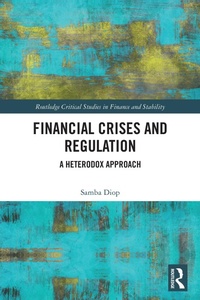
Financial Crises and Regulation
A Heterodox Approach
Will be published approx. on 30. June 2026
204 pages
978-1-040-52286-8 (ISBN)
Description

The bank failures of the early 2020s challenged the view that the financial reforms implemented after the 2007-2009 financial crisis had strengthened the robustness of the financial system.
Despite the commonly held belief that measures such as the Basel Framework and Dodd Frank Act had provided the financial sector with an effective shield against disruption, this book argues that the failure of these reforms to prevent further financial crises was not inevitable. The book contextualizes the long history of financial instability, elucidating the features of capitalism's current phase that make it so prone to financial crises, and highlighting other periods (notably the post-war period) characterized by remarkable stability. The book draws on post-Keynesian analyses of the evolution of capitalism and the endogenous instability of capitalist economies - by Minsky in particular - and incorporates insights from French regulatory theory. From this perspective, financial crises are not the result of exogenous deviant behaviors on the part of ill-intentioned or incompetent agents but the result of the normal functioning of capitalist economies. In this respect, the 2007-2009 crisis and the bank failures of 2023 are manifestations of this endogenous financial instability. Preventing their resurgence requires an alternative understanding of financial instability, one that interrogates the intrinsic dynamics of the financial system, engages in a critical examination of extant regulatory frameworks, questions the effectiveness of resolution mechanisms, and considers the increasingly urgent climate-related financial risks.
This book will be of interest to researchers working on issues of financial instability and regulation as well as money and banking more broadly.
Despite the commonly held belief that measures such as the Basel Framework and Dodd Frank Act had provided the financial sector with an effective shield against disruption, this book argues that the failure of these reforms to prevent further financial crises was not inevitable. The book contextualizes the long history of financial instability, elucidating the features of capitalism's current phase that make it so prone to financial crises, and highlighting other periods (notably the post-war period) characterized by remarkable stability. The book draws on post-Keynesian analyses of the evolution of capitalism and the endogenous instability of capitalist economies - by Minsky in particular - and incorporates insights from French regulatory theory. From this perspective, financial crises are not the result of exogenous deviant behaviors on the part of ill-intentioned or incompetent agents but the result of the normal functioning of capitalist economies. In this respect, the 2007-2009 crisis and the bank failures of 2023 are manifestations of this endogenous financial instability. Preventing their resurgence requires an alternative understanding of financial instability, one that interrogates the intrinsic dynamics of the financial system, engages in a critical examination of extant regulatory frameworks, questions the effectiveness of resolution mechanisms, and considers the increasingly urgent climate-related financial risks.
This book will be of interest to researchers working on issues of financial instability and regulation as well as money and banking more broadly.
More details
Series
Language
English
Place of publication
London
United Kingdom
Publishing group
Taylor & Francis Ltd
Target group
College/higher education
Illustrations
6 Line drawings, black and white; 6 Illustrations, black and white
File size
94,05 MB
ISBN-13
978-1-040-52286-8 (9781040522868)
Copyright in bibliographic data and cover images is held by Nielsen Book Services Limited or by the publishers or by their respective licensors: all rights reserved.
Schweitzer Classification
Other editions
Additional editions
Book
approx. 06/2026
1st Edition
Routledge
€191.50
Not yet published
Person
Samba Diop is Associate Professor in Economics at the University of Picardie Jules Verne and conducts his research at CRIISEA. His work focuses on money and banking, with particular attention to financial instability and the regulation of capitalist economies.
Content
Introduction 1. The terms of rising financial instability 2. The theoretical foundations of the evolution of financial regulation 3. Regulating Complexity Rather Than Complicating Regulation 4. Regulation of non-bank financial intermediaries: weaknesses and alternative approaches 5. Regulating Climate-Related Financial Risks Conclusion Index
