

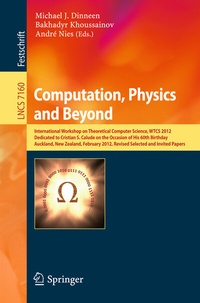
Computation, Physics and Beyond
Description

This Festschrift volume has been published in honor of Cristian Calude on the occasion of his 60th birthday and contains contributions from invited speakers and regular papers presented at the International Workshop on Theoretical Computer Science, WTCS 2012, held in Auckland, New Zealand, in February 2012.
Cristian Calude has made a significant contribution to research in computer science theory. Along with early work by Chaitin, Kucera, Kurtz, Solovay, and Terwijn his papers published in the mid-1990s jointly with Khoussainov, Hertling, and Wang laid the foundation for the development of modern theory of algorithmic randomness. His work was essential for establishing the leading role of New Zealand in this area.
The research interests of Cristian Calude are reflected in the topics covered by the 32 papers included in this book, namely: algorithmic information theory, algorithms, automata and formal languages, computing and natural sciences, computability and applications, logic and applications, philosophy of computation, physics and computation, and unconventional models of computation. They have been organized into four parts. The first part consists of papers discussing his life achievements. This is followed by papers in the three general areas of complexity, computability, and randomness; physics, philosophy (and logic), and computation; and algorithms, automata, and formal models (including unconventional computing).
More details
Other editions
Additional editions
Content
The Art of Reaching the Age of Sixty.- Calude as Father of One of the Computer Science Journals.- Random Semicomputable Reals Revisited.- Constructing the In mum of Two Projections.- Bounded Randomness.- A Note on Blum Static Complexity Measures.- A Program-Size Complexity Measure for Mathematical Problems and Conjectures.- On Degrees of Randomness and Genetic Randomness.- Hartmanis-Stearns Conjecture on Real Time and Transcendence.- Learning Families of Closed Sets in Matroids.- Invariance and Universality of Complexity.- Demuth's Path to Randomness (extended abstract).- Correcting Codes.- Some Transfinite Generalisations of Gödel's Incompleteness Theorem.- Phase Transition between Unidirectionality and Bidirectionality.- Computer Runtimes and the Length of Proofs.- Symmetry ofInformation: A Closer Look.- How Much Information Can There Be in a Real Number?.- Mathematics, Metaphysics and the Multiverse.- Exponential Decay in Quantum Mechanics.- Randomness Increases Order in Biological Evolution.- Haunted Quantum Contextuality Versus Value Indefiniteness.- Outerplanar Graphs and Delaunay Triangulations.- Representing Reaction Systems by Trees.- Derivatives of Regular Expressions and An Application.- Triangular and Hexagonal Tile Self-Assembly Systems.- dP Automata versus Right-Linear Simple Matrix Grammars.- State Complexity of Kleene-Star Operations on Trees.- Composition Sequences and Synchronizing Automata.- On the Connected Partition Dimension of a Wheel Related Graph.
