

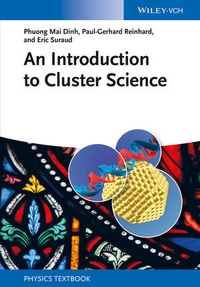
An Introduction to Cluster Science
1st Edition
Published on 30. September 2013
200 pages
978-3-527-68188-4 (ISBN)
Description

Filling the need for a solid textbook, this short primer in cluster science is ideal for a one-semester lecture for advanced undergraduate students. It is based on a series of lectures given by the well-established and recognized authors for the past ten years.
The book covers both the basics of the domain as well as up-to-date developments. It can be divided roughly into two parts. The first three chapters introduce basic concepts of cluster science. Chapter 1 provides a general introduction, complemented by chapter 2 on experimental and chapter 3 on theoretical aspects. The second half of the book is devoted to a systematic presentation of free cluster properties, and to a thorough discussion of the impact of clusters in other domains of science. These explicitly worked-out links between cluster physics and other research areas are unique both in terms of fundamental aspects and of applications, and cannot be found elsewhere in the literature.
Also suitable for researchers outside of the field looking for an introduction to cluster science.
The book covers both the basics of the domain as well as up-to-date developments. It can be divided roughly into two parts. The first three chapters introduce basic concepts of cluster science. Chapter 1 provides a general introduction, complemented by chapter 2 on experimental and chapter 3 on theoretical aspects. The second half of the book is devoted to a systematic presentation of free cluster properties, and to a thorough discussion of the impact of clusters in other domains of science. These explicitly worked-out links between cluster physics and other research areas are unique both in terms of fundamental aspects and of applications, and cannot be found elsewhere in the literature.
Also suitable for researchers outside of the field looking for an introduction to cluster science.
More details
Other editions
Additional editions
Phuong Mai Dinh | Paul-Gerhard Reinhard | Eric Suraud
An Introduction to Cluster Science
Book
11/2013
1st Edition
Wiley-VCH
€105.00
Article exhausted; check for reprint
Phuong Mai Dinh | Paul-Gerhard Reinhard | Eric Suraud
An Introduction to Cluster Science
Book
11/2013
Wiley-VCH
€46.90
Article exhausted; check different version
Persons
Phuong Mai Dinh is an Assistant Professor for Theoretical Physics. She joined the Paul Sabatier University in Toulouse in 2002 and gradually moved her research activities to cluster physics. She has been awarded by the French Physics Society in 2002 and by the Ecole Polytechnique in 2003 for her PhD work.
Paul-Gerhard Reinhard is Professor for Theoretical Physics at the Friedrich-Alexander University Erlangen/Nuremberg, Germany. His research interests cover cluster physics, nuclear structure physics and plasma physics. He (co-)authored three books, several review articles, and about 400 research articles. He received several awards, amongst them the Humboldt-Bessel prize and an Honorary degree from the University of Toulouse.
Eric Suraud is Professor in Toulouse where he started a research program on dynamics of clusters and molecules in strong fields. He was director of a CNRS research association, and as Vice Director at CNRS in charge of cross disciplinarity and relations with universities. Prof. Suraud is a senior member of Institut Universitaire de France and member of European Academy of Sciences.
Paul-Gerhard Reinhard is Professor for Theoretical Physics at the Friedrich-Alexander University Erlangen/Nuremberg, Germany. His research interests cover cluster physics, nuclear structure physics and plasma physics. He (co-)authored three books, several review articles, and about 400 research articles. He received several awards, amongst them the Humboldt-Bessel prize and an Honorary degree from the University of Toulouse.
Eric Suraud is Professor in Toulouse where he started a research program on dynamics of clusters and molecules in strong fields. He was director of a CNRS research association, and as Vice Director at CNRS in charge of cross disciplinarity and relations with universities. Prof. Suraud is a senior member of Institut Universitaire de France and member of European Academy of Sciences.
Content
1. Clusters in Nature
2. Measuring Clusters
3. How to Describe Clusters
4. Some Properties of Free Clusters
5. Clusters in Contact with other Material
6. Links to other Areas of Science
7. Conclusions and Perspectives
2. Measuring Clusters
3. How to Describe Clusters
4. Some Properties of Free Clusters
5. Clusters in Contact with other Material
6. Links to other Areas of Science
7. Conclusions and Perspectives
