

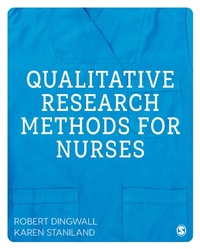
Qualitative Research Methods for Nurses
1st Edition
Published on 30. September 2020
232 pages
978-1-5297-3781-3 (ISBN)
Description

Covering the entire research process - from understanding theory to writing up your project - this book provides you with an easy-to-follow introduction to qualitative methods in nursing and healthcare.
It offers straightforward guidance on key issues such as ethics and equips you with practical tools for approaching steps like searching and reviewing the literature. It also:
Provides a clear historical overview of nursing and healthcare research, helping you deepen your understanding of the field
Shows you how to use literature to inform your choice of a research topic and research question
Helps you develop a critical approach to your own thinking and practice.
Grounded in numerous real-world examples that offer insight into best practice and how to overcome potential pitfalls, this book helps you develop your research skills and use qualitative methods with confidence.
Visit https://study.sagepub.com/dingwallandstaniland to watch author-hosted video introductions to each chapter, exclusive videos from the SAGE Research Methods collection and a variety of research-focused YouTube videos to support your learning.
It offers straightforward guidance on key issues such as ethics and equips you with practical tools for approaching steps like searching and reviewing the literature. It also:
Provides a clear historical overview of nursing and healthcare research, helping you deepen your understanding of the field
Shows you how to use literature to inform your choice of a research topic and research question
Helps you develop a critical approach to your own thinking and practice.
Grounded in numerous real-world examples that offer insight into best practice and how to overcome potential pitfalls, this book helps you develop your research skills and use qualitative methods with confidence.
Visit https://study.sagepub.com/dingwallandstaniland to watch author-hosted video introductions to each chapter, exclusive videos from the SAGE Research Methods collection and a variety of research-focused YouTube videos to support your learning.
Reviews / Votes
As social scientists who have had a long relationship with nurses learning to conduct qualitative studies, the authors present this basic methods primer in a highly engaging style, building on what their audience already understands about the world and making a case for the value of expanding upon existing ways of knowing through the use of qualitative inquiry methods.This text will be an excellent resource for nurses wanting to expand their capacity to answer questions arising from their practice, and for educators wanting to engage pre-or post registration learners in taking the next steps toward using knowledge to advance their profession. -- Sally Thorne The book takes the novice qualitative researcher by the hand and walks them through the scary bits in the gentlest of ways. -- Joy Adamson A very engaging text that encourages novice students to understand key concepts and practical strategies within qualitative research methods. A great addition to undergraduate nursing programmes. -- Dianne Wepa
More details
Edition
1. Auflage
Language
English
Place of publication
London
United Kingdom
Publishing group
Sage Publications Ltd (Digital)
Target group
College/higher education
Product notice
Reflowable
ISBN-13
978-1-5297-3781-3 (9781529737813)
Copyright in bibliographic data and cover images is held by Nielsen Book Services Limited or by the publishers or by their respective licensors: all rights reserved.
Schweitzer Classification
Other editions
Additional editions
Robert Dingwall | Karen Staniland
Qualitative Research Methods for Nurses
Book
10/2020
1st Edition
SAGE Publications Ltd
€68.00
Shipment within 15-20 days
Persons
Robert Dingwall is a consulting sociologist through Dingwall Enterprises Ltd and part-time Professor of Sociology at Nottingham Trent University.
He draws on more than forty years' experience as an academic researcher studying health care, legal services, and science and technology policy at the Universities of Aberdeen, Oxford and Nottingham. Over that time, he has held grants and contracts worth more than GBP7 million (at 2017 prices) in total from the Leverhulme and Wellcome Trusts, ESRC, NERC, MRC, EPSRC, BBSRC, the EU, the UK Department of Health and various NHS/NIHR programmes, the Ministry of Justice, the Royal Pharmaceutical Society and the Food Standards Agency. These have resulted in 30 books and more than 100 scientific papers. Robert Dingwall is also an experienced manager: he served for five years as head of a large social science department and founded and directed what was one of Europe's leading research institutes in science and technology studies for 12 years.
Robert has been a Fellow of the Academy of Social Sciences since 2002 and an Honorary Member of the Faculty of Public Health since 2014. He was awarded the 2019 Prize for Contributions to the Socio-Legal Community by the Socio-Legal Studies Association. Karen Staniland was formerly a Senior Lecturer in Nursing at Salford University. After lengthy clinical experience in acute medical nursing, she trained as a nurse tutor and then as a researcher with a particular interest in quality and hospital organization.
He draws on more than forty years' experience as an academic researcher studying health care, legal services, and science and technology policy at the Universities of Aberdeen, Oxford and Nottingham. Over that time, he has held grants and contracts worth more than GBP7 million (at 2017 prices) in total from the Leverhulme and Wellcome Trusts, ESRC, NERC, MRC, EPSRC, BBSRC, the EU, the UK Department of Health and various NHS/NIHR programmes, the Ministry of Justice, the Royal Pharmaceutical Society and the Food Standards Agency. These have resulted in 30 books and more than 100 scientific papers. Robert Dingwall is also an experienced manager: he served for five years as head of a large social science department and founded and directed what was one of Europe's leading research institutes in science and technology studies for 12 years.
Robert has been a Fellow of the Academy of Social Sciences since 2002 and an Honorary Member of the Faculty of Public Health since 2014. He was awarded the 2019 Prize for Contributions to the Socio-Legal Community by the Socio-Legal Studies Association. Karen Staniland was formerly a Senior Lecturer in Nursing at Salford University. After lengthy clinical experience in acute medical nursing, she trained as a nurse tutor and then as a researcher with a particular interest in quality and hospital organization.
Content
Chapter 1: What is research and why does it matter?
Chapter 2: Theory and methodology
Chapter 3: Creating a project
Chapter 4: Reviewing literature
Chapter 5: Doing the right thing - ethics in qualitative research
Chapter 6: Observing people
Chapter 7: Interviewing people
Chapter 8: Analysing documents and artefacts
Chapter 9: What do you do with your data?
Chapter 10: Writing your dissertation
Chapter 2: Theory and methodology
Chapter 3: Creating a project
Chapter 4: Reviewing literature
Chapter 5: Doing the right thing - ethics in qualitative research
Chapter 6: Observing people
Chapter 7: Interviewing people
Chapter 8: Analysing documents and artefacts
Chapter 9: What do you do with your data?
Chapter 10: Writing your dissertation
