

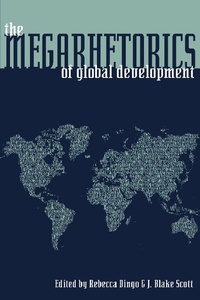
The Megarhetorics of Global Development
Published on 29. January 2012
279 pages
978-0-8229-7741-4 (ISBN)
Description

After World War II, an unprecedented age of global development began. The formation of the World Bank and the International Monetary Fund allowed war torn and poverty stricken nations to become willing debtors in their desire to entice Western investment and trade. New capital, it was foretold, would pave the way to political and economic stability, and the benefits would "trickle down" to even the poorest citizens. The hyperbole of this neocolonialism, however, has left many of these countries with nothing but compounded debt and unfulfilled promises.
The Megarhetorics of Global Development examines rhetorical strategies used by multinational corporations, NGOs, governments, banks, and others to further their own economic, political, or technological agendas. These wide-ranging case studies employ rhetorical theory, globalization scholarship, and analysis of cultural and historical dynamics to offer in-depth critiques of development practices and their material effects. By deconstructing megarhetorics, at both the local and global level, and following their paths of mobilization and diffusion, the concepts of "progress" and "growth" can be reevaluated, with the end goal of encouraging self-sustaining and ethical outcomes.
The Megarhetorics of Global Development examines rhetorical strategies used by multinational corporations, NGOs, governments, banks, and others to further their own economic, political, or technological agendas. These wide-ranging case studies employ rhetorical theory, globalization scholarship, and analysis of cultural and historical dynamics to offer in-depth critiques of development practices and their material effects. By deconstructing megarhetorics, at both the local and global level, and following their paths of mobilization and diffusion, the concepts of "progress" and "growth" can be reevaluated, with the end goal of encouraging self-sustaining and ethical outcomes.
More details
Other editions
Additional editions
Rebecca Dingo | J. Blake Scott
Megarhetorics of Global Development, The
Book
01/2012
University of Pittsburgh Press
€70.70
Article exhausted; check different version
Persons
Rebecca Dingo (Editor)
Rebecca Dingo is professor in the Department of English and the Department of Women's and Gender Studies at the University of Missouri. She is the author of Networking Arguments: Rhetoric, Transnational Feminism, and Public Policy Writing.
J. Blake Scott (Editor)
J. Blake Scott is associate professor of writing and rhetoric at the University of Central Florida. He is the author of Risky Rhetoric: AIDS and the Cultural Practices of HIV Testing, coeditor of Critical Power Tools: Technical Communication and Cultural Studies, and winner of the 2007 NCTE Award for Best Collection of Essays on Technical and Scientific Communication.
Rebecca Dingo is professor in the Department of English and the Department of Women's and Gender Studies at the University of Missouri. She is the author of Networking Arguments: Rhetoric, Transnational Feminism, and Public Policy Writing.
J. Blake Scott (Editor)
J. Blake Scott is associate professor of writing and rhetoric at the University of Central Florida. He is the author of Risky Rhetoric: AIDS and the Cultural Practices of HIV Testing, coeditor of Critical Power Tools: Technical Communication and Cultural Studies, and winner of the 2007 NCTE Award for Best Collection of Essays on Technical and Scientific Communication.
Content
- Intro
- Copyright
- Contents
- Acknowledgments
- Introduction: The "Megarhetorics" of Global Development / J. Blake Scott and Rebecca Dingo
- Part 1. Extending Rhetorical Concepts and Methods
- 1. Tracking "Transglocal" Risks in Pharmaceutical Development: Novartis's Challenge of Indian Patent Law / J. Blake Scott
- 2. Meeting the Challenge of Globalization: President Clinton's "Double Movement" Discourse / Jason A. Edwards and Jaime L. Wright
- 3. Ethos in a Bottle: Corporate Social Responsibility and Humanitarian Doxa / D. Robert DeChaine
- 4. Developmental Shifts: Changing Feelings about Compassion in Korea / Matt Newcomb
- 5. Staging the Beijing Olympics: Intersecting Human Rights and Economic Development Narratives / Tim Jensen and Wendy S. Hesford
- Part II. Building Counter-Rhetorics of Resistance
- 6. Framing the Megarhetorics of Agricultural Development: Industrialized Agriculture and Sustainable Agriculture / Eileen E. Schell
- 7. Turning the Tables on the Megarhetoric of Women's Empowerment / Rebecca Dingo
- 8. Making the Case: 'Bamako' and the Problem of Anti-Imperial Art / Bret Benjamin
- 9. Enfreakment
- or, Aliens of Extraordinary Disability / Robert McRuer
- Contributors
- Index
