

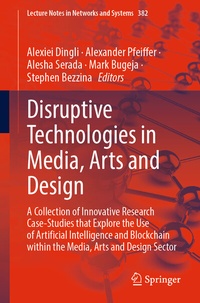
Disruptive Technologies in Media, Arts and Design
Description

This book presents selected proceedings from two installments of the MAD Conference in 2020-MAD Blockchain 2020 and MAD Artificial Intelligence 2020. These events focused on applications of these novel technologies in media, arts and design. A number of researchers present their own projects and practical implementations of blockchain and AI in games, art, education and sustainable living, while other authors explore theoretical and ethical questions that these technologies bring into society. First and foremost, we recommend this book to aspiring scholars and practitioners who are also building new solutions using blockchain and AI. Besides, the book extends the existing scholarship on AI and blockchain and provides proven cases and tools for education in ICT.
The conference has been organized by Danube-University Krems, Drexel University Philadelphia and University of Malta with support from the MIT Education Arcade, the Texas A&M LIVE Lab and University of Vaasa.
More details
Other editions
Additional editions

Content
- Intro
- Preface
- Contents
- Blockchain
- SoliNomic: A Self-modifying Smart Contract Game Exploring Reflexivity in Law
- 1 Introduction
- 2 Blockchain, Smart Contracts, Rules, and Games
- 3 SoliNomic
- 3.1 Representing the SoliNomic Ruleset
- 3.2 The Game Versus the Ruleset
- 3.3 Rules Versus the Ruleset
- 4 Discussion
- 5 Conclusions
- References
- HotCity-A Gamified Token System for Reporting Waste Heat Sources
- 1 Introduction
- 2 Gamifying the Challenge
- 2.1 Gamification as a Method for Incentivizing the Identification of Waste Heat Sources
- 2.2 Blockchain as a Method for Securing the Gamification Framework
- 3 The HotCity App
- 3.1 The Token Framework
- 4 The HotCity Field Test
- 4.1 The Game Rating and Winning Strategies
- 4.2 Lessons Learned
- 5 Conclusion and Outlook
- 5.1 Recommendations Regarding Gamified Apps for Serious Application Scenarios
- 5.2 Recommendations Regarding the Use of Blockchain Technology in Gamified Frameworks
- References
- "Blockchain May Automate Jobs Done by the Boss and AI Can Predict a Heart Attack"
- 1 Introduction
- 2 Theoretical Framework
- 3 Data and Methods
- 4 Analysis and Results
- 4.1 Scenario 1: Opportunities of Blockchain
- 4.2 Scenario 2: Opportunities of AI
- 4.3 Scenario 3: Risks of Blockchain
- 4.4 Scenario 4: Risks of AI
- 5 Discussion and Conclusions
- References
- Gallery Defender: Integration of Blockchain Technologies into a Serious Game for Assessment: A Guideline for Further Developments
- 1 Introduction
- 2 Related Work
- 3 The Context of the Demonstrator
- 4 Methodology
- 5 Results
- 6 Conclusion
- 7 Future Research
- References
- Cryptogames as Drivers for Blockchain Application Development
- 1 Introduction: Serious and Not-So-Serious Applications of Blockchain
- 2 Cryptogames
- 3 Discussion
- 4 Directions for Future Research
- References
- Fairness by Design: The Fair Game and the Fair Price on a Blockchain-Based Marketplace
- 1 Introduction. Why CryptoKitties?
- 2 Artificial Scarcity on Blockchain
- 3 Why Are Games not Always Fair?
- 4 Designing Fair Competition
- 5 Second Morality?
- 6 Conclusion. Ethics of Blockchain Versus Ethics of Its Adopters
- References
- Horizontal Scalability of Blockchain Games Using the GSP Model
- 1 Introduction
- 2 Scalability for Blockchain Games
- 2.1 Vertical Scalability
- 2.2 Horizontal Scalability
- 3 The Role of Miners
- 4 Game-State Processors
- 4.1 Game States
- 4.2 Decoupling States from the Core Blockchain
- 5 Drawbacks of Game-State Decoupling
- 5.1 SPV Security
- 5.2 No Control Over the Coin
- 6 Conclusion
- References
- AI
- A Criticism of the Technological Singularity
- 1 Introduction
- 2 Singularity Requirements
- 3 Moore's Law Revisited
- 3.1 Quantum Computing
- 3.2 Spintronics and Photonics
- 3.3 Reversible Computation
- 4 A Case for History
- 5 The Rise of Deep Learning
- 6 The Fall of Deep Learning
- 7 Singularity Contradictions
- 7.1 The Myth of Better Introspection
- 7.2 The Myth of Continued Exponential Economy Growth
- 7.3 The Myth of Recursive Self-improvement in Research
- 8 Mind Is Always the Highest Available Technology ... and Always Will Be
- 9 Conclusion, Discussion and Outlook
- References
- Algorithms, Ethics and Justice
- 1 Algorithms, Ethics and Justice
- 2 Legal Positivism and Natural Law
- 3 The Disciplinary Power of Artificial Intelligence
- 4 AI Technologies and Restorative Justice: The Ethics of Care
- References
- Training Social Skills in Virtual Reality Machine Learning as a Process of Co-Creation
- 1 The Virtual Skills Lab Project
- 1.1 The Ideas Lab
- 1.2 Training Social Interaction to Improve Organizational Culture
- 2 VR Training of Social Skills
- 2.1 Social Interaction in the Workplace
- 2.2 VR as Environment for Training Social Interaction
- 2.3 Solutions for VR Soft Skills Training and Perspective Taking
- 3 The Co-Creation of a Social Skills Training
- 3.1 Dramaturgic and Technical Challenges
- 4 The Office Scene
- 4.1 How Real Does Virtual Need to Be?
- 4.2 How Complex Can or Must a Conversation Be?
- 4.3 How Mira Deals with Social and Conversational Complexity
- 5 How We Are Dealing with Mira's Limitations
- 5.1 Reflecting on the Virtual Character of Social Interaction
- 5.2 Design Elements for Enabling Machine Learning
- 6 Conclusion
- References
- The Brokenness in Our Recommendation Systems: Computational Art for an Ethical Use of A.I.
- 1 Introduction
- 2 A Metaphor for the Digital Age
- 3 Critical Algorithm Studies
- 4 This Recommendation System Is Broken
- 5 Favoring Epistemological Ruptures in Algorithmic Practice
- 6 Conclusion
- References
- Exploring Reinforcement Learning: A Case Study Applied to the Popular Snake Game
- 1 Introduction
- 1.1 Aims and Objectives
- 1.2 Snake
- 1.3 Game Mechanics
- 1.4 Artwork and Theme
- 2 Background Research
- 3 Methodology and Evaluation
- 3.1 Q-Learning
- 3.2 SARSA
- 3.3 PPO
- 3.4 Other AI
- 4 Conclusion
- References
- An Approach Towards Architecture-Independent Output for Generative Networks: Texturing Aerial Town Maps for Roleplaying Games
- 1 Introduction
- 2 Related Work
- 2.1 Current Mapping Options
- 2.2 Generative Adversarial Networks
- 2.3 Conditional Generative Adversarial Networks
- 2.4 Spatial Generative Adversarial Networks
- 2.5 Generation of Maps with Machine Learning
- 2.6 Blending Techniques
- 3 Methodology
- 3.1 Dataset
- 3.2 Network Model
- 3.3 Blending Algorithm
- 3.4 Computational Resources
- 4 Results
- 4.1 Sample Output
- 4.2 Image Quality Metrics
- 4.3 Reference Analysis
- 4.4 Segmentation Scores
- 4.5 User Opinion Scores
- 5 Experiments
- 5.1 Algorithm Parameters
- 5.2 Processing Times
- 5.3 Image Scaling Potential
- 6 Discussion
- 7 Conclusion and Future Work
- 8 Appendix
- References
- Author Index
