

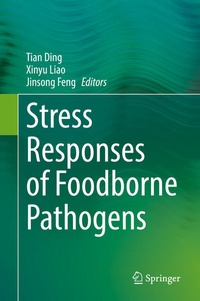
Stress Responses of Foodborne Pathogens
Description

Food-borne bacterial pathogens encounter a number of stressors during food processing and preservation. More and more pathogens are able to adapt their physiological properties and/or genetic expression to survive these stressors and pose a risk to food safety and public health.
This book provides the reader with a comprehensive overview of common food processing-associated stressors (e.g., heat, cold, acid, osmosis, and oxidation) and deals with the molecular basis of the respective bacterial stress response mechanisms (e.g., viable but nonculturable state, biofilm formation, sporulation, and cross-protection response).
Additionally, various chapters cover the response mechanisms of foodborne pathogens to emerging nonthermal sterilisation technologies such as ultrasound, high-pressure processing, pulsed electric fields, ultraviolet light, irradiation and phytochemicals.
Through this book we also learn about future prospects for the efficient control of stressadaption in foodborne pathogens to ensure maximum consumer safety.
This book offers a valuable resource for researchers, graduate students, food process engineers and product developers in the fields of food science and microbiology.
More details
Other editions
Additional editions
Persons
Tian Ding is a professor and deputy director at the Institute of Food Engineering in Zhejiang University, China. His research interests include foodborne pathogens, nonthermal technology and microbial risk assessment. Dr. Ding is an associate editor of Food Research International and editorial board member of Food Control , Journal of Food Protection , and Food Science and Human Wellness . He is also a committee member of the Youth Council of Chinese Institute of Food Science and Technology (CIFST), a member of the International Association of Food Protection (IAFP) and the American Society for Microbiology (ASM).
Xinyu Liao is a research assistant in the Department of Food Science and Nutrition, Zhejiang University. Her research focuses on microbial inactivation mechanisms of cold plasma technology as well as the formation of viable but nonculturable (VBNC) Staphylococcus aureus upon cold plasma treatment. So far, Dr. Liao has publishedover 25 peer-reviewed SCI articles in high-impact journals, including Applied and Environmental Microbiology , Trends in Food Science and Technology , etc. Liao also serves as reviewer for prestigious journals, including Food Research International and Environmental Pollution .
Jinsong Feng is an associate professor at the Department of Food Science and Nutrition, Zhejiang University, China. Dr. Feng got his Ph.D degree at The University of British Columbia. His research interest focuses on the investigation of the influence of commensal microflora on the survival of foodborne pathogens. So far, he has published several papers in prestigious journals, such as Applied and Environmental Microbiology , Trends in Food Science and Technology, and Food Control .
