

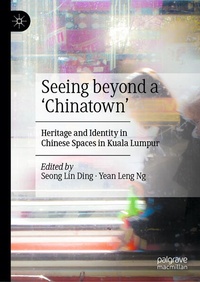
Seeing beyond a 'Chinatown'
Description

This book moves beyond the stereotyped approaches adopted in earlier works on 'Chinatowns' and introduces instead the Chinese spaces in the metropolitan city of Kuala Lumpur (KL), Malaysia. Seeing beyond the 'Chinatown', this book puts forward the historical, political, linguistic, educational, economic, sociocultural, religious, and architectural perspectives of the Chinese spaces, in local and global contexts, thus offering critical insights into the complex intertwining of historical impact, heritage language vitality, ethnic politics, out-migration issue, socioeconomic development, urban heritage sustainability, and the potential conflict between the official and the 'vernacular' representation of various Chinese neighbourhoods. Seeing beyond the notion of stereotyping 'Chinatown', this book expounds on the one hand, the tensions between branding and rebranding, positioning and repositioning of heritage and identity in Chinese urban spaces. On the other hand, this work also raises broader questions of social integration, and the underlying challenges in maintaining urban space and urban heritage amidst state-facilitated dispossession, touristification, and gentrification, thus allowing for an exploration of the nuanced interplay between power dynamics and struggles for empowerment. This book contributes both to our understanding of Chinese spaces embedded in the (re)imagination of 'Chinatown' and more importantly, a critical understanding of urban sustainability and social inclusivity that goes beyond ethnic and racial boundaries. It is relevant to cultural theorists and social scientists with a particular interest in heritage studies in Malaysia, and in wider Asia.
More details
Other editions
Additional editions
Persons
Seong Lin Ding is Associate Professor of Sociolinguistics at the Faculty of Languages and Linguistics, Universiti Malaya. Her research focuses on minority/heritage languages and communities, migration, sociology of education, identity, and linguistic landscape.
Yean Leng Ng
is Professor and the Dean of Faculty of Arts and Social Sciences, New Era University College, Malaysia. Her research focuses on the historical and cultural significance of traditional Chinese family businesses (Lao zi hao), the cultural role of Chinese enterprises, and the contributions of Chinese educational and social organisations.
Content
1. Introduction: Seeing beyond a 'Chinatown'.- 2. Multi-ethnic interaction in Kuala Lumpur: A colonial town of Malaya, 1920-1957.- 3. Hub of legitimacy: The Malayan Communist Party Kuala Lumpur Office (1945-1948).- 4. The Hakka language in Kuala Lumpur.- 5. Linguistic landscape as a dynamic 'palimpsest': Exploring Kuala Lumpur's urban space as a multilingual, negotiated and contested zone.- 6. Navigating global futures: The attraction of learning German among Malaysian Chinese families.- 7. Chee Chong Kai and inter-ethnic business ties: Adapting to generational changes in multiracial society in Malaysia.- 8. Petaling Street and Chinese legacy businesses: The cultural memory of a Malaysian Chinese community.- 9. Religion and localisation in Kuala Lumpur: Transformation in the cult of
Sin Si Sze Ya
.- 10. A linguistic landscape analysis of a Malaysian Christian cemetery in a Chinese space.- 11. Negotiating identities: The case of rejuvenation of Kuala Lumpur 'Chinatown'.
