

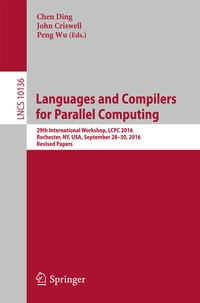
Languages and Compilers for Parallel Computing
29th International Workshop, LCPC 2016, Rochester, NY, USA, September 28-30, 2016, Revised Papers
Published on 20. January 2017
XI, 348 pages
978-3-319-52709-3 (ISBN)
Description

This book constitutes the thoroughly refereed post-conference proceedings of the 29th International Workshop on Languages and Compilers for Parallel Computing, LCPC 2016, held in Rochester, NY, USA, in September 2016.
The 20 revised full papers presented together with 4 short papers were carefully reviewed. The papers are organized in topical sections on large scale parallelism, resilience and persistence, compiler analysis and optimization, dynamic computation and languages, GPUs and private memory, and runt-time and performance analysis.More details
Series
Edition
1st ed. 2017
Language
English
Place of publication
Cham
Switzerland
Publishing group
Springer International Publishing
Product notice
Reflowable
Illustrations
XI, 348 p. 137 illus.
File size
22,44 MB
ISBN-13
978-3-319-52709-3 (9783319527093)
DOI
10.1007/978-3-319-52709-3
Schweitzer Classification
Other editions
Additional editions
Chen Ding | John Criswell | Peng Wu
Languages and Compilers for Parallel Computing
29th International Workshop, LCPC 2016, Rochester, NY, USA, September 28-30, 2016, Revised Papers
Book
01/2017
Springer
€53.49
Shipment within 10-15 days
Content
Large Scale Parallelism.- Resilience and Persistence.- Compiler Analysis and Optimization.- Dynamic Computation and Languages.- GPUs and Private Memory.- Runt-time and Performance Analysis.
