

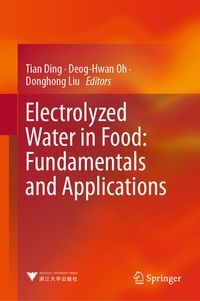
Electrolyzed Water in Food: Fundamentals and Applications
Description

The book can be a go-to reference book of EW for: (1) Researchers who need to understand the role of various parameters in its generation, the bactericidal mechanism of EW and its wide applications for further research and development; (2) Equipment producers who need comprehensive understanding of various factors (e.g. type of electrolyte, flow rates of water and electrolyte) which govern the efficacy of EW and developing its generators; (3) Food processors who need good understanding of EW in order to implement it in the operations and supervisors who need to balance the advantages and limitations of EW and ensuring its safe use.
More details
Other editions
Additional editions
Persons
Deog-Hwan Oh is a professor of Kangwon National University-Department of Food Science and Biotechnology, South Korea. He specializes in Food Microbiology and Safety with emphasis in nonthermal food sanitizers e.g. electrolyzed water alone and hurdle enhancement with other sanitizers. He has been published more than 200 papers and received continuous citations on his work.
Donghong Liu is a professor in College of Biosystems Engineering and Food Science of Zhejiang University, China. Her ongoing research interests focus on the food safety including simulation, optimization, quality safety monitor, postharvest of fruits and vegetables and research development and application of electrolyzed water in food. In the recent five years, she presides over 20 projects including National key research project, National 863 key project, National Science Foundation project and foreign aid project hosted by MOST. Thereinto, in the aspect of EW, she presides two provincial projects about food preservation by EW and guides two master students to research the postharvest of fruits and vegetables and prolong its shelf-life by using EW. To date, she has published more than 260 papers of which 101 were includedin SCI, 50 were included in EI and obtained over 40 authorizations for patents. Beyond that, she has participated in composing five books and setting up a national standard. For her contribution to the scientific community, she has been honored with National advanced science and technology workers and Zhejiang outstanding contributions to young and middle-aged experts.
Content
Generation of EW.- Decontamination Efficacy and Principles of EW.- Pesticide Degradation of food by EW.- Hurdle Enhancement of EW with Other techniques.- Application of EW in fruits and vegetables.- Application of EW in Poultry and Meat.- Application of EW on Aquatic Product.- Application of EW on environment sterilization.- Application of EW on livestock.- Application of EW in agriculture.- Safety evaluation of EW.- Future trends.
