

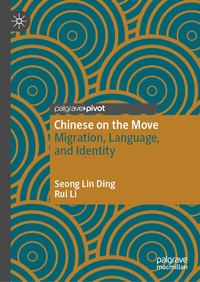
Chinese on the Move
Description

This book is the first to study the language and politics of identity of recent mainland Chinese migrants to Malaysia. Drawing on a variety of fieldwork data, the volume provides an accessible and succinct view of this 'new' transnational migrant community in multilingual Malaysia. Unlike earlier Chinese migrants (the 'old' Chinese communities) who migrated to Malaysia (previously British Malaya) due to experiencing poverty in China, the 'new' Chinese community in Malaysia comprises mainly students, professionals, migrants who participated in the Malaysia My Second Home (MM2H) programme and individuals who married locals. This book focuses on the experiences of these new migrants from mainland China, how they were received in Malaysian society, the language problems and barriers they faced, their language accommodation and potential linguistic dislocation, their attitudes and identities, whether these shifted over time, and the (in)visibility and social inclusion of these migrants in Malaysian society. It also offers insights and understanding of the dynamic and complex nature of how migrants are inclined towards their 'home' country while adapting to their 'host' society. This book enriches the literature on language use and adaptation in Chinese diaspora communities throughout the world, as well as the politics of language and identity, and it will be of interest to students and scholars of Sociolinguistics, Chinese studies, Asian studies, Migration studies, and Southeast Asian studies.
More details
Other editions
Additional editions
Persons
Seong Lin Ding is an Associate Professor of Sociolinguistics at the Faculty of Languages and Linguistics, Universiti Malaya, Malaysia. Her research focuses on ethnic minority/heritage languages and communities, migration, sociology of education, identity, and linguistic landscape.
Rui Li is a lecturer at a private university in Malaysia, who has recently completed a PhD in Sociolinguistics at the Faculty of Languages and Linguistics, Universiti Malaya. Her research interests lie primarily in the areas of Chinese migration, language practice and attitude, and language accommodation.
Content
1 Introduction.- 2 The dynamics of transnational migration language and identity.- 3 Multilingual contact and communication Languages in a new land.- 4 Politics of language and identity.- 5 Visibility in the linguistic landscape.- 6 Conclusion Rethinking migration language and identity.
