

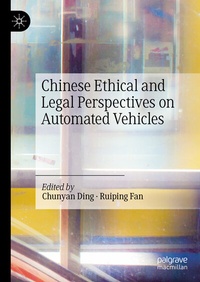
Chinese Ethical and Legal Perspectives on Automated Vehicles
Description

This book explores the significance of automated vehicles from a Chinese perspective, bringing a wide range of scholarship to bear on the question. This project takes a deep dive into Chinese ethical and legal perspectives on automated vehicles, providing a valuable resource for the general public. It also prompts readers to compare and contrast Chinese and Western viewpoints regarding the use of automated vehicles as future transportation and their impact on human-machine relationships. By dedicating individual chapters to specific issues such as programming, safety, liability, privacy, and data protection, this book enables policymakers and general readers to gain a clear understanding of the societal implications of automated vehicles shaped by culture and law. Additionally, by including survey results from two representative Chinese cities with distinct cultural and legal backgrounds, it caters to the need for insights into general Chinese perspectives on the ethical and legal issues surrounding automated vehicles. This book will interest policymakers, technologists and scholars.
More details
Other editions
Additional editions
Persons
Chunyan Ding , Professor of Law at City University of Hong Kong, specializes in tort law, health law, privacy and data protection, and comparative civil law. She has authored "Medical Negligence Law in Transitional China" (2012) and has contributed over fifty journal articles and book chapters in her areas of expertise.
Ruiping Fan , Chair Professor of Philosophy at City University of Hong Kong, specialises in bioethics and comparative philosophy, focusing on Confucian cultural resources. With 190+ published articles and chapters, he authored "Reconstructionist Confucianism", "Contemporary Confucian Bioethics", "Contemporary Medicine and Confucian Thought" and (co-)edited 12 volumes in his research fields.
Content
Part One: Introduction.- 1. Exploring Chinese Ethical and Legal Perspectives on Automated Vehicles.- Part Two: Chinese Ethical Accounts.- 2. Automated Vehicles, Human-Machine Relation, and Ethics: A Daoist View.- 3. Algorithmic Morality and Moral Decision Making for Automated Vehicles: A Confucian Account .- 4. "I must Have a Steering Wheel in My Automated Car to Protect My Family": A Confucian Ethical Reflection on Programming Automated Vehicles.- 5. Automated Vehicles, Privacy Protection, and Ethics: A Comparing Study on Western Theories and Confucianism.- Part Three: Chinese Legal Accounts.- 6. Navigating the Evolving Risk Landscape of Automated Driving: Regulatory Approaches and Challenges.- 7. Exploring a Suitable Legal Framework of Civil Liability for Automated Vehicle Accidents.- 8 Data Governance Rules in the Context of Connected Vehicles.- Part Four: A Survey Report.- 9. Chinese People's Preferences for Automated Vehicle Designs: A Survey Findings Report in Hong Kong and Shenzhen.
