

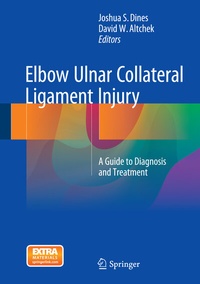
Elbow Ulnar Collateral Ligament Injury
Description

Presenting a comprehensive discussion of the biomechanics, assessment, diagnosis and management of injuries to the elbow ulnar collateral ligament (UCL), including video clips of selected surgical techniques, this is a thorough and practical text for any clinician seeing athletes with this increasingly common injury. The book is organized thematically, beginning with anatomy and biomechanics of the ligament. Diagnosis of these injuries follows, with chapters focusing on both physical exam tests and imaging studies. Chapters on both conservative treatment and surgical approaches form the heart of the text, including revision surgery and complications, and review the variety of techniques and expected outcomes. Additionally, individual chapters are devoted to the female and high school-aged athlete. Proper rehabilitation is essential and rounds out the text, including a unique focus on sports-specific rehabilitation. Written and edited by top clinicians in orthopedics and sports medicine, this book is an essential reference for diagnosing and treating injuries to the elbow UCL.
Reviews / Votes
"This book is dedicated to a singular problem of the elbow: the ulnar collateral ligament injury. . This is perhaps the most comprehensive book on this topic I have ever read. It is well designed, up to date, easy to read, and a valuable guide for orthopedic surgeons treating these patients. It is a worthy addition to the institutional library and a must-have for anyone who does UCL surgery." (Mark R. Hutchinson, Doody's Book Reviews, July, 2015)
More details
Other editions
Additional editions
Persons
Joshua S. Dines, MD, Sports Medicine and Shoulder Service, Hospital for Special Surgery, New York, NY, USA
David W. Altchek, MD, Sports Medicine and Shoulder Service, Hospital for Special Surgery, New York, NY, USA
Content
Clinically Relevant Elbow Anatomy and Surgical Approaches.- Ulnar Collateral Ligament: Throwing Biomechanics.- Valgus Extension Overload.- Ulnohumeral Chondral and Ligamentous Overload.- Epidemiology of Elbow Ulnar Collateral Ligament Injuries.- History and Physical Exam on the Thrower's Elbow.- Radiographic Imaging of the Elbow.- MR Imaging in Patients with Ulnar Collateral Ligament Injury.- Ultrasound Imaging of Ulnar Collateral Ligament Injury.- The Conservative Treatment of Ulnar Collateral Ligament Injuries.- Injections Including Platelet Rich Plasma.- Ulnar Collateral Ligament Reconstruction: Graft Selection and Harvest Technique.- Primary Repair of Ulnar Collateral Ligament Injuries of the Elbow.- The Role of Arthroscopy in Athletes with Ulnar Collateral Ligament Injuries.- Biomechanics of Reconstruction Constructs.- Figure of 8 Technique and Outcomes.- Ulnar Collateral Ligament Reconstruction: Docking Technique.- American Sports Medicine Institute Techniques and Outcomes.- Ulnar Collateral Ligament Reconstruction: Alternative Surgical Techniques.- Combined Flexor-Pronator Mass and Ulnar Collateral Ligament Injuries.- Ulnar Nerve Issues in Throwing Athletes.- Revision Ulnar Collateral Ligament Reconstruction.- Ulnar Collateral Ligament Injuries in High School-Aged Athletes.- Ulnar Collateral Ligament Injury in Female Athletes.- Complications of Ulnar Collateral Ligament Repair.- Sports Specific Outcomes for Ulnar Collateral Ligament Reconstruction.- Rehabilitation of the Overhead Athlete's Elbow.- Sport Specific Rehabilitation after Ulnar Collateral Ligament Surgery.
