

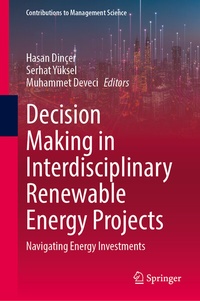
Decision Making in Interdisciplinary Renewable Energy Projects
Description

This edited book presents a comprehensive analysis of the multidimensional aspects associated with decision making in renewable energy investment projects. It delves into the interplay between interdisciplinary studies, sustainability considerations, and circular economy principles within the renewable energy sector. By examining the impact of these interconnected domains, the book offers valuable insights into the challenges and opportunities inherent in decision making for renewable energy investments.
The book is tailored to a diverse audience, including researchers, scholars, and professionals in the fields of renewable energy, sustainability, circular economy, and business management. It is equally suitable for graduate and undergraduate students studying environmental studies, renewable energy, sustainability, and related disciplines. Professionals working in the renewable energy industry, including project developers, investors, and policymakers, will find valuable insights to inform their decision-making processes. Additionally, engineers, economists, social scientists, and environmental consultants interested in interdisciplinary studies and their intersection with renewable energy will benefit from the book's comprehensive analysis.
More details
Other editions
Additional editions
Persons
Hasan Dinçer is a Professor of Finance at Istanbul Medipol University, Faculty of Economics and Administrative Sciences, Istanbul, Türkiye.
Serhat Yüksel is an Associate Professor of Finance at Istanbul Medipol University, Faculty of Economics and Administrative Sciences, Istanbul, Türkiye.
Muhammet Deveci is Honarary Senior Research Fellow at The Bartlett School of Sustainable Construction in the University College London, London, UK, and a Visiting Professor at Royal School of Mines in the Imperial College London, UK. He is also Associate Professor at the Department of Industrial Engineering in the Turkish Naval Academy, National Defence University, Istanbul, Türkiye.
Content
An Analysis of Alternative Energy Sources and Applications in Maritime Transportation with a Strategic Management Approach.- Development and implementation of an enterprise's energy efficiency.- Institutional Quality, Trade Openness and Renewable Energy Consumption in the GCC Countries.- Energy efficiency management in China.- Energy Crisis: An Actual Collapse? Energy Crisis and Apocalypse Societies in Popular Films.- Evaluation of Psychosocial Risk Factors Encountered for Energy Sector Employees by MAIRCA Method.- Analysis of modern methodological approaches to assessing the energy efficiency of enterprises and industrial complexes.- An Analysis of Alternative Energy Sources and Applications in Maritime Transportation with a Strategic Management Approach.- The cost of output in the energy industry in Russia.- Modeling the Long-Term Relationships Between Renewable Energy and Human Capital Index Economic Growth in The German Economy.- Methodological tools for assessing the energy efficiency of the industrial complex.- Conceptual and methodological foundations of multi-criteria selection of priority projects energy-efficient projects for the development of large industrial complexes.- Navigating the Energy Transition: How R&D Investment and Governance Quality Drive Clean Energy in the MENA Region.- Assessment and improvement of energy efficiency in the context of competitiveness.- Charismatic leadership in work organizations: An evaluation for energy industry.- The Role of Insurance in Promoting Clean Energy Transition.- Investments in energy complexe: Evidence from Tajikistan.- Evaluation of investment projects by analyzing a system of financial coefficients.- Financial Regulation of Households Poverty and Income Inequality: ESG sustainability and effectiveness of social security systems.- Challenges and solutions of AB-SFC methodology for ESG sustainable social security systems.- Investigating Energy Consumption in Hospitals by Text Mining Method.- Electrical vehicles in the context of sustainability: an analysis through social media platforms.- Unlocking the Benefits of Energy Efficiency: A Guide to Assessing and Improving Your Business's Energy Conservation
