

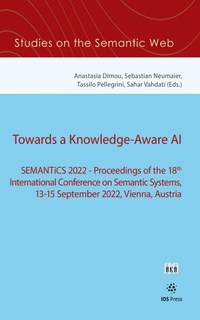
Towards a Knowledge-Aware AI
SEMANTiCS 2022 - Proceedings of the 18th International Conference on Semantic Systems, 13-15 September 2022, Vienna, Austria
1st Edition
Published on 15. September 2022
234 pages
978-1-64368-321-8 (ISBN)
Description

Semantic systems lie at the heart of modern computing, interlinking with areas as diverse as AI, data science, knowledge discovery and management, big data analytics, e-commerce, enterprise search, technical documentation, document management, business intelligence, enterprise vocabulary management, machine learning, logic programming, content engineering, social computing, and the Semantic Web.
This book presents the proceedings of SEMANTiCS 2022, the 18th International Conference on Semantic Systems, held as a hybrid event - live in Vienna, Austria and online - from 12 to 15 September 2022. The SEMANTiCS conference is an annual meeting place for the professionals and researchers who make semantic computing work, who understand its benefits and encounter its limitations, and is attended by information managers, IT architects, software engineers, and researchers from organizations ranging from research facilities and NPOs, through public administrations to the largest companies in the world. The theme and subtitle of the 2022 conference was Towards A Knowledge-Aware AI, and the book contains 15 papers, selected on the basis of quality, impact and scientific merit following a rigorous review process which resulted in an acceptance rate of 29%. The book is divided into four chapters: semantics in data quality, standards and protection; representation learning and reasoning for downstream AI tasks; ontology development; and learning over complementary knowledge.
Providing an overview of emerging trends and topics in the wide area of semantic computing, the book will be of interest to anyone involved in the development and deployment of computer technology and AI systems.
This book presents the proceedings of SEMANTiCS 2022, the 18th International Conference on Semantic Systems, held as a hybrid event - live in Vienna, Austria and online - from 12 to 15 September 2022. The SEMANTiCS conference is an annual meeting place for the professionals and researchers who make semantic computing work, who understand its benefits and encounter its limitations, and is attended by information managers, IT architects, software engineers, and researchers from organizations ranging from research facilities and NPOs, through public administrations to the largest companies in the world. The theme and subtitle of the 2022 conference was Towards A Knowledge-Aware AI, and the book contains 15 papers, selected on the basis of quality, impact and scientific merit following a rigorous review process which resulted in an acceptance rate of 29%. The book is divided into four chapters: semantics in data quality, standards and protection; representation learning and reasoning for downstream AI tasks; ontology development; and learning over complementary knowledge.
Providing an overview of emerging trends and topics in the wide area of semantic computing, the book will be of interest to anyone involved in the development and deployment of computer technology and AI systems.
More details
Series
Language
English
Place of publication
London
Netherlands
Publishing group
IOS Press
Target group
Professional and scholarly
File size
6,77 MB
ISBN-13
978-1-64368-321-8 (9781643683218)
Copyright in bibliographic data and cover images is held by Nielsen Book Services Limited or by the publishers or by their respective licensors: all rights reserved.
Schweitzer Classification
Other editions
Additional editions

Anastasia Dimou | Sebastian Neumaier | Sahar Vahdati
Towards a Knowledge-Aware AI
SEMANTiCS 2022 - Proceedings of the 18th International Conference on Semantic Systems, 13-15 September 2022, Vienna, Austria
Book
10/2022
1st Edition
IOS Press,US
€109.13
Shipment within 10-20 days
Content
- Intro
- Title Page
- Preface
- Program Committee of SEMANTiCS 2022
- Contents
- Semantics in Data Quality, Standards, and Protection
- Evaluating Web Content Using the W3C Credibility Signals
- Evaluating Quality Improvement Techniques Within the Linked Data Generation Process
- A Semantic Specification for Data Protection Impact Assessments (DPIA)
- AIRO: An Ontology for Representing AI Risks Based on the Proposed EU AI Act and ISO Risk Management Standards
- Representation Learning and Reasoning for Downstream AI Tasks
- On a Generalized Framework for Time-Aware Knowledge Graphs
- Assigning Systems to Test Environments Through Ontological Reasoning
- Adding Domain Knowledge to Improve Entity Resolution in 17th and 18th Century Amsterdam Archival Records
- Ontology Development
- Automatically Drafting Ontologies from Competency Questions with FrODO
- Plow: A Novel Approach to Interlinking Modular Ontologies Based on Software Package Management
- Modelling Business Agreements in the Multimodal Transportation Domain Through Ontological Smart Contracts
- Learning over Complementary Knowledge
- Learning Ontology Classes from Text by Clustering Lexical Substitutes Derived from Language Models
- Metadata Based Contextual Summarizer for Technical Conversations in Public Forums
- esT5s: A Spanish Model for Text Summarization
- A Joint Model for Detecting Causal Sentences and Cause-Effect Relations from Text
- Distinguishing the Types of Coordinated Verbs with a Shared Argument by Means of New ZeugBERT Language Model and ZeugmaDataset
- Subject Index
- Author Index
