

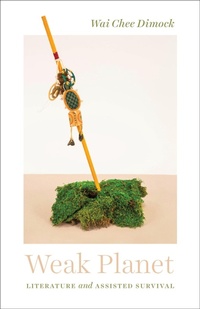
Weak Planet
Literature and Assisted Survival
1st Edition
Published on 22. December 2022
238 pages
978-0-226-47724-4 (ISBN)
Description

"Exploring weakness and vulnerability from the origins of American literature to the present, she provocatively argues for 'collateral resilience.'" -Viet Thanh Nguyen, Pulitzer Prize-winning author
Vulnerability. We see it everywhere. In once permanent institutions. In runaway pandemics. In democracy itself. And most frighteningly, in ecosystems with no sustainable future. Against these large-scale hazards of climate change, what can literature teach us? This is the question Wai Chee Dimock asks in Weak Planet, proposing a way forward, inspired by works that survive through kinship with strangers and with the nonhuman world.
Drawing on Native American studies, disability studies, and environmental humanities, Dimock shows how hope can be found not in heroic statements but in incremental and unspectacular teamwork. Reversing the usual focus on hegemonic institutions, she highlights instead incomplete gestures given an afterlife with the help of others. She looks at Louise Erdrich's and Sherman Alexie's user-amended captivity narratives; nontragic sequels to Moby-Dick by C. L. R. James, Frank Stella, and Amitav Ghosh; induced forms of Irishness in Henry James, Colm Tóibín, W. B. Yeats, and Gish Jen; and the experimentations afforded by a blurry Islam in works by Henri Matisse, James Joyce, Ezra Pound, and Langston Hughes. Celebrating literature's durability as an assisted outcome, Weak Planet gives us new ways to think about our collective future.
" Weak Planet invites us to reflect on the deep interconnections between two threatened extinctions: that of the humanities and that of a host of animal species (not least our own). The book is nothing short of a radical reorientation of literary history." -Stephen Best, author of None Like Us: Blackness, Belonging, Aesthetic Life
Vulnerability. We see it everywhere. In once permanent institutions. In runaway pandemics. In democracy itself. And most frighteningly, in ecosystems with no sustainable future. Against these large-scale hazards of climate change, what can literature teach us? This is the question Wai Chee Dimock asks in Weak Planet, proposing a way forward, inspired by works that survive through kinship with strangers and with the nonhuman world.
Drawing on Native American studies, disability studies, and environmental humanities, Dimock shows how hope can be found not in heroic statements but in incremental and unspectacular teamwork. Reversing the usual focus on hegemonic institutions, she highlights instead incomplete gestures given an afterlife with the help of others. She looks at Louise Erdrich's and Sherman Alexie's user-amended captivity narratives; nontragic sequels to Moby-Dick by C. L. R. James, Frank Stella, and Amitav Ghosh; induced forms of Irishness in Henry James, Colm Tóibín, W. B. Yeats, and Gish Jen; and the experimentations afforded by a blurry Islam in works by Henri Matisse, James Joyce, Ezra Pound, and Langston Hughes. Celebrating literature's durability as an assisted outcome, Weak Planet gives us new ways to think about our collective future.
" Weak Planet invites us to reflect on the deep interconnections between two threatened extinctions: that of the humanities and that of a host of animal species (not least our own). The book is nothing short of a radical reorientation of literary history." -Stephen Best, author of None Like Us: Blackness, Belonging, Aesthetic Life
More details
Other editions
Additional editions
Book
12/2020
University of Chicago Press
€113.89
Shipment within 10-20 days
Person
Wai Chee Dimock is the William Lampson Professor of English and American Studies at Yale University. She is the author of three scholarly books, most recently,
Through Other Continents: American Literature across Deep Time.
Content
- Intro
- Contents
- List of Figures
- Introduction: Endangered
- I. Revamped Genres
- 1. Still Hungry: Louise Erdrich and Sherman Alexie Edit Mary Rowlandson
- 2. Almost Extinct: Elegy, Pastoral, and Sounds in and out of Thoreau
- 3. Less Than Tragic: C. L. R. James, Frank Stella, and Amitav Ghosh Dilute Melville
- II. Rebuilt Networks
- 4. Contagiously Irish: Colm Tóibín, W. B. Yeats, and Gish Jen Infect Henry James
- 5. Vaguely Islamic: Henri Matisse, James Joyce, Ezra Pound, and Langston Hughes, with Paul Bowles
- 6. Remotely Japanese: William Faulkner Indigenous and Trans-Pacific
- Afterword: Not Paralyzed
- Acknowledgments
- Notes
- Index
