

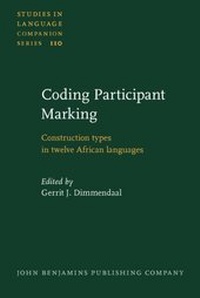
Coding Participant Marking
Construction types in twelve African languages
1st Edition
Published on 22. April 2009
XVI, 389 pages
978-90-272-8961-2 (ISBN)
Description

Whereas Africa as a typological area is often associated with extensive verb morphology and verb serialization, this collection of studies shows that there is tremendous typological diversity at the clausal level. Verb serialization in the Khoisan area contrasts with extensive case-marking in languages of northeastern Africa, which also use converbs and light verb plus coverb constructions. Although the categorial distinction between nouns and verbs is generally clear in African languages, a number of them nevertheless provide intricate analytical challenges in this respect. Whereas some languages are strongly head marking at the clausal level, others manifest an interesting mixture of alternative strategies for the coding of participants. The analysis of information packaging, and related issues such as split ergativity, Differential Object Marking, and discourse-configurational properties also play a role in several contributions. The collection contains not only innovative analyses for the respective language families these languages belong to, but also material relevant for the current debate in theoretical linguistics concerning lexical specification as against construction-based approaches towards argument structure.
More details
Other editions
Additional editions
Book
04/2009
John Benjamins Publishing Co
€111.30
Shipment within 10-15 days
Person
Content
- Coding Participant Marking
- Editorial page
- Title page
- LCC data
- Table of contents
- Preface
- Abbreviations and glossing conventions
- List of contributors
- Introduction
- 1.1 Distinguishing between core and peripheral constituents
- 1.2 Event structures
- 1.3 Case marking
- 1.4 Ergativity
- 1.5 Categorization
- 1.6 The interaction between syntax and pragmatics
- 1.7 A note on genetic classification and areal typology
- References
- !Xun
- 1. Introduction
- 2. Verb classes
- 3. Core and peripheral participants
- 4. Head - dependent marking
- 4.1 Clause
- 4.2 Noun phrase
- 5. Svc
- 6. Modification strategies
- 7. Wordhood
- 8. Pragmatic features
- 9. Metereological expressions
- 10. Conclusions
- References
- Alaaba
- 1. Introduction
- 2. The case system for nouns
- 2.1 Absolutive
- 2.2 Nominative
- 2.3 Genitive
- 2.4 Dative
- 2.5 Ablative
- 2.6 Locative and instrumental
- 2.7 Similative
- 3. Problems regarding case distinction
- 4. The case system of nominal modifiers
- 4.1 Demonstratives
- 4.2 Numerals
- 4.3 Adjectives
- 5. The pronominal case system
- 6. Summarizing thoughts on case distinction in alaaba
- 7. Valency of verbs
- 7.1 Causative
- 7.2 Transitivizing morpheme -a?-
- 7.3 Detransitivizing morpheme -ta?- (Anticausative)
- 7.4 Passive
- 7.5 Middle voice
- 7.6 Reciprocal
- 8. Constituent-order
- Appendix
- References
- Haro
- 1. Background
- 2. Participant marking on nouns
- 2.1 Definiteness
- 2.2 Case
- 2.2.1 The Absolutive case and the Nominative case
- 2.2.2 The genitive case
- 2.3 Peripheral cases
- 2.3.1 The dative
- 2.3.2 The comitative
- 2.3.3 The Instrumental case
- 2.3.4 The Ablative case
- 2.3.5 The Locative case
- 2.3.6. The Directive
- 3. Participant marking on verbs
- 4. Participant marking in elliptic noun phrases
- 4.1 Participant marking in headless relative clauses
- 4.2 Headless adjectives
- 4.3 Headless deictic expressions
- 4.4 Headless Genitive phrases
- 5. Participant marking on focused referents
- 5.1 The focused object
- 5.2 The focussed subject
- 5.3 No participant but a verb in focus
- Acknowledgements
- References
- Hone
- 1. Introduction
- 2. The Hone language
- 3. Valency, transitivity, and mirativity
- 4. Valency and predicate syntax in Hone
- 5. Transitivity and cognate objects
- 6. Mirativity
- 7. Word classes: verb or noun?
- 8. Typological and historical considerations
- References
- Ik
- 1. Introduction
- 2. Verb classes
- 3. Core and peripheral participants
- 4. Head - dependent marking
- 4.1 Dependent - case
- 4.2 Head marking
- 4.2.1 Cross reference
- 4.3 Double verbal derivation
- 4.4 Phrase level
- 5. Modification strategies
- 5.1 Causative
- 5.2 Venitive and andative
- 6. Wordhood
- 7. Pragmatic features
- 8. Conclusion
- References
- Jalonke
- 1. Introduction
- 1.1 The language and its speakers
- 1.2 Previous research on Jalonke, Yalunka and Soso
- 1.3 Data base
- 2. Typological characteristics relevant to participant encoding and argument structure
- 2.1 Word order and grammatical relations
- 2.2 Arguments and adjuncts
- 2.2.1 Optionality of 'oblique' arguments
- 2.2.2 Availability of syntactic operations such as relativization and passivization
- 2.2.3 Differences in the case marking between arguments and adjuncts
- 2.2.4 Semantic necessity of a participant
- 2.3 Major word classes
- 3. Participant marking
- 3.1 Effectors and agents
- 3.2 Instruments
- 3.3 Themes
- 3.4 Location
- 3.5 Beneficiaries
- 4. Argument structure classes
- 4.1 Intransitive verbs
- 4.2 Transitive verbs
- 4.3 Causative/inchoative alternating verbs
- 4.4 Reflexive-only verbs
- 4.5 Motivations for argument structure classes
- 4.5.1 Causation types
- 4.5.2 Likelihood of the denoted event to be construed as uncaused
- 4.5.3 Inclination of the language towards 'fundamental transitivity' or 'fundamental intransitivity'
- 5. Argument realization
- 5.1 Motivations and relevant issues for a study of argument realization
- 5.1.1 The verification of the language-internal analysis of Jalonke argument structure classes.
- 5.1.2 The investigation of the availability of argument ellipsis
- 5.1.3 The assessment of the level of information structure at which the number of arguments is specified and the verification of such a level of information structure
- 5.2 Main results
- 6. Conclusion and outlook
- Notation conventions used in examples
- Example labeling
- Acknowledgments
- References
- Khwe
- 1. Introduction
- 2. Constituent order
- 3. Adpositions and case
- 3.1 Adpositions
- 3.1.1 Core participants
- 3.1.2 Peripheral participants
- 3.1.3 Nominal possession
- 3.2 Inflected case: Genitive
- 4. Verbal derivation and serialization
- 4.1 Valency constant with an implied argument
- 4.2 Valency decrease
- 4.3 Valency increase
- 4.3.1 Causative
- 4.3.2 Benefactive
- 4.4 Valency constant
- 4.5 Verb serialization
- 5. Summary
- References
- Likpe
- 1. Events and participants
- 2. The Likpe language and its speakers
- 3. Semantic valence of predicates and participant coding
- 3.1 One-participant situations
- 3.2 Two-participant situations
- 3.2.1. Figure-Ground reversal in two-place constructions
- 3.2.2 Semantic frames and interpretation of events and participants
- 3.2.3 Stative locative constructions with oblique arguments
- 3.3 Three-participant situations
- 3.3.1 The Dative Double Object Construction
- 3.3.2 The Locative Double Object construction
- 3.3.3 The double complement construction
- 3.4 Multiple argument realisation
- 4. Other devices for coding participants
- 4.1 Verb extensions and participant marking
- 4.1.1 The causative
- 4.1.2 The associative
- 4.2 Prepositions
- 4.2.1 The comitative preposition
- 4.2.2 The locative preposition
- 5. Participant structure in dedicated grammatical constructions
- 5.1 Serial verb constructions
- 5.2 The Undergoer Voice Construction
- 5.3 Experiential constructions
- 5.3.1 The craving/longing for construction
- 6. Conclusion
- Acknowledgements
- References
- Makonde
- 1. The Makonde people
- 2. Typical and special Bantu features
- 3. The conjoint/disjoint system
- 3.1 A brief history
- 3.2 Conjoint and disjoint verbal forms in Chinnima
- 3.3 Conjoint and disjoint specifiers in Chinnima
- 3.4 Conjoint and disjoint verbal forms in Makwe
- 3.5 Conjoint and disjoint specifiers in Makwe
- 4. Functional differences between conjoint and disjoint forms
- 4.1 Differences between conjoint and disjoint tenses
- 4.2 Differences between conjoint and disjoint specifiers
- Acknowledgement
- References
- Tama
- 1. Introduction
- 2. Some observations on Tama phonology
- 3. Noun phrases
- 4. The verb
- 5. Simple and complexes clauses
- 6. Participant marking at the clausal level
- 6.1. Case
- 6.2. Differential object marking and related economy principles
- Acknowledgements
- References
- Tima
- 1. Introduction
- 2. Some observations on Tima phonology
- 3. Noun phrases
- 4. Verb morphology
- 5. Constituent order and information packaging
- 6. Split ergativity
- Acknowledgements
- References
- Wolaitta
- 1. Introduction
- 2. The case-marking strategy
- 2.1 Case morphology in nouns
- 2.2 Case morphology in pronouns and proper names
- 2.3 Case marking and verb types
- 2.3.1 Marking S in one place-verb clauses
- 2.3.1.1 Agent S in one-place verbs
- 2.3.1.2. Undergoer S in one- or two-place verbs
- 2.3.1.3 S in one-place verbs that express meteorological phenomenon
- 2.3.2 Participant marking in two-place verbs
- 2.3.4 One- or two-place verbs? The problem of cognate objects
- 2.3.5 Participant marking in Three-place verbs
- 3. The head-marking strategy
- 3.1 Affirmative and negative declarative clauses
- 3.2. Affirmative and negative interrogative clauses
- 4. Word order and subject - object identification
- 5. Coreference and disjoint-reference of subject in complex sentences
- 6. Summary and conclusion
- Acknowledgments
- References
- Index
- The Studies in Language Companion Series
