

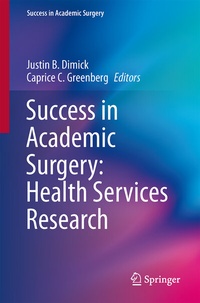
Success in Academic Surgery: Health Services Research
Description

More details
Other editions
Additional editions
Persons
Justin Dimick, MD, MPH is the current AAS Secretary. He is Assistant Professor of Surgery, the Chief of the Division of Minimally Invasive Surgery, and the Associate Chair for Faculty Development in the Department of Surgery at the University of Michigan. He completed surgical residency at the University of Michigan and a fellowship in health services research at Dartmouth. He has an active health services research program and serves as Director of Policy Research at the Center for Healthcare Outcomes & Policy. His research is supported by grants from the Agency for Healthcare Research and Quality and National Institutes of Health. His research aims to develop better measures of hospital quality and evaluate the effectiveness of different strategies for improving surgical care. He has more than 100 peer reviewed publications, including papers in The New England Journal of Medicine, Journal of the American Medical Association, Health Affairs, and Health Services Research.
Caprice Greenberg, MD, MPH is the current AAS Representative to and the President of the Surgical Outcomes Club. She is Associate Professor of Surgery, the WARF Professor of Surgical Research, and the Director of the Wisconsin Surgical Outcomes Research Program at the University of Wisconsin. She obtained her medical degree at the University of Chicago, completed her residency at Brigham and Women's Hospital in Boston, obtained an MPH at the Harvard School of Public Health, and completed a fellowship in surgical oncology at Dana-Farber/Partner Cancer Center in Boston. The overall emphasis of Dr. Greenberg's research program is on performance and safety in surgical care, comparative effectiveness research and qualitative research, particularly in relation to patient and provider interactions. She has been funded by the Agency for Healthcare Research and Quality and National Institutes of Health.
Content
Part 1. Main Research Areas.- 1. An Introduction to Health Services Research.- 2. Comparative Effectiveness Research.- 3. Understanding Variations in the Use of Surgery.- 4. Health Policy Research in Surgery.- 5. Studying Surgical Disparities: It's not all Black and White.- 6. Measuring Health Care Quality in Surgery: Strategies, Limitations, and Currently Available Initiatives.- 7. Using data for local quality improvement.- Part 2. Emerging Areas of Research.- 8. Implementation Science and Quality Improvement.- 9. Understanding and changing organizational culture in surgery.- 10. Assessing patient-centered outcomes.- 11. Studying What Happens in the OR.- 12. Collaborative Quality Improvement.- Part 3. Tools of the Trade.- 13. Large Databases used for Outcomes Research.- 14. Methods for Enhancing Causal Inference in Observational Studies.- 15. Systematic Review and Meta-analysis: a Clinical Exercise.- 16. Medical Decision-Making Research in Surgery.- 17. Survey research.- 18. Qualitative research methods. Part 4. Career Development.- 19. Engaging Students in Surgical Outcomes Research.- 20. Finding a Mentor in Outcomes Research.- 21. What Every Outcomes Research Fellow Should Learn.- 22. Funding Opportunities for Outcomes Research.- 23. Choosing your first job as a surgeon and health services researcher.- 24. Building a Health Services Research Program.
