

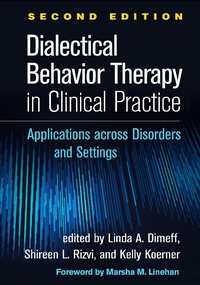
Dialectical Behavior Therapy in Clinical Practice
Applications across Disorders and Settings
2nd Edition
Published on 10. November 2020
446 pages
978-1-4625-4473-8 (ISBN)
Description

Clinical psychologists, psychiatrists, clinical social workers, mental health counselors, and psychiatric nurses. May serve as a supplemental text in graduate-level courses.
More details
Other editions
Additional editions
Linda A. Dimeff | Shireen L. Rizvi | Kelly Koerner
Dialectical Behavior Therapy in Clinical Practice, Second Edition
Applications across Disorders and Settings
Book
04/2023
2nd Edition
Guilford Press
€59.50
Shipment within 15-20 days
Linda A. Dimeff | Shireen L. Rizvi | Kelly Koerner
Dialectical Behavior Therapy in Clinical Practice, Second Edition
Applications across Disorders and Settings
Book
01/2021
2nd Edition
Guilford Press
€95.50
Shipment within 15-20 days
Persons
Linda A. Dimeff, PhD, is Chief Scientific Officer at Jaspr Health (www.jasprhealth.com), Institute Director at Portland DBT Institute, and Clinical Faculty in the Department of Psychology at the University of Washington. Since 1994, Dr. Dimeff has collaborated closely with Marsha M. Linehan to develop and evaluate an adaptation of dialectical behavior therapy (DBT) for individuals with substance use disorders and borderline personality disorder; to produce DBT training materials for clinicians; and to train, consult, and supervise clinicians in their practice of DBT. She has worked with public- and private-sector systems throughout the world in their efforts to implement DBT. Dr. Dimeff is a recipient of the Cindy J. Sanderson Outstanding Educator Award from the International Society for the Improvement and Teaching of DBT. She has received over 20 federal grants to facilitate the dissemination of evidence-based therapies and has published over 55 peer-reviewed publications.
Shireen L. Rizvi, PhD, ABPP, is Professor of Psychiatry and Behavioral Sciences at Montefiore Einstein Medical Center in New York, where she serves as Director of Psychology Training and Director of DBT Services and Research. Dr. Rizvi received her doctorate under the mentorship of Marsha M. Linehan. She has received extensive grant funding and published dozens of research papers. Dr. Rizvi is board certified in cognitive and behavioral therapies and DBT. Her mission is to get DBT tools to as many people as possible. Her website is shireenrizvi.com.
Kelly Koerner, PhD, is CEO of Jaspr Health (www.jasprhealth.com) and Clinical Faculty in the Department of Psychology at the University of Washington. Weaving together science, design, and social entrepreneurship, she develops highly collaborative, technology-based solutions to get evidence-based practices (EBPs) to the right point of care. Dr. Koerner has extensive practical experience in supporting individuals and systems as they learn, implement, and sustain EBPs in diverse settings (e.g., from paraprofessionals in juvenile justice facilities, to master's-level counselors in community mental health and substance abuse treatment centers, to research therapists in academic clinical trials). Most recently, she and her human-centered design team have worked closely with scientists, people with lived experience, and emergency medicine providers to develop a tablet-based application for suicidal people. She maintains an active research program and is a recipient of the Career Achievement Award from the Dissemination and Implementation Science Special Interest Group of the Association for Behavioral and Cognitive Therapies.
Shireen L. Rizvi, PhD, ABPP, is Professor of Psychiatry and Behavioral Sciences at Montefiore Einstein Medical Center in New York, where she serves as Director of Psychology Training and Director of DBT Services and Research. Dr. Rizvi received her doctorate under the mentorship of Marsha M. Linehan. She has received extensive grant funding and published dozens of research papers. Dr. Rizvi is board certified in cognitive and behavioral therapies and DBT. Her mission is to get DBT tools to as many people as possible. Her website is shireenrizvi.com.
Kelly Koerner, PhD, is CEO of Jaspr Health (www.jasprhealth.com) and Clinical Faculty in the Department of Psychology at the University of Washington. Weaving together science, design, and social entrepreneurship, she develops highly collaborative, technology-based solutions to get evidence-based practices (EBPs) to the right point of care. Dr. Koerner has extensive practical experience in supporting individuals and systems as they learn, implement, and sustain EBPs in diverse settings (e.g., from paraprofessionals in juvenile justice facilities, to master's-level counselors in community mental health and substance abuse treatment centers, to research therapists in academic clinical trials). Most recently, she and her human-centered design team have worked closely with scientists, people with lived experience, and emergency medicine providers to develop a tablet-based application for suicidal people. She maintains an active research program and is a recipient of the Career Achievement Award from the Dissemination and Implementation Science Special Interest Group of the Association for Behavioral and Cognitive Therapies.
Content
Foreword, Marsha M. Linehan
I. Overview and Getting Started with DBT
1. Overview of DBT, Kelly Koerner, Linda A. Dimeff, & Shireen L. Rizvi
2. Adopt or Adapt?: Fidelity Matters, Kelly Koerner, Linda A. Dimeff, Charles R. Swenson, & Shireen L. Rizvi
3. Evaluating Your DBT Program, Shireen L. Rizvi, Maria Monroe-DeVita, & Linda A. Dimeff
II. Applications across Settings
4. Implementing Standard DBT in an Outpatient Setting, Linda A. Dimeff, Kim Skerven, Andrew White, Shelley McMain, Katherine Anne Comtois, Cedar R. Koons, Soonie A. Kim, Sharon Y. Manning, & Elisabeth Bellows
5. DBT in Milieu-Based Programs, Charles R. Swenson, Suzanne Witterholt, & Juliet Nelson
6. Applications of DBT in a School-Based Setting, Elizabeth T. Dexter-Mazza, James J. Mazza, Alec L. Miller, Kelly Graling, Elizabeth Courtney-Seidler, & Dawn Catucci
7. DBT in University Counseling Centers, Jacqueline Pistorello & Carla D. Chugani
8. DBT in Juvenile Justice Programs, Debra M. Bond, Jesse Homan, & Bradley Beach
9. Comprehensive DBT Forensic and Correctional Programs: Orchids, Not Dandelions, Robin A. McCann & Elissa M. Ball
III. Applications across Populations
10. DBT-Accepting the Challenges of Employment and Self-Sufficiency, Katherine Anne Comtois, Lynn Elwood, Jenna Melman, & Adam Carmel
11. DBT for Individuals with Borderline Personality Disorder and Substance Use Disorders, Linda A. Dimeff, Shelley McMain, Jennifer H. R. Sayrs, Chelsey Wilks, & Marsha M. Linehan
12. Treating Posttraumatic Stress Disorder during DBT: Applying the Principles and Procedures of the DBT Prolonged Exposure Protocol, Melanie S. Harned & Sara C. Schmidt
13. DBT and Eating Disorders, Lucene Wisniewski & Debra L. Safer
14. DBT beyond Stage 1: An Overview of Stages 2, 3, and 4, Cedar R. Koons
15. An Overview of DBT for Preadolescent Children: Addressing Primary Treatment Targets, Francheska Perepletchikova & Donald Nathanson
16. DBT for Adolescents, Alec J. Miller, Jill H. Rathus, Elizabeth T. Dexter-Mazza, Chad S. Brice, & Kelly Graling
17. DBT with Families, Alan E. Fruzzetti, Luciana G. Payne, & Perry D. Hoffman
IV. Special Topics
18. Training and Supervision in Outpatient DBT Programs, Jesse Homan, Jennifer H. R. Sayrs, & Travis L. Osborne
19. Pharmacotherapy Guidelines for Treating Stage 1 DBT Patients, Elisabeth P. Bellows, W. Maxwell Burns, & Chelsy R. Wilks
I. Overview and Getting Started with DBT
1. Overview of DBT, Kelly Koerner, Linda A. Dimeff, & Shireen L. Rizvi
2. Adopt or Adapt?: Fidelity Matters, Kelly Koerner, Linda A. Dimeff, Charles R. Swenson, & Shireen L. Rizvi
3. Evaluating Your DBT Program, Shireen L. Rizvi, Maria Monroe-DeVita, & Linda A. Dimeff
II. Applications across Settings
4. Implementing Standard DBT in an Outpatient Setting, Linda A. Dimeff, Kim Skerven, Andrew White, Shelley McMain, Katherine Anne Comtois, Cedar R. Koons, Soonie A. Kim, Sharon Y. Manning, & Elisabeth Bellows
5. DBT in Milieu-Based Programs, Charles R. Swenson, Suzanne Witterholt, & Juliet Nelson
6. Applications of DBT in a School-Based Setting, Elizabeth T. Dexter-Mazza, James J. Mazza, Alec L. Miller, Kelly Graling, Elizabeth Courtney-Seidler, & Dawn Catucci
7. DBT in University Counseling Centers, Jacqueline Pistorello & Carla D. Chugani
8. DBT in Juvenile Justice Programs, Debra M. Bond, Jesse Homan, & Bradley Beach
9. Comprehensive DBT Forensic and Correctional Programs: Orchids, Not Dandelions, Robin A. McCann & Elissa M. Ball
III. Applications across Populations
10. DBT-Accepting the Challenges of Employment and Self-Sufficiency, Katherine Anne Comtois, Lynn Elwood, Jenna Melman, & Adam Carmel
11. DBT for Individuals with Borderline Personality Disorder and Substance Use Disorders, Linda A. Dimeff, Shelley McMain, Jennifer H. R. Sayrs, Chelsey Wilks, & Marsha M. Linehan
12. Treating Posttraumatic Stress Disorder during DBT: Applying the Principles and Procedures of the DBT Prolonged Exposure Protocol, Melanie S. Harned & Sara C. Schmidt
13. DBT and Eating Disorders, Lucene Wisniewski & Debra L. Safer
14. DBT beyond Stage 1: An Overview of Stages 2, 3, and 4, Cedar R. Koons
15. An Overview of DBT for Preadolescent Children: Addressing Primary Treatment Targets, Francheska Perepletchikova & Donald Nathanson
16. DBT for Adolescents, Alec J. Miller, Jill H. Rathus, Elizabeth T. Dexter-Mazza, Chad S. Brice, & Kelly Graling
17. DBT with Families, Alan E. Fruzzetti, Luciana G. Payne, & Perry D. Hoffman
IV. Special Topics
18. Training and Supervision in Outpatient DBT Programs, Jesse Homan, Jennifer H. R. Sayrs, & Travis L. Osborne
19. Pharmacotherapy Guidelines for Treating Stage 1 DBT Patients, Elisabeth P. Bellows, W. Maxwell Burns, & Chelsy R. Wilks
