

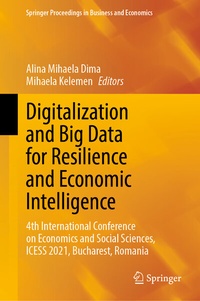
Digitalization and Big Data for Resilience and Economic Intelligence
Description

More details
Other editions
Additional editions
Persons
Alina Mihaela Dima is Professor at the Faculty of Business Administration in foreign languages, Bucharest University of Economic Studies (Romania). She is Vice-Rector for Scientific Research, Development and Innovation of the Bucharest University of Economic Studies, and previously, she was Director of the UNESCO Department for Business Administration. Her main research fields of interest are International Business, Competition Policy, European Integration, and Higher Education. She is Chief-Editor of the journal 'Management & Marketing': Challenges for Knowledge Society (Sciendo/De Gruyter) and President of the 'Society for Business Excellence'. She is Editor of several international books, Coordinator of national research projects, and Author of various papers published by prestigious international journals.
Mihaela Kelemen
is Chair in Business and Society at Nottingham University Business School (UK). Prior to joining Nottingham University, she taught and researched at Keele University (UK) for 23 years, as Professor of Management and Public Engagement and Director of its Community Animation and Social Innovation Centre (CASIC). She holds doctoral degrees from Oxford University and Bucharest University of Economic Studies (Romania). Her research employs creative and participatory methodologies of stakeholder engagement and knowledge co-production to explore a wide range of business and society topics in the UK and internationally. Her research is published in books, academic articles and practice papers as well as being disseminated via artistic outputs including community-based exhibitions, virtual games, documentary dramas and interactive creative websites developed in collaboration with the New Vic Theatre. She is a member of the UKRI Future Leaders Fellowships Peer Review College and of the AHRC Peer Review College.
Content
- Intro
- Preface
- Contents
- High-Tech Industries Performance in the European Union
- 1 Introduction
- 2 Literature Review
- 3 Methodology
- 4 Analysis and Results Interpretation
- 4.1 Industry Characteristics
- 4.2 Country Characteristics
- 4.3 Performance with Respect to the Specific Industries
- 4.4 Discussion on the Relevance of the Inferences in a Global Context
- 5 Conclusions
- References
- Analysis of Fluctuations of Aggregate Indicators and Persistence of Business Cycles in the Caspian Countries
- 1 Introduction
- 2 Literature Review
- 3 Methodology
- 4 Analysis
- 5 Conclusions
- References
- E-Government and the General Population's Digital Skills in the European Union and OECD Member States
- 1 Introduction
- 2 Literature Review
- 3 Methodology
- 4 Analysis/Results Interpretation
- 4.1 Digital Skills-The Foundation of the Digital Government a Subsection Sample
- 4.2 The OECD Digital Government Policy Framework (DGPF)
- 5 Conclusions
- References
- Risk Management of Agri-Food Value Chains-Exploring Research Trends from the Web of Science
- 1 Introduction
- 1.1 Problem Statement
- 1.2 Research Questions and Research Aims
- 2 Methodology
- 3 Results Findings
- 4 Conclusions
- References
- Civic University Challenges in Romanian Higher Education
- Students' Perceptions of Civic Engagement
- 1 Introduction
- 2 Literature Review
- 2.1 Civic Engagement in Universities-Conceptual Analysis
- 2.2 Civic University and Its Characteristics
- 2.3 Civic University in Romanian Higher Education
- 3 Methodology
- 3.1 The University of Bucharest as a Civic University-The Leadership Approach
- 3.2 Students' Perceptions of Civic Engagement
- 4 Analysis/Results Interpretation
- 4.1 UB Case Study-Leadership Approach
- 4.2 Students' Perceptions on Civic Engagement-Questionnaire Results
- 5 Conclusions
- References
- The Impact of Data Science, Big Data, Forecasting, and Predictive Analytics on the Efficiency of Business System
- 1 Introduction
- 2 Literature Review
- 3 Research Questions/Aims of the Research
- 3.1 Data
- 3.2 Technological Development Impacted the Financial-Banking Sector
- 3.3 Applying Modern Forecasting with Machine Learning Algorithm-SVM
- 4 Research Methods
- 4.1 Methodology and Specification of the Model
- 4.2 Applied Algorithm and Results
- 5 Analysis/Results Interpretation
- 6 Conclusions
- References
- Is Trust a Valid Indicator of Tax Compliance Behaviour? A Study on Taxpayers' Public Perception Using Sentiment Analysis Tools
- 1 Introduction
- 2 Literature Review
- 3 Methodology
- 4 Results Interpretation
- 5 Conclusions
- References
- The Context of Digital Entrepreneurship. New Technologies Between Evolution and Revolution
- 1 Introduction
- 2 Literature Review
- 3 Methodological Analysis
- 4 Conclusions
- References
- The Impact of Covid-19 on Food Prices in Romania
- 1 Introduction
- 2 Literature Review
- 3 Methodology
- 4 Analysis/Results Interpretation
- 4.1 Correlation Between Consumer Price Index and GDP Index Volume
- 5 Conclusions
- References
- Fiscal Consolidation in Romania in the Wake of the COVID-19 Pandemic: How Much and How Fast?
- 1 Introduction
- 2 Literature Review
- 3 Methodology
- 4 Results Interpretation
- 5 Conclusions
- References
- Solutions for Post-pandemic Economic Recovery: The Case of China
- 1 Introduction
- 2 Literature Review
- 3 Methodology
- 4 Analysis/Results Interpretation
- 5 Conclusions
- Appendix
- References
- Individual Work Valuation in a Digital World-The Case of Personal Token's Pricing
- 1 Introduction
- 2 Literature Review
- 3 Methodology
- 4 Analysis/Results Interpretation
- 4.1 Nature and Characteristics of Personal Tokens
- 4.2 Classification of Services Offered by PT Issuers
- 4.3 Axiological Valuation of Work by 12 Token Issuers
- 4.4 Personal Tokens Valuation
- 5 Conclusions
- References
- Factors Affecting Consumers' Attitude and Intentions Toward Online Events During the COVID-19 Pandemic
- 1 Introduction
- 2 Literature Review
- 3 Methodology
- 4 Analysis/Results Interpretation
- 5 Conclusions
- References
- Non-financial Performance of Energy Companies Listed on the Bucharest Stock Exchange and Relevance for Stakeholders
- 1 Introduction
- 2 Literature Review
- 3 Data and Methodology
- 4 Results and Discussions
- 5 Conclusions
- References
- Resilience and Recovery: The Impact of COVID-19 Pandemic on the Global Cruise Tourism
- 1 Introduction
- 2 Literature Review
- 3 Methodology
- 4 Analysis/Results Interpretation
- 5 Conclusions
- References
- Implications of the Migration Phenomenon in Romania
- 1 Introduction
- 2 Literature Review
- 3 Methodology
- 4 Analysis
- 5 Conclusions
- References
- The Importance of the Family Brand
- 1 Introduction
- 1.1 Problem Statement
- 1.2 Understanding of the Brand Concept
- 1.3 Marketing Campaign, a Strategic Tool of Branding
- 1.4 Family Brand Strategy Built on Family Heritage
- 1.5 The Family Branding Built on the Amalgam of Tradition, Value, and Innovation
- 1.6 Family Brand Strategy Built on Values and Dedication
- 2 The Consequences of Associating the Family Name with the Family Business Brand
- 3 Research Questions
- 4 Research Methods
- 5 Findings
- 6 Conclusion
- References
