

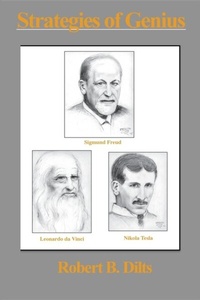
Strategies of Genius
Description

Is it possible for mental and even physical healing to take place through the use of language alone? If so, how and why?
What was the basis of Sigmund Freud's "talking cure" for the symptoms of hysteria and neurosis?
What is the relationship between Freud's work and modern psychotherapeutic models?
How can his methods help deal with everyday problems or assist people to change limiting beliefs?
What made Leonardo da Vinci such a prolific scientific researcher as well as an exceptional artist?
Is it possible for an average person to be as inventive as Leonardo?
What made it possible for Nikola Tesla to build an entire machine using only his mind's eye?
How does a person learn to visualize if he or she is not already able to do it naturally?
These questions and many others are explored and answered in this third volume of Strategies of Genius. NLP developer, trainer and author Robert Dilts studies the cognitive strategies of Sigmund Freud, Leonardo da Vinci and Nikola Tesla to uncover unique strategies for healing, change and creativity. This fascinating inquiry into the minds of these three exceptional men unveils the strategies by which they were able to explore and uncover the 'deeper structures' of the mind, nature and the future, and in doing so, change our world.
Examine Freud's strategies for observation, analysis and interpretation by focusing on seemingly trivial details. Investigate Leonardo's strategies for stimulating his imagination, improving his memory and probing the 'first principles' of nature by 'chunking' and synthesizing the core elements of a system. Learn how Nikola Tesla developed his ability to visualize to the degree that the only laboratory he needed in order to develop his incredible inventions was the one in his imagination.
By combining the power of NLP with the brilliance and wisdom of some of history's greatest geniuses and innovators, Dilts is able to model and present simple but effective techniques for changing beliefs and behavior
More details
Person
Content
Chapter 1 Sigmund Freud: The Search for Deep Structure
Freud's Epistemology of Mind
Freud's Analysis of Leonardo da Vinci
Freud's Analysis of Michelangelo's Moses
Applications of Freud's Strategies - Exploring Deeper Structures
The Meta Model
Changing Personal History
Reframing
Reimprinting
Integration of Conflicting Beliefs
Freud and Self-Organization Theory
Self Organization, Sublimation and the 'Swish' Pattern
The Belief Change Cycle
Strategies of Change Management
Chapter 2 Leonardo da Vinci: Mapping the Microcosm
Knowing How to See
Leonardo's 'Cosmography' of the Body
'Seeing' Systemically
Imagination: The Rudder and Bridle of the Senses
Making Machines
Making Masterpieces
Implementing Leonardo's Strategies
Developing Perceptual Filters
Leonardo's Strategy for Systemic Thinking and Invention
Chapter 3 Nikola Tesla: Mastering the Mind's Eye
Envisioning the Future
Developing the Capability to Visualize
Applying Tesla's Strategy - Creating the Future
Chapter 4 Conclusion: More Patterns of Genius
