

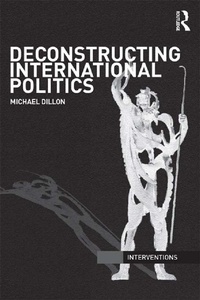
Deconstructing International Politics
Published on 17. January 2013
232 pages
978-1-136-16013-4 (ISBN)
Description

Michael Dillon is internationally regarded for his contributions by political philosophers, international relations scholars and security studies experts, as well as by philosophers more broadly. It is difficult to overrate his importance to the development of critical deconstructive approaches not only in challenging traditional scholarship and addressing contemporary politics, but in articulating new approaches and new thinking.
This book draws together some of his key works and is framed by an introduction written specially for the volume. It is the first full-length work to draw on the insights and techniques of deconstruction to analyse international relations. Influenced primarily by Derrida, it critiques the cornerstones of international relations such as modernity, the state, the subject, security and ethics and justice.
This volume will provide an invaluable resource for teaching at undergraduate and postgraduate levels on traditional international relations courses and on the increasing number of specialised courses in critical approaches. Well designed and structured, it is accessible to the novice as well as challenging for the specialist.
This book draws together some of his key works and is framed by an introduction written specially for the volume. It is the first full-length work to draw on the insights and techniques of deconstruction to analyse international relations. Influenced primarily by Derrida, it critiques the cornerstones of international relations such as modernity, the state, the subject, security and ethics and justice.
This volume will provide an invaluable resource for teaching at undergraduate and postgraduate levels on traditional international relations courses and on the increasing number of specialised courses in critical approaches. Well designed and structured, it is accessible to the novice as well as challenging for the specialist.
Reviews / Votes
Deconstructing International Politics represents a journey of sustained scholarship and political thought at the highest level. Prepare to be dazzled anew by the tour de force of Dillon's unique treatment of the philosophy of international politics. From the refashioning of military bodies in-formation to Derrida's intractable aporia, the analysis in this collection of essays is incisive, urgent, politically astute. "Politics is what takes place", writes Dillon, amid a "specific clash of the calculable and the incalculable" - these essays testify to a thought always already ahead of its time.Louise Amoore, Professor of Political Geography, Durham University.
Integral to the development of politics and political thinking within this stage of modernity is the move from the national to the international. International law is invoked to justify military actions. The centrality of the nation state as a locus of power is being effaced as economic orders that are transnational now have a determining effect of the economic policy of nation states. As a result there have never been a greater need for a sustained theoretical analysis of the primacy of the International. It is not surprising that Michael Dillon, one of the most significant figures writing political theory today has provided it. This is an important book written by one of our foremost thinkers of the political.
Andrew Benjamin, Professor of Critical Theory and Philosophical Aesthetics. Monash University and Distinguished Anniversary Professor of Philosophy and the Humanities at Kingston University.
Michael Dillon's work is more than a brilliant application of deconstruction to international relations; his essays take the measure of deconstruction itself by uncovering its politico-theological core, just as they reveal the inner link between anarchy and political realism in modernity. This book is an indispensable contribution to the task of rethinking contemporary political theory and international relations beyond the opposition of realism and constructivism.
Miguel Vatter, University of New South Wales
More details
Series
Language
English
Place of publication
London
United Kingdom
Publishing group
Taylor & Francis Ltd
Target group
College/higher education
Illustrations
3 s/w Abbildungen, 3 s/w Zeichnungen
3 Line drawings, black and white; 3 Illustrations, black and white
File size
2,88 MB
ISBN-13
978-1-136-16013-4 (9781136160134)
Copyright in bibliographic data and cover images is held by Nielsen Book Services Limited or by the publishers or by their respective licensors: all rights reserved.
Schweitzer Classification
Other editions
Additional editions
Michael Dillon
Deconstructing International Politics
Book
12/2012
1st Edition
Routledge
€205.50
Shipment within 15-20 days
Michael Dillon
Deconstructing International Politics
Book
12/2012
1st Edition
Routledge
€63.20
Shipment within 15-20 days
Person
Michael Dillon is Emeritus Professor of International Politics at the University of Lancaster, UK
Content
1. Introduction 2. Modernity, Security and Deterrence 3. Signifying Power 4. The Scandal of the Refugee 5. The Sovereign and the Stranger 6. Another Justice 7. Deconstructing the Military Body 8. Transformation 9. Violence, the Messianic and the Tragic 10. Lethal Freedom. Divine Violence and the Machiavellian Moment
