

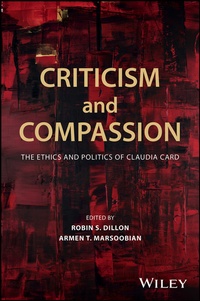
Criticism and Compassion
Description

* Investigates her work as an early leader in the development of feminist philosophy, challenging many preconceptions about the society's norms regarding gender, marriage, and motherhood
* Crossing many disciplinary boundaries, her concept of social death has come to play a significant role in multidisciplinary field of genocide studies
* This volume combines many of Claudia Card's important essays with recently commissioned essays by leading philosophers whose work has been influenced by Card
* The full scope of Card's philosophy is presented here - both in her own words and those of her critics and interpreters
More details
Other editions
Additional editions
Persons
and virtue and vice.
ARMEN T. MARSOOBIAN is Professor and Chair of Philosophy at Southern Connecticut State University and Editor-in-Chief of Metaphilosophy. He has taught as a visiting professor at Columbia University. He has lectured and published extensively on topics in American philosophy, aesthetics, moral philosophy, and genocide studies. He has edited five books, including The Blackwell Guide to American Philosophy and Genocide's Aftermath: Responsibility and Repair with Claudia Card. His award-winning book Fragments of a Lost Homeland: Remembering Armenia is based upon extensive research about his family, the Dildilians, who were accomplished photographers in the Ottoman Empire. Exhibitions of their photography were mounted in Turkey, Armenia, Great Britain, and the United States.
Content
INTRODUCTION
ARMEN T. MARSOOBIAN AND ROBIN S. DILLON
Claudia Card epitomized the highest virtues of the philosopher-teacher. Her passing in September 2015 was a great loss to the profession and to the innumerably many students she taught and advised in her nearly forty years in the Department of Philosophy at the University of Wisconsin - Madison. She had a long and distinguished career that began at a time when being a woman in the philosophy profession was not an easy matter-not that we can assume that it is easy today. She earned her Ph.D. in 1969 from Harvard with a dissertation on theories of punishment under the direction of John Rawls, despite the fact that women were not admitted to the Harvard Ph.D. program then except under the aegis of Radcliffe College. She was a pioneer in feminist and lesbian philosophy whose trailblazing work has influenced generations of philosophers. Indeed, as her then chairperson said in nominating her in 2011 for the University of Wisconsin's Hilldale Award, "Her books and articles have become as essential to feminist thinking as Das Kapital is to labor theory. You simply can't do feminism without reading Card, and even if you don't read Card, today's feminism bears her mark so deeply that you may not even realize that you have in some other way digested her theoretical perspectives."1 Her influence goes beyond feminism, even beyond philosophy, however, as demonstrated by her concept of social death, which has had continuing impact in the field of genocide studies.
Card's writings in feminist philosophy and other areas in moral, social, and political philosophy take everyday life and ordinary experiences seriously, displaying a realistic sensitivity to all forms of oppression. Card's work is marked by a careful attention to and analysis of less obvious ways that oppression structures people's characters and life possibilities, and by a commitment to the necessity of fighting oppression, injustice, cruelty, and violence with integrity and without causing further damage to oneself or others, while also remaining alive to involvement with evil and one's capacity to compromise with it.
Card had a very productive career that unfortunately ended too soon. Starting with her first and still widely cited article, "On Mercy,"2 she published ten monographs and edited several volumes and nearly 150 articles and reviews, and gave more than 250 talks at conferences, colleges, and universities. Her research interests included ethics and social philosophy, including normative ethical theory; feminist ethics; environmental ethics; theories of justice, of punishment, and of evil; and the ethics of Kant, Schopenhauer, and Nietzsche. Card published articles on mainstream topics such as gratitude and obligation, friendship and fidelity, justice, the value of persons, and the basis of moral rights. But she is most widely known for her influential work in analytic feminist philosophy and on evil. Her work in feminist philosophy was especially notable for discussions of difficult topics, such as sadomasochism, adult-child sex, and lesbian battery, and for challenging standard feminist and lesbian positions on separatism, marriage, and motherhood, including arguing against same-sex marriage. Card's feminist work includes ground-breaking essays and a monograph on lesbian ethics;3 key essays and a monograph on moral agency, character, and moral luck in circumstances of oppression;4 and pioneering articles on dimensions of oppression, such as domestic violence, rape as a form of terrorism, gay divorce, homophobic military codes, and the evils of closeting, among many others.
In the later stages of her career, Card's attention turned explicitly to a topic whose various dimensions she had been writing and teaching about for years. In addition to more than twenty-five articles on evils, Card was at the time of her death in the midst of finishing a trilogy of monographs on evil, the first two of which appeared in her lifetime.5 In the first book, The Atrocity Paradigm: A Theory of Evil, she developed a secular conception of evil as foreseeable, intolerable harms produced by culpable wrongdoing, and examined the evils of rape in war, domestic violence, and child abuse, the moral powers of victims and the moral burdens and obligations of perpetrators, and the predicament of people who are at once victims and perpetrators, which she called "gray zones." In the second book, Confronting Evils: Terrorism, Torture, Genocide, she refined her analysis of evil, focusing on the inexcusability of atrocities and expanding her account to consider structural evil and collectively perpetrated and collectively suffered atrocities, such as genocide. But she also argued that not all evils are extraordinary and urged us to pay attention to evils that are so common that we tend to overlook them, such as racism, violence against women, prison violence and executions, and violence against animals. An important dimension of Confronting Evils was addressing the problem of how to preserve humanitarian values in responding to atrocities. The third book, Surviving Atrocity, on which she was working extensively until her death, focused on surviving long-term mass atrocities, poverty, and global and local misogyny.
The significant contributions Card made to philosophy were acknowledged with numerous honors. The Society for Women in Philosophy, of which she was a longtime member, named her Distinguished Philosopher of the Year in 1996; the Central Division of the American Philosophical Association elected her president for 2010-2011; the APA invited her to give a John Dewey Lecture in 2008; and she was selected by the APA to deliver the prestigious 2016 Carus Lectures. She completed two of the latter lectures, "Surviving Homophobia" and "Gratitude to the Decent Rescuer," which were delivered by two of the contributors to this volume, Victoria Davion and Diana Tietjens Meyers, respectively.
Just before her death, the Society for Analytical Feminism, of which Card was a long-time member, organized two APA sessions that featured talks on various aspects of her work. Those papers, as well as a number of others that also explore and expand on her philosophical legacy, are contained in this volume. We are also fortunate to be able to include eleven of Card's articles, which here are brought together for the first time in one volume.6 These articles cover a span of twenty years, beginning in 1996, with the last article published the year after Card died, in 2016. This truly unique volume thus combines her own powerful voice with the best in recent scholarship on issues central to her own philosophical concerns.
Although Card's contributions are far-ranging and cut across a range of topics, we have divided this volume into two parts: "War, Genocide, and Evil" and "Feminist Ethical Theory and Its Applications." Of course, this is a somewhat arbitrary division, for Card always brings her feminist ethical insights to bear on the many social and political issues she explores. Her work on rape and sexual violence as a weapon of war, which was ground-breaking when it first appeared in the mid-1990s, is a case in point.
We begin part 1 of our volume, "War, Genocide, and Evil," with "Rape as a Weapon of War" (1996), followed by "Addendum to 'Rape as a Weapon of War'" (1997), in which Card expanded her treatment of the martial weapon of rape to include sex crimes against men. Such crimes can be as racist as they are sexist, and may be quite simply racist. The essays propose social strategies to change the meaning of rape in order to undermine its use as a martial weapon.
In "Stoicism, Evil, and the Possibility of Morality" (1998), Card explores the idea that the very possibility of morality, understood as social or interpersonal ethics, presupposes, contra Stoicism, that we do value things that elude our control. She argues that Stoic ethics is unable to recognize the validity of morality (so understood) and can at most acknowledge duties to oneself. A further implication is that moral luck, far from undermining morality, as some have held, is presupposed by the very possibility of morality.
In "Women, Evil, and Gray Zones" (2000), Card, building upon Primo Levi's reflections on "gray zone" in Nazi death camps and ghettos, contends that such zones develop wherever oppression is severe and lasting. They are inhabited by victims of evil who become complicit in perpetrating on others the evils that threaten to engulf themselves. Women, who have inhabited many gray zones, present challenges for feminist theorists, who have long struggled with how resistance is possible under coercive institutions. Card argues that resistance is sometimes possible, although outsiders are rarely, if ever, in a position to judge when. She also raises questions about the adequacy of ordinary moral concepts to mark the distinctions that would be helpful for thinking about how to respond in a gray zone.
"Genocide and Social Death" (2003) played a pivotal role in Card's two-decade-long eplorations into the concept and consequences of evil, beginning with The Atrocity Paradigm: A Theory of Evil and culminating in Confronting Evils: Terrorism, Torture, Genocide. Social death, central to the evil of genocide (whether the...
