

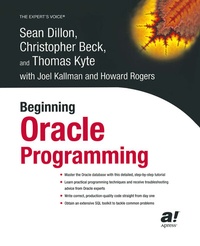
Beginning Oracle Programming
Description

More details
Other editions
Additional editions
Persons
Sean Dillon: Sean Dillon started programming a Commodore Vic 20 back in 1980 at the age of nine. Sean grew and so did his love for programming. He began his professional programming career in the United States Marine Corps, shortly after returning from the Gulf War. Sean is now a Principal Technologist, working for Oracle Corporation based in Reston, Virginia. He has ten years of experience specializing in database architecture, database tuning, web application development, XML, and Web Services technologies.
Christopher Beck: Christopher Beck has a bachelor's degree in Computer Science from Rutgers University. He has worked in the industry for 11 years. Starting off as a junior Ada software developer for a government systems integrator, he has spent the last seven years with Oracle Corporation and is now a Principal Technologist there. He specializes in core database technologies and web application development. WebView, a "science project" that he and a colleague wrote, has now become the commercial product known as Oracle Portal.
Thomas Kyte: Thomas Kyte is the Vice President of the Core Technologies Group at Oracle Corporation. He has been working for Oracle since version 7.0.9 (that's 1993 for people who don't mark time by Oracle versions). However, he has been working with Oracle since about version 5.1.5c. Before coming to work at Oracle, Thomas worked for more than six years as a systems integrator building large scale, heterogeneous databases and applications, mostly for military and government customers. These days, he spends a great deal of time working with the Oracle database and, more specifically, helping people who are using the Oracle database. He works directly with customers, either in specifying and building their systems or, more frequently, helping them rebuild or tune them ('tuning' frequently being a synonym for rebuilding). In addition, he is the Tom behind 'AskTom' in Oracle Magazine, answeringpeople's questions about the Oracle database and tools. On a typical day, he receives and answers 30 to 40 questions at http://asktom.oracle.com. Every two months, he publishes a 'best of' in the magazine (all of the questions asked are available on the Web - stored in an Oracle database of course). He is the author of "Expert One-on-One Oracle" and "Effective Oracle by Design" and the contributing author of "Professional Oracle 8i Application Programming".
Joel Kallman: Joel Kallman is a Web systems technologist for Oracle Corporation. His background over the past 13 years has centered around database and content management, from SGML databases and publishing systems to text and document management. He is currently developing solutions and tools for customers to easily build database-centric Web applications. When he's not consumed by the daily advances in computer technology, he enjoys reading about investment principles as well as working out at the local "Y". Joel is a proud alumnus of The Ohio State University, where he received his bachelor's degree in computer engineering. He and his wife Kristin reside in Powell, Ohio.
