

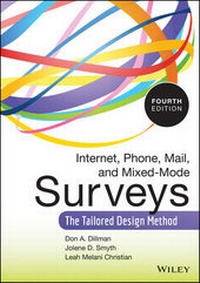
Internet, Phone, Mail, and Mixed-Mode Surveys
Description

More details
Other editions
Additional editions
Persons
Content
Preface
Writing the fourth edition of this book nearly four decades after preparing the first edition has brought into perspective how survey science has evolved. It has also led us to reflect on how each edition needed to be refocused in order to fit with dramatically changing times.
The first edition was written on a typewriter, when personal computers, fax machines, the Internet, and cell phones were mostly unimagined by those wanting to do surveys. The title of this 1978 book, Mail and Telephone Surveys: The Total Design Method, suggested what was then a revolutionary idea—sample surveys of the general public, which prior to that time were viewed as synonymous with in-person interviews, could be done in other ways. It proposed standardized step-by-step methods for conducting such surveys by either mail or by telephone. Those procedures contained the seeds of a bold idea, “For very little investment of money, almost any academic institution or agency can establish the capability for conducting credible mail and telephone surveys” (Dillman, 1978, p. 275).
Nearly 20 years elapsed before work began on the second edition. During those years dozens of experiments and field tests involving different survey populations were undertaken to refine the 1978 mail data collection procedures and test new ones. The main outcome was to realize the necessity of tailoring specific data collection strategies to different populations, survey situations, and topics rather than using the one-size-fits-all approach described in that first book. The title of the 2000 edition, Mail and Internet Surveys: The Tailored Design Method, concisely summarized the fundamental changes introduced there. More than half of the new book was devoted to tailored designs such as alternative ways to deliver questionnaires, how to achieve greater speed and efficiency, challenges specific to government surveys, and how to survey businesses. The last chapter to be drafted, and the first to go out of date, was about Internet and interactive voice response surveys, which seemed ready to revolutionize surveying. In addition, the idea of mixed-mode survey designs, using the strengths of one mode to assist another, was introduced. To make room for these changes, telephone data collection methods were removed. This book was about a 95% revision of the first edition.
Only 6 years elapsed before work began in earnest on the third edition with two new coauthors, Jolene Smyth and Leah Christian. The three of us had begun working together as a team in 2002 to systematically research the effects of visual layout and design on the ways people answered survey questions and how responses differed across aural and visual modes of response. In this edition, we were first able to articulate what we had learned as guidelines for designing questionnaires. It was also apparent that there were multiple barriers to the conduct of mixed-mode surveys, ranging from how surveyors tended to structure questions for use in particular modes to inherent differences between aural and visual communication that might not be amenable to solutions for some types of questions. This edition began and ended with a discussion about the turbulence being felt among surveyors with declining response rates, coverage problems with telephone surveys, and a concern that the Internet was not yet ready to replace telephone as a stand-alone data collection mode, especially for household surveys. When bringing closure on this substantial rewrite in early 2008, we were also examining soon-to-be published results from a new kind of experiment we had done, which was a significant departure from the measurement and question wording issues that constituted much of our focus in this revision. These preliminary results seemed to show that we could use address-based sampling (our best source of coverage for household surveys in the United States) with mail contact and effectively encourage many people to respond over the Internet. These results (Smyth, Dillman, Christian, & O'Neill 2010) were included in this 2009 edition as having potential for surveying the general public by Internet using a mixed-mode design.
Work began on the fourth edition of this book, only 4 years after publication of the previous edition, and it was quickly apparent to us that the revisions would need to be nearly as substantial as the changes between the second and third editions. The telephone as an independent survey mode was continuing to face difficulties, and seemed on the verge of being rejected for certain national as well as state and smaller area surveys. It was also clear that the Internet had still not yet achieved the use and comfort levels that would allow it to be a sole data collection mode for many, and perhaps most, surveys. In addition, new challenges to designing and getting people to respond to Internet surveys had arisen because of the quick adoption of smartphones and tablets as devices for accessing the Internet. And mail, which was once our least expensive mode but had the poorest coverage, had become the mode with the best coverage of households but had also become a higher-cost mode. These were the new issues we were grappling with in the constantly changing survey landscape.
The most significant change in this edition is bringing the telephone back into the book after leaving it out of the 2000 and 2009 editions. This decision may seem curious at a time when most surveyors are moving away from the telephone mode. But it is apparent to us that the telephone is still necessary for certain types of surveys and, perhaps more importantly, that there are many ways it can be used in mixed-mode designs to overcome the weaknesses of single contact and/or response mode surveys. Including the telephone in this edition reflects our commitment to integrating some of the main themes of the previous edition—tailored design and mixed-mode surveys—throughout the book, rather than assigning them to individual chapters. In this edition we have also expanded the theoretical underpinnings of our approach to asking people to cooperate with survey requests and updated the social exchange framework used in all previous editions, placing more emphasis on trust and its response consequences in today's rapid-fire communication environment. Rethinking this framework was critical to laying a base for showing how different modes of contact, different response modes, and their coordinated use each provides potential for improving survey response rates and response quality.
Much more is understood now about the different processes of communicating aurally and visually than when previous editions were written, and our comfort with blending aural and visual modes together has increased. Thus, an entire chapter is now devoted to these issues. It brings together the past 15 years of published research and will be invaluable to those designing both single- and mixed-mode surveys. Stand-alone telephone, web, and mail data collection methods are presented in individual chapters, because they are still relevant for certain survey situations; those chapters are also a prelude to their integration in mixed-mode designs.
This book ends on a note of uncertainty about exactly what lies ahead but also conveys our belief that the fundamental ideas of social exchange and tailored design that have evolved through all editions of this book will continue to be relevant and helpful for figuring out how to conduct surveys in the face of significant cultural and technological changes. Survey methods will undoubtedly continue to change and successful change will depend upon reconciling the needs and desires of surveyors with those of the people being surveyed. The ideas of social exchange and tailored design will be useful in figuring out how to do that. This edition draws heavily upon our own research experiences and experiments. Some of this research was conducted when we were working together at Washington State University with assistance from the Social and Economic Sciences Research Center (SESRC), but this edition also draws heavily on our separate experiences and research foci since that time. This includes Don's continued work at the SESRC, Jolene's experiences at the Survey Research and Methodology Program, the Department of Sociology, and the Bureau of Sociological Research at the University of Nebraska–Lincoln and Leah's experiences at the Pew Research Center and Nielsen.
For the first time we have developed a companion website for this book that contains additional materials. On the website you will find example survey materials (i.e., questionnaires, contact materials, descriptions of implementation, etc.) for web, mail, telephone, and mixed-mode surveys; resources developed to demonstrate good survey visual design; color versions of many of the figures from throughout the book; and a cognitive interview example report. Readers can access these materials at www.wiley.com/go/dillman.
This book is dedicated to two consummate professionals—John Tarnai and Janet Harkness—both of whom were taken from us too early. Each has influenced our work in ways neither may have realized.
As the Assistant Director and Director of the SESRC from 1981 to 2012, John, more than any individual, nurtured the development of the web, mail, and telephone data collection capabilities of the SESRC, which provided the survey infrastructure that made it possible for us to conduct dozens of experiments that are reported in this book. Without his entrepreneurial leadership, our joint research could not have been done. His quiet demeanor and insights inspired us to do our best work and to share our survey experiences...
