

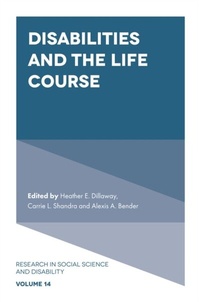
Disabilities and the Life Course
1st Edition
Published on 31. July 2023
232 pages
978-1-80455-201-8 (ISBN)
Description

Life course analysis recognizes that, depending on the exact life stage, different factors and contexts can become important in shaping identity and experience, as well as the ability to accomplish and respond to certain life transitions and events.
Prioritizing individuals' lived experiences, Disabilities and the Life Course broadens the application of life course perspective to explore how impairments and disabilities factor across life span and impact assorted life stages. Conceptual, methodological, and empirical, chapters consider how individuals might think about, maneuver, and encounter impairments, or 'become disabled,' in a variety of ways depending on time, place, and life contexts. Contributors highlight commonalities and differences in identity and experience with special attention to intersecting social locations and the diversity of impairments and disabilities.
Featuring a framework rarely applied in the field of disability studies, Disabilities and the Life Course explores not only a range of disabilities and impairments but also a diverse array of life course experiences, deepening knowledge across both fields for the widest possible impact.
The Research in Social Science and Disability series is essential reading for researchers and students across the social sciences interested in disability, social movements, activism, and identity.
Prioritizing individuals' lived experiences, Disabilities and the Life Course broadens the application of life course perspective to explore how impairments and disabilities factor across life span and impact assorted life stages. Conceptual, methodological, and empirical, chapters consider how individuals might think about, maneuver, and encounter impairments, or 'become disabled,' in a variety of ways depending on time, place, and life contexts. Contributors highlight commonalities and differences in identity and experience with special attention to intersecting social locations and the diversity of impairments and disabilities.
Featuring a framework rarely applied in the field of disability studies, Disabilities and the Life Course explores not only a range of disabilities and impairments but also a diverse array of life course experiences, deepening knowledge across both fields for the widest possible impact.
The Research in Social Science and Disability series is essential reading for researchers and students across the social sciences interested in disability, social movements, activism, and identity.
More details
Series
Language
English
Place of publication
Bingley
United Kingdom
Target group
Professional and scholarly
ISBN-13
978-1-80455-201-8 (9781804552018)
Copyright in bibliographic data and cover images is held by Nielsen Book Services Limited or by the publishers or by their respective licensors: all rights reserved.
Schweitzer Classification
Other editions
Additional editions
Heather E. Dillaway | Carrie L. Shandra | Alexis A. Bender
Disabilities and the Life Course
Book
07/2023
Emerald Publishing Limited
€146.20
Shipment within 3-4 weeks
Persons
Heather E. Dillaway is Professor of Sociology at Illinois State University, Illinois, USA.
Carrie L. Shandra is Associate Professor in the Department of Sociology at Stony Brook University, New York, USA.
Alexis A. Bender is Assistant Professor in the Department of Medicine at Emory University, Georgia, USA.
Carrie L. Shandra is Associate Professor in the Department of Sociology at Stony Brook University, New York, USA.
Alexis A. Bender is Assistant Professor in the Department of Medicine at Emory University, Georgia, USA.
Content
Introduction: Disabilities And The Life Course; Heather E. Dillaway, Carrie L.Shandra, Kiera Chan, And Alexis A. Bender
Chapter 1. Integrating the Social and Political Dimensions of Disability Into Life Course Theory; Kenzie Latham-Mintus And Scott D. Landes
Chapter 2. Multiple Sclerosis Diagnosis Pathways: An Intersectional Feminist Disability Life Course Perspective; Louise C. Palmer
Chapter 3. Disability, Gender, or Something Else? Identity-Based Interpretations of Inequalities Over the Life Course In France; Celia Bouchet And Mathea Boudinet
Chapter 4. Young-Adulthood Development in the Lived Experience of Persons With Kidney Failure: Challenges of Youth, Disability, And Transition; Nancy G. Kutner And Tess Bowles
Chapter 5. Doing Gender, Doing Disability: How Disabled Young Adults Approach Gender in Response to Ableism; Hillary Steinberg
Chapter 6. The Reception of Disability Policy in France: A Qualitative Life Course Perspective on Policy Impact; Anne Revillard
Chapter 7. College Completion Among Young Adults with a Disabled Sibling; Anna Penner
Chapter 8. Negotiating the Spousal Caregiving Relationship Following Spinal Cord Injury; Alexis A. Bender
Chapter 9. Disability and Precarious Work Over the Life Course: An Application of Key Concepts; Robyn Lewis Brown
Chapter 10. The Disability Gap in Time Use by Age Across the Life Course; Carrie L. Shandra And Fiona Burke
Chapter 1. Integrating the Social and Political Dimensions of Disability Into Life Course Theory; Kenzie Latham-Mintus And Scott D. Landes
Chapter 2. Multiple Sclerosis Diagnosis Pathways: An Intersectional Feminist Disability Life Course Perspective; Louise C. Palmer
Chapter 3. Disability, Gender, or Something Else? Identity-Based Interpretations of Inequalities Over the Life Course In France; Celia Bouchet And Mathea Boudinet
Chapter 4. Young-Adulthood Development in the Lived Experience of Persons With Kidney Failure: Challenges of Youth, Disability, And Transition; Nancy G. Kutner And Tess Bowles
Chapter 5. Doing Gender, Doing Disability: How Disabled Young Adults Approach Gender in Response to Ableism; Hillary Steinberg
Chapter 6. The Reception of Disability Policy in France: A Qualitative Life Course Perspective on Policy Impact; Anne Revillard
Chapter 7. College Completion Among Young Adults with a Disabled Sibling; Anna Penner
Chapter 8. Negotiating the Spousal Caregiving Relationship Following Spinal Cord Injury; Alexis A. Bender
Chapter 9. Disability and Precarious Work Over the Life Course: An Application of Key Concepts; Robyn Lewis Brown
Chapter 10. The Disability Gap in Time Use by Age Across the Life Course; Carrie L. Shandra And Fiona Burke
