

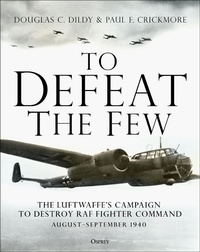
To Defeat the Few
The Luftwaffe's Campaign to Destroy RAF Fighter Command, August-September 1940
1st Edition
Published on 9. July 2020
384 pages
978-1-4728-3915-2 (ISBN)
Description

This history, based on an exhaustive study of German records, explores The Battle of Britain through the eyes of the Luftwaffe.
Over the past 80 years, histories of the Battle of Britain have consistently portrayed the feats of 'The Few' (as they were immortalized in Churchill's famous speech) as being responsible for the RAF's victory in the epic battle. However, this is only part of the story.
The results of an air campaign cannot be measured in terms of territory captured, cities occupied or armies defeated, routed or annihilated. Successful air campaigns are those that achieve their intended aims or stated objectives. Victory in the Battle of Britain was determined by whether the Luftwaffe achieved its objectives.
The Luftwaffe, of course, did not, and this detailed and rigorous study explains why. Analysing the battle in its entirety in the context of what it was - history's first independent offensive counter-air campaign against the world's first integrated air defence system - Douglas C. Dildy and Paul F. Crickmore set out to re-examine this remarkable conflict.
Presenting the events of the Battle of Britain in the context of the Luftwaffe's campaign and RAF Fighter Command's battles against it, this title is a new and innovative history of the battle that kept alive the Allies' chances of defeating Nazi Germany.
Over the past 80 years, histories of the Battle of Britain have consistently portrayed the feats of 'The Few' (as they were immortalized in Churchill's famous speech) as being responsible for the RAF's victory in the epic battle. However, this is only part of the story.
The results of an air campaign cannot be measured in terms of territory captured, cities occupied or armies defeated, routed or annihilated. Successful air campaigns are those that achieve their intended aims or stated objectives. Victory in the Battle of Britain was determined by whether the Luftwaffe achieved its objectives.
The Luftwaffe, of course, did not, and this detailed and rigorous study explains why. Analysing the battle in its entirety in the context of what it was - history's first independent offensive counter-air campaign against the world's first integrated air defence system - Douglas C. Dildy and Paul F. Crickmore set out to re-examine this remarkable conflict.
Presenting the events of the Battle of Britain in the context of the Luftwaffe's campaign and RAF Fighter Command's battles against it, this title is a new and innovative history of the battle that kept alive the Allies' chances of defeating Nazi Germany.
More details
Edition
1. Auflage
Language
English
Place of publication
London
United Kingdom
Publishing group
Bloomsbury Publishing PLC
Illustrations
300 colour and mono images, 8 maps and 5 graphics
ISBN-13
978-1-4728-3915-2 (9781472839152)
Copyright in bibliographic data and cover images is held by Nielsen Book Services Limited or by the publishers or by their respective licensors: all rights reserved.
Schweitzer Classification
Other editions
Additional editions
Douglas C. Dildy | Paul F. Crickmore
To Defeat the Few
The Luftwaffe's campaign to destroy RAF Fighter Command, August-September 1940
Book
07/2020
Osprey Publishing
€37.50
Shipment within 3-4 weeks
Persons
Douglas C. Dildy is a retired US Air Force colonel who spent nine years of his 26-year career in Western Europe. He is also a USAF Academy graduate with a degree in history. He attended the US Armed Forces Staff College and USAF Air War College and holds a Master's Degree in Political Science. Doug has authored several campaign studies and is a regular contributor to the amateur modelling magazine Small Air Forces Observer.
Paul F. Crickmore is the author of the much-acclaimed Lockheed Blackbird: Beyond the Secret Missions. He was commissioned to write his first book for Osprey 35 years ago and that since then he has written 20 books, including 12 for Osprey. He is also an honorary member of several A-12 and SR-71 veterans' associations.
Paul F. Crickmore is the author of the much-acclaimed Lockheed Blackbird: Beyond the Secret Missions. He was commissioned to write his first book for Osprey 35 years ago and that since then he has written 20 books, including 12 for Osprey. He is also an honorary member of several A-12 and SR-71 veterans' associations.
Content
Foreword by Paul E. Eden
Prologue
1. Westfeldzug: Why the Battle of Britain occurred
2. Fall Gelb: Prologue to the Battle of Britain
3. Dunkirk: Triumph without victory
4. 'Was nun?': Hitler's strategic options, July 1940
5. The Luftwaffe's Capabilities: Germany's only real means to defeat Great Britain
6. The Luftwaffe's Opponent: RAF Fighter Command
7. Kanalkampf (Channel Battle): The Luftwaffe's maritime air campaign
8. Seelöwe (Sea Lion): Hitler's plan to invade Britain
9. Adlerangriff Stage 1: 12-16 August 1940
10. Adlerangriff Stage 2: 17-19 August 1940
11. Adlerangriff Stage 3: 24 August to 6 September 1940
12. Adlerangriff Stage 4: 7-17 September 1940
13. Defeat Dies Slowly: 17 September through 31 October 1940
14. Analysis: Assessing the Battle of Britain from the Luftwaffe's perspective
Appendices
Glossary
Bibliography
Endnotes
Index
Prologue
1. Westfeldzug: Why the Battle of Britain occurred
2. Fall Gelb: Prologue to the Battle of Britain
3. Dunkirk: Triumph without victory
4. 'Was nun?': Hitler's strategic options, July 1940
5. The Luftwaffe's Capabilities: Germany's only real means to defeat Great Britain
6. The Luftwaffe's Opponent: RAF Fighter Command
7. Kanalkampf (Channel Battle): The Luftwaffe's maritime air campaign
8. Seelöwe (Sea Lion): Hitler's plan to invade Britain
9. Adlerangriff Stage 1: 12-16 August 1940
10. Adlerangriff Stage 2: 17-19 August 1940
11. Adlerangriff Stage 3: 24 August to 6 September 1940
12. Adlerangriff Stage 4: 7-17 September 1940
13. Defeat Dies Slowly: 17 September through 31 October 1940
14. Analysis: Assessing the Battle of Britain from the Luftwaffe's perspective
Appendices
Glossary
Bibliography
Endnotes
Index
