

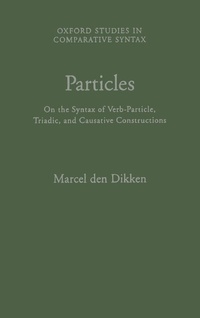
Particles
On the Syntax of Verb-Particle, Triadic, and Causative Constructions
1st Edition
Published in December 1995
301 pages
978-0-19-535800-1 (ISBN)
Description

Particles are words that do not change their form through inflection and do not fit easily into the established system of parts of speech. Examples include the negative particle "not," the infinitival particle "to" (as in "to go"), and do and let in "do tell me" and "let's go." Particles investigates the constraints on the distribution and placement of verbal particles. A proper understanding of these constraints yields insight into the structure of various secondary predicative constructions. Starting out from a detailed analysis of complex particle constructions, den Dikken brings forth accounts of triadic constructions and Dative Shift, and the relationship between dative and transitive causative constructions--all of them built on the basic structural template proposed from complex particle constructions. Drawing on data from Norwegian, English, Dutch, German, West Flemish, and other languages, this book will interest a wide audience of students and specialists.
More details
Language
English
Place of publication
Oxford
United Kingdom
Target group
Academic/professional/technical: Research and professional
Illustrations
10 line illus.
File size
19,25 MB
ISBN-13
978-0-19-535800-1 (9780195358001)
Copyright in bibliographic data and cover images is held by Nielsen Book Services Limited or by the publishers or by their respective licensors: all rights reserved.
Schweitzer Classification
Other editions
Additional editions
Book
08/1995
Oxford University Press Inc
€246.20
Shipment within 15-20 days
Book
08/1995
Oxford University Press Inc
€156.20
Shipment within 15-20 days
Content
- Intro
- Contents
- Preface
- 1 Preliminaries
- 1.1 Introduction
- 1.2 Some theoretical assumptions
- 1.2.1 A modular theory
- 1.2.2 A conjunctive ECP
- 1.2.3 NP-traces and the ECP
- 1.2.4 Incorporation and the ECP
- 1.2.5 Incorporation, indexation and c-command
- 1.2.6 Uniformity of Theta Assignment
- 1.2.7 Modularity and syntactic word formation
- 1.2.8 Small clauses and subject-predicate relationships
- 1.2.9 Small clauses and abstract syntactic structure
- 1.3 Particles
- 1.4 Preview
- 2 The structure of particle constructions
- 2.1 Introduction
- 2.2 Complex particle constructions: Preliminaries
- 2.2.1 The clause-final constituent as a SC predicate
- 2.2.2 The particle as a SC head
- 2.2.3 Conclusion
- 2.3 The structure of English complex particle constructions
- 2.3.1 Introduction: The theoretical options
- 2.3.2 On Kayne's (1985) analysis of complex particle constructions
- 2.3.3 The alternative
- 2.3.4 Another possibility?
- 2.3.5 An inventory of complex particle constructions
- 2.3.6 On the non-lexical status of particles
- 2.4 Simplex particle constructions
- 2.4.1 Word-order alternation: The theoretical options
- 2.4.2 Against extraposition
- 2.4.3 On the locus of particle incorporation
- 2.4.4 On the ergativity of particles
- 2.4.5 On pronouns and word order
- 2.4.6 Particle modification
- 2.5 Conclusion
- 3 Particles and the dative alternation
- 3.1 Introduction
- 3.2 Why Larson's analysis of Dative Shift fails: Evidence from triadic verb-particle constructions
- 3.3 The predicativity of the dative PP
- 3.4 Particle modification and Dative Shift
- 3.5 Particle reanalysis: A correlation
- 3.6 Why obligatory reanalysis?
- 3.7 An empty verb in triadic constructions
- 3.8 Decomposition of main verb have
- 3.9 The structure of triadic constructions and the analysis of Dative Shift
- 3.10 The motivation for movement
- 3.10.1 Case Theory
- 3.10.2 Licensing the empty preposition
- 3.11 Triadic constructions lacking a lexical particle
- 3.11.1 An empty verb and an empty particle
- 3.11.2 Word order in Dutch dative constructions
- 3.11.3 Word order in Chinese dative constructions
- 3.11.4 Interim conclusion and road map
- 3.12 Transformational Dative Shift and distribution
- 3.12.1 The role played by the (empty) preposition
- 3.12.2 Idioms and affectedness
- 3.13 Transformational Dative Shift and incorporation
- 3.13.1 Chinese Dative Shift
- 3.13.2 Triadic serial verbs and V-V compounds
- 3.13.3 Conclusion
- 3.14 The with construction
- 3.15 Particles revisited
- 3.15.1 On the cross-linguistic distribution of double object particle constructions
- 3.15.2 Particles in unexpected positions
- 3.15.3 On dative PPs with prepositional subjects
- 3.16 Conclusion
- 4 Movement and structural ambiguity in double object constructions
- 4.1 Introduction
- 4.2 A'-extraction of the double object Goal: Evidence for an empty preposition
- 4.2.1 Restrictions on Goal movement: Introduction to the problem
- 4.2.2 Overt versus empty operator movement
- 4.2.3 Analysis
- 4.2.4 English topicalisation and relativisation
- 4.2.5 English long wh-extraction
- 4.2.6 English short wh-extraction
- 4.2.7 Heavy NP Shift
- 4.2.8 Summary
- 4.3 A'-extraction of the double object Theme: Structural ambiguity in double object constructions
- 4.3.1 The problem
- 4.3.2 Dative Shift and Theme extraction
- 4.3.3 Preliminaries: Structural ambiguity
- 4.3.4 Theme extraction: Analysis
- 4.3.5 Conclusion
- 4.4 Raising-to-subject and the double object Theme
- 4.5 Interactions of A'-movement and passivisation
- 4.5.1 A'-extraction of the English double object Theme
- 4.5.2 A'-extraction of the Kichaga double object Goal
- 4.5.3 Summary
- 4.6 German has no Dative Shift
- 4.6.1 Binding asymmetries
- 4.6.2 The binding facts of German
- 4.6.3 Analysis
- 4.6.4 Summary
- 4.7 Conclusion
- 5 Affixal particles in applicatives and causatives
- 5.1 Introduction
- 5.2 Homophony of applicative and causative affixes
- 5.2.1 The problem from a Dutch perspective
- 5.2.2 The problem from a Sanuma perspective
- 5.2.3 The problem from an Indonesian perspective
- 5.2.4 Synthesis
- 5.2.5 Interlude: Affixal particles in French
- 5.2.6 Two central questions for the analysis of causative constructions
- 5.3 The structure of transitive causatives
- 5.3.1 Two correlations between datives and causatives
- 5.3.2 Structural assimilation
- 5.3.3 The structure
- 5.3.4 Decomposition of triadic verbs
- 5.3.5 Causatives, possession and affectedness
- 5.3.6 Ergativisation
- 5.3.7 Embedding under the causativised verb
- 5.3.8 Transitive and intransitive causatives
- 5.3.9 Alternative analyses
- 5.4 Conclusion
- 6 Conclusions
- References
