

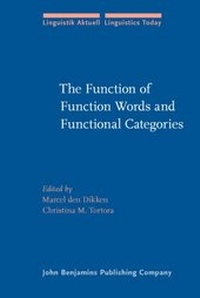
The Function of Function Words and Functional Categories
1st Edition
Published on 25. August 2005
VII, 292 pages
978-90-272-9433-3 (ISBN)
Description

This volume brings together papers which address a range of issues regarding the syntax of function words and functional categories in the Germanic languages. The works offered in this volume derive specifically from comparative studies of Germanic; at the same time they all bear directly on long-standing problems in syntactic theory and universal grammar. The contributions include novel theoretical and empirical approaches to infinitives, the syntax and acquisition of Verb Second, the structure and interpretation of present tense, the syntax and semantics of reflexives, the relationship between expletive syntax and the EPP, the syntax of possession, and the DP-internal syntax of pronouns. Some contributions present the results of experimental research which provide an entirely fresh perspective on previously unchallenged claims.
More details
Other editions
Additional editions
Marcel den Dikken | Christina Tortora
The Function of Function Words and Functional Categories
Book
08/2005
John Benjamins Publishing Co
€127.20
Shipment within 10-15 days
Persons
Content
- The Function of FunctionWords and Functional Categories
- Editorial page
- Title page
- LCC data
- Table of contents
- Acknowledgements
- The function of function words and functional categories
- References
- Verb second as a function of Merge*
- 1. Introduction
- 2. General V2 properties
- 3. Problems associated with V2
- 3.1. V2 asymmetries
- 3.2. Nonstandard V2 phenomena
- 3.3. V2 deviations18
- 4. The relation of V2 to morphology
- 5. A note on OT approaches to V2
- 6. Conclusion
- Notes
- References
- Nonnative acquisition of verb second
- 1. Introduction
- 2. The V2 requirement in German and Swedish
- 3. Exceptions to V2
- 3.1. Clause-initial connective elements
- 3.2. Clause-initial sen (`then') with optional V3
- 3.3. Pauseless left dislocations
- 3.4. V3 with certain adverbs
- 4. L2 acquisition of German(ic) verb placement: Common notions
- 5. Existing studies of V2 in L1 Swedish learners of L2 German
- 6. New empirical studies
- 6.1. The intermediate learners
- 6.2. The ab initio learners and the English puzzle
- 7. Conclusion
- Notes
- References
- Clause union and clausal position
- 1. Introduction
- 2. Infinitival complementation in language processing
- 2.1. Extraposition and intraposition: A corpus study
- 2.2. Coherent and non-coherent constructions: A questionnaire study
- 2.3. Scope of negation: A reading time experiment
- 2.4. Summary of empirical investigations
- 3. Syntactic and comparative investigations
- 3.1. The distribution of daß-CPs in German
- 3.2. Distribution of infinitives in German and adjacency
- 3.3. An answer from Bangla
- 3.4. Status checking
- 3.5. Status checking and agreement
- 4. Conclusions
- Appendix: Re-positioned zu
- Acknowledgements
- Notes
- References
- Explaining Expl
- 0. Introduction
- Part I. Merge-Expl
- 1. An unexpected asymmetry
- 2. Why TP-Expl is inadequate
- 3. Raising a solution
- Part II. Move-Expl
- 4. Empirical support: EPP-satisfaction in Germanic
- 4.1. Introduction: Problematic data and previous accounts
- 4.2. A new proposal
- 5. Diachronic support: The emergence of Expl in the history of Germanic
- 5.1. The diachrony of Expl in German and Icelandic
- 5.2. The diachrony of Expl in Dutch and Afrikaans
- 5.3. The diachrony of Expl in MSc and English
- 5.4. Summary of the diachronic facts
- 6. Synchronic optionality: Evidence from Dutch and Afrikaans
- 7. Concluding remarks
- Notes
- References
- Reflexives in contexts of reduced valency: German vs. Dutch
- 1. Introduction
- 2. Reflexive paradigms
- 2.1. Sich selbst is not zichzelf, and sich is not zich
- 2.2. The organization of reflexive paradigms
- 3. German sich
- 3.1. Anticausatives
- 3.2. Inherent reflexives
- 4. Dutch zich
- 4.1. Everaert's (1986) terminatives
- 4.2. Everaert's (1986) inchoatives
- 4.3. Everaert's (1986) psych-movement verbs
- 4.4. Inherent reflexives
- 4.5. On a generalized notion of `inherent reflexivity'
- 5. Afrikaans and Frisian
- 6. Conclusion
- Notes
- References
- Simple tense
- 1. Introduction
- 2. Background
- 3. The Simple Present with non-stative events
- 4. The Simple Present: States
- 5. Generic sentences as ILP
- 6. Conclusion
- Notes
- References
- Possessor licensing, definiteness and case in Scandinavian
- 1. DP-internal possessors in Scandinavian
- 2. Postnominal possessors
- 3. The syntactic structure of DPs with postnominal possessors
- 4. Pronominal postnominal possessors
- 5. Nonpronominal possessors
- 6. Prenominal possessors
- 6.1. Prenominal nonpronominal possessors
- 6.2. Prenominal possessors trigger definiteness
- 6.3. Prenominal possessors are in Spec-DP
- 6.4. The absence of the suffixed definiteness marker
- 6.5. Prenominal possessors and case
- 6.6. An argument from Solør Norwegian
- 7. The definiteness of possessed DPs
- 8. Summary
- Notes
- References
- Pronouns are determiners after all
- 1. Introduction
- 2. Pronominal DPs must have a determiner
- 2.1. Adjectival morphology
- 2.2. Idiot-noun phrases require a determiner
- 3. Pronominal DPs involving proper names
- 3.1. Pronouns as determiners for proper names
- 3.2. Proper names as predicates
- 4. Cardinaletti (1994) and some consequences
- 5. Discussion
- 6. Conclusion
- Appendix: Singular pronominal DPs
- Notes
- References
- Index
- The series Linguistik Aktuell/Linguistics Today
