

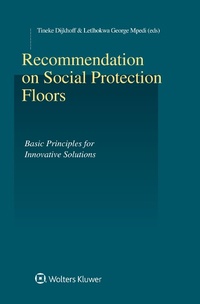
Recommendation on Social Protection Floors
Basic Principles for Innovative Solutions
Published on 24. April 2016
344 pages
978-90-411-8633-1 (ISBN)
Description

Despite the international community's recognition of social protection as a human right, the vast majority of the world's population still has no access to social protection. In a major effort to address this situation, the International Labour Conference unanimously adopted the Social Protection Floors Recommendation 202 of 2012. However, because of the wide variety of possible schemes (and techniques that can be employed to administer them), there is a genuine risk that important values relating to social protection will be overlooked in implementing the Recommendation. This collection of expert essays contains an in-depth clarification and analysis of the Recommendation and sets forth a clear and practicable set of principles that can be used both as a policy tool and as an assessment framework for the creation, maintenance, and supervision of a national social protection floor.
This book pays detailed attention to each of the Recommendation's key principles, including the following:
- - state responsibility;
- - universality of protection;
- - entitlement based in law;
- - adequacy and predictability of benefits;
- - non-discrimination;
- - financial solidarity;
- - good governance;
- - coherence of policies; and
- - social participation.
A special feature of the book is its inclusion of case studies that display innovative social protection schemes focusing on children and families, persons of working age (particularly informal sector workers), and elderly persons. A concluding section offers useful insights on measures that can be taken and lessons learned.
As a deeply informed and practical guide to ways in which states can (and do) establish and maintain a social protection floor as a fundamental element of their national social protection systems, this book has no peers. It will be warmly welcomed by jurists concerned with social protection throughout the world, by pertinent government agencies at all levels, by non-governmental organizations, and by academics in the field.
This book pays detailed attention to each of the Recommendation's key principles, including the following:
- - state responsibility;
- - universality of protection;
- - entitlement based in law;
- - adequacy and predictability of benefits;
- - non-discrimination;
- - financial solidarity;
- - good governance;
- - coherence of policies; and
- - social participation.
A special feature of the book is its inclusion of case studies that display innovative social protection schemes focusing on children and families, persons of working age (particularly informal sector workers), and elderly persons. A concluding section offers useful insights on measures that can be taken and lessons learned.
As a deeply informed and practical guide to ways in which states can (and do) establish and maintain a social protection floor as a fundamental element of their national social protection systems, this book has no peers. It will be warmly welcomed by jurists concerned with social protection throughout the world, by pertinent government agencies at all levels, by non-governmental organizations, and by academics in the field.
More details
Other editions
Additional editions
Tineke Dijkhoff | George Letlhokwa Mpedi
Recommendation on Social Protection Floors
Basic Principles for Innovative Solutions
Book
11/2017
Kluwer Law International
€188.84
Shipment within 10-20 days
Content
- Intro
- Editors
- Contributors
- Preface
- List of Abbreviations and Acronyms
- PART IIntroduction to the Social Protection Floors: Basic Principles and Broader Context
- CHAPTER 1Recommendation on Social Protection Floors and Basic Principles for Innovative Solutions: G
- CHAPTER 2Principles for National Social Protection Floors
- CHAPTER 3Implementing the Principles of Social Protection Floors Recommendation, 2012 (No. 202)
- CHAPTER 4Social Protection Floors and the Right to Food
- PART IIImplementation of the Basic Principles: Case Studies
- CHAPTER 5The Child Support Grant in the Republic of South Africa
- CHAPTER 6Conditional Cash Transfers for Families and Children under Mexico's PROSPERA Programme
- CHAPTER 7Argentina: From an Emblematic Case to Its Institutionalization - An Analysis of the Univers
- CHAPTER 8Tunisian National Programme for Assistance to Families in Need
- CHAPTER 9Chile Solidario CCT Programme: New Logic Behind Chilean Social Protection Programmes
- CHAPTER 10Does Employment Guarantee Support a Social Protection Floor?: A Case Study of Mahatma Gand
- CHAPTER 11Namibia National Pension Scheme
- CHAPTER 12Old-Age Allowance Scheme in Thailand
- PART IIIConclusions
- CHAPTER 13A Framework of Principles as a Policy and Assessment Tool: Conclusions
- Appendix
- 1.1 The Road Towards National Social Protection Floors: A General Overview
- 1.1.1 The Global Protection Gap and the Birth of Recommendation
- 1.1.2 The Broader Perspective of the Joint United Nations Social Protection Floor Initiative
- 1.2 A Set of Principles As Policy Tool and Assessment Framework
- 1.3 Objectives, Methods and Design of the Book
- 1.3.1 Objectives
- 1.3.2 Methods and Choices
- 1.3.3 Structure of the Book
- Bibliography
- 2.1 Introduction
- 2.2 Recommendation 202: An Overview
- 2.2.1 Preamble
- 2.2.2 Part I: Objectives, Scope, and Principles
- 2.2.3 Part II: National Social Protection Floors
- 2.2.4 Part III: National Strategies for the Extension of Social Security
- 2.2.5 Part IV: Monitoring
- 2.3 Preliminary Observations
- 2.3.1 The National Floor: Social Protection or Social Security?
- 2.3.2 Binding Force Versus Political Support
- 2.4 Classifying and Clarifying the Principles
- 2.4.1 Selection of 'Umbrella Principles'
- 2.4.2 State Responsibility
- 2.4.3 Universality of Protection
- 2.4.4 Entitlements Based on Law
- 2.4.5 Adequacy and Predictability of Benefits
- 2.4.6 Non-discrimination
- 2.4.7 Financial Solidarity
- 2.4.8 Good Governance
- 2.4.9 Coherence of Policies
