

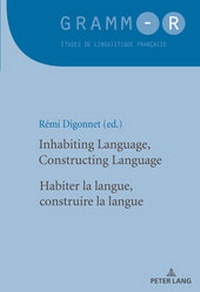
Inhabiting Language, Constructing Language / Habiter la langue, construire la langue
Description

The juxtaposition of habitat, a product of architecture, and speech, a product of language, enables us to envisage a dual orientation for what could be called "architexture". The architectural text focuses on the analysis of architects' discourse, architectural metaphors or spatial markers and prepositions. Textual architecture, meanwhile, explores composition, syntactic ordering, text structure or "construction" grammars. Through verbalisation or spatialization, through verbal or architectural communication, the speaker and the architect are subjected to numerous constraints despite a certain freedom of speech and freedom of construction. Both this constructed speech and this spoken construction summon the architect-speaker to his or her language domus. It is this dual position that the articles in this collection aim to occupy.
La mise en regard de l'habitat, produit de l'architecture, et du discours, produit de la langue, permet d'envisager une double orientation de ce que l'on pourrait nommer l'« architexture ». Le texte de l'architecture traite de l'analyse de discours d'architectes, de métaphores architecturales ou de marqueurs spatiaux et prépositions spatiales, tandis que l'architecture du texte investit la composition, l'agencement syntaxique, la structure d'un texte ou encore les grammaires dites « de construction ». D'une mise en discours ou en espace, à travers une communication verbale ou architecturale, l'énonciateur et l'architecte sont soumis à de nombreuses contraintes en dépit d'une liberté de parole et de construction. Cette parole construite autant que cette construction parlée convoquent l'énonciateur-architecte dans sa domus langagière. C'est cette double posture qui fait l'objet des contributions de cet ouvrage collectif.
More details
Other editions
Additional editions
Person
Rémi Digonnet est maître de conférences en linguistique anglaise à l'université de Saint-Étienne. Ses recherches centrées sur l'analyse du discours et les divers procédés lexicogéniques concernent le domaine sensoriel. Il est l'auteur de Métaphore et olfaction : une approche cognitive, paru en 2016.
Rémi Digonnet is a lecturer in English linguistics at the University of Saint-Étienne. His research centred on discourse analysis and the emergence of various linguistic processes focuses on the sensory domain (Métaphore et olfaction : une approche cognitive, 2016).
