

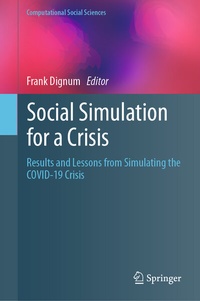
Social Simulation for a Crisis
Description

More details
Other editions
Additional editions
Person
Dignum received his PhD in 1989 from the VU University Amsterdam. He started his academic career as assistant professor and chair of the department of Computer Science at the University of Swaziland in 1990. In 1992 he moved back to Portugal and became assistant professor at the Instituto Superior Técnico in Lisbon. After coming back in the Netherlands in 1993 as assistant professor at Eindhoven University of Technology, in 2000 he was appointed Associate professor at the Department of Information and Computing Sciences of the Utrecht University.
Content
Part 1. ASOCC Theory and Platform.- Chapter 1. Introduction.- Chapter 2. Foundations.- Chapter 3. From Theories to Implementation.- Chapter 4. Simulation Use.- Part II. Scenario's and Submodels.- Chapter 5. Closing of Schools.- Chapter 6. Testing & Smart Testing.- Chapter 7. Deployment and Effects of an App for Tracking and Tracing Contacts.- Chapter 8. How Culture Influences the Management of a Pandemic: Simulating the Effect of Culture on the Effective Management of the COVID-19 crisis,- Chapter 9. Economics.- Chapter 10. Exit Strategies.- Part III. Results and Lessons Learned.- Chapter 11. Extensible Model-Building in Crises.- Chapter 12. Comparative Validation of Simulation Models for the COVID-19 Pandemic.- Chapter 13. Supporting Policy Makers in a Crisis.- Chapter 14. From Crisis to Resilience Support.- Chapter 15. Challenges and Issues.- Chapter 16. Conclusions.
