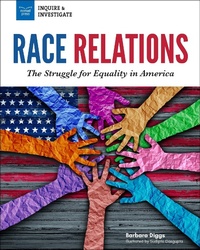
Race Relations
Description

How could a country founded on the honorable ideals of freedom and equality have so willingly embraced the evils of enslavement and oppression?
America's history of race relations is a difficult one, full of uncomfortable inconsistencies and unpleasant truths. Although the topic is sensitive, it is important to face this painful past unflinchingly-knowing this history is key to understanding today's racial climate and working towards a more harmonious society.
InRace Relations: The Struggle for Equality in America, kids ages 12 to 15 follow the evolution of race relations in America from the country's earliest beginnings until present day. The book examines how the concept of race was constructed in the seventeenth century and how American colonists used racial differences to justify slavery, discrimination and the persecution of people of color. Through links to online primary sources such as newspaper articles, letters, poems, and songs, young readers will explore how race relations changed-and didn't-through the eras of Reconstruction, Jim Crow, and Civil Rights, and under the presidencies of Barack Obama and Donald Trump.
The book introduces students to people from four different centuries-some famous, some ordinary citizens-who took great risks to fight for freedom, equality, and social justice. It also fosters discussions of contemporary racial issues and social justice movements, including Black Lives Matters, and encourages students to consider steps they can take to help improve race relations.
Race Relations: The Struggle for Equality in America teaches students about American race relations in a fact-based way that promotes empathy and understanding. Projects such as identifying the influences that contributed to the reader's own view of other races, writing journal entries from the perspective of student of color at a newly-integrated school in the 1960s, and investigating implicit racial bias in newspaper photographs or news articles helps students to think critically and creatively about their own position and role in society and gain a broader understanding of the world they live in. Interesting facts, links to online primary sources and other supplemental material, and essential questions take readers on an exploration of the past, present, and future of race relations.
Race Relations is part of a set of four books called Inquire & Investigate Social Issues of the Twenty-First Century, which explores the social challenges that have faced our world in the past and that continue to drive us to do better in the future. Other titles in this set areGender Identity,Feminism, andImmigration Nation.
Nomad Press books integrate content with participation, encouraging readers to engage in student-directed learning as opposed to teacher-guided instruction. This student-centered approach provides readers with the tools they need to become inquiry-based learners. Common Core State Standards and National Curriculum Standards for Social Studies all place project-based learning as key building blocks in education. Combining content with inquiry-based projects stimulates learning and makes it active and alive. As informational texts, our books provide key ideas and details from which readers can make their own inferences. Nomad's unique approach simultaneously grounds kids in factual knowledge while allowing them the space to be curious, creative, and critical thinkers.
More details
Other editions
Additional editions