

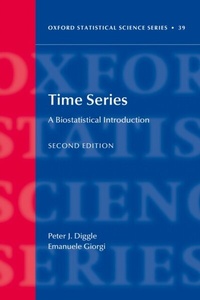
Time Series: A Biostatistical Introduction
A Biostatistical Introduction
2nd Edition
Published on 25. February 2025
304 pages
978-0-19-102420-7 (ISBN)
Description

Time series analysis is one of several branches of statistics whose practical importance has increased with the availability of powerful computational tools. Methodology that was originally developed for specialized applications, for example in finance or geophysics, is now widely available within general statistical packages.
The second edition of Time Series: A Biostatistical Introduction is an introductory account of time series analysis, written from the perspective of applied statisticians whose interests lie primarily in the biomedical and health sciences. This edition has a stronger focus on substantive applications, in which each statistical analysis is directed at a specific research question. Separate chapters cover simple descriptive methods of analysis, including time-plots, smoothing, the correlogram and the periodogram; theory of stationary random processes; discrete-time models for single series; continuous-time models for single series; generalized linear models for time series of counts; models for replicated series; spectral analysis, and bivariate time series.
The book is unique in its focus on biomedical and health science applications, which has been strengthened in this second edition. Nevertheless, the methods described are more widely applicable. It should be useful to teachers and students on masters-level degree courses in statistics, biostatistics and epidemiology, and to biomedical and health scientists with a knowledge of statistical methods at undergraduate level. Throughout, examples based on real datasets show a close interplay between statistical method and substantive science. This book will also describe the implementation of the methods in the R computing environment and provide access to R code and datasets.
More details
Persons
Peter Diggle is a Distinguished University Professor Emeritus in the Faculty of Health and Medicine, Lancaster University. He holds Adjunct positions at Johns Hopkins and Yale Universities, and was president of the Royal Statistical Society from July 2014 to December 2016. His publications include 12 books and more than 300 articles on the development and application of statistical methods for spatial and longitudinal data analysis. Awards for his research in these areas include the Royal Statistical Society Guy Medal in Silver (1997), and the Dean's Medal, Johns Hopkins University School of Public Health (2023).
Dr. Emanuele Giorgi, a Lancaster University Ph.D. graduate in Statistics and Epidemiology (2015), is an Associate Professor in Biostatistics at the Lancaster Medical School. While leading the Centre for Health Informatics, Computing, and Statistics (CHICAS), he specializes in the development of spatial and spatio-temporal statistical methods and their application to tropical diseases epidemiology.
Content
- Cover
- Title Page
- Copyright Page
- Preface
- Preface to the first edition
- Contents
- 1 Introduction
- 1.1 Examples
- 1.2 Separating deterministic and stochastic components of variation
- 1.3 Objectives of time-series analysis
- 1.4 Notation
- 1.5 Trend, serial dependence, and stationarity
- 1.6 Duality between trend and serial dependence
- 1.7 Software
- 2 Simple descriptive methods of analysis
- 2.1 Time plots
- 2.2 Smoothing
- 2.2.1 Moving averages
- 2.2.2 Kernel smoothing
- 2.2.3 Polynomial regression
- 2.2.4 Regression splines
- 2.2.5 Smoothing splines
- 2.2.6 Splines, kernels, and moving averages
- 2.2.7 Non-linear smoothers
- 2.2.8 Additive models
- 2.2.9 Summary
- 2.3 Differencing
- 2.4 The autocovariance and autocorrelation functions
- 2.5 Estimating the autocovariance and autocorrelation functions
- 2.5.1 Equally spaced series: the correlogram
- 2.5.2 Unequally spaced series: the variogram
- 2.6 Impact of trend removal on autocorrelation structure
- 2.7 The periodogram
- 2.8 The connection between the correlogram and the periodogram
- 2.9 Exercises
- 3 Theory of stationary processes
- 3.1 Notation and definitions
- 3.2 The spectrum of a stationary process
- 3.3 Linear filters
- 3.4 Autoregressive moving average processes
- 3.4.1 The backward shift operator: a convenient notational shorthand
- 3.4.2 Second-order properties of the moving average process
- 3.4.3 Second-order properties of the autoregressive process: AR(p)
- 3.4.4 Second-order properties of the autoregressive moving average process: ARMA(p, q)
- 3.4.5 Invertibility
- 3.4.6 Why are ARMA processes useful?
- 3.5 Sampling and integration of stationary random functions
- 3.6 Impact of autocorrelation on elementary statistical methods
- 3.7 Hierarchical model specification: signal-plus-noise
- 3.8 Exercises
- 4 Discrete-time models for unreplicated series
- 4.1 ARIMA processes as empirical models for non-stationary time series
- 4.2 Fitting an ARIMA model
- 4.2.1 Identification
- 4.2.2 Estimation
- 4.2.3 Diagnostic checking
- 4.2.4 Fitting an ARIMA model to Covid-19 test positivity rates
- 4.3 State-space models
- 4.4 Further reading
- 4.5 Exercises
- 5 Continuous-time linear models for unreplicated series
- 5.1 Introduction
- 5.2 The Mat"00E9rn class of correlation functions
- 5.3 Fitting a Mat"00E9rn process model
- 5.3.1 Exploring residual correlation using the empirical variogram
- 5.3.2 Estimation
- 5.4 Some other constructions for continuous-time stochastic process models: Brownian motion, Wiener, and Ornstein-Uhlenbeck processes
- 5.5 A case study in renal failure monitoring
- 5.6 A conditional re-interpetation of the Mat"00E9rn model
- 5.7 Further reading
- 5.8 Exercises
- 6 Generalized linear models for unreplicated series
- 6.1 Generalized linear mixed models
- 6.2 Exploratory analysis: testing for temporal correlation
- 6.3 Parameter estimation
- 6.4 Forecasting
- 6.5 Exercises
- 7 Replicated series
- 7.1 Introduction
- 7.2 Exploratory analysis
- 7.3 Parameter estimation
- 7.4 Extension to generalized linear models
- 7.4.1 Random-effects models
- 7.4.2 Marginal models
- 7.5 Exercises
- 8 Spectral analysis
- 8.1 Introduction
- 8.2 The periodogram revisited
- 8.3 Periodogram-based test of white noise
- 8.4 A periodogram-based goodness-of-fit test
- 8.5 The fast Fourier transform
- 8.6 Smoothing the periodogram
- 8.6.1 Simple moving averages
- 8.6.2 Weighted moving averages
- 8.6.3 Spectral windows
- 8.6.4 Regression spline estimates
- 8.6.5 Autoregressive spectral estimates
- 8.6.6 Summary
- 8.7 Adjusting spectral estimates for the effects of filtering
- 8.8 Harmonics
- 8.9 Leakage
- 8.10 Spectral checking
- 8.11 Combining and comparing spectral estimates
- 8.11.1 Comparing spectral estimates from time series collected under different experimental conditions
- 8.11.2 Combining spectral estimates from replicated time series
- 8.12 Periodogram analysis as generalized linear modelling
- 8.12.1 A log-linear gamma model
- 8.12.2 Fitting parametric models
- 8.12.3 Random effects
- 8.13 Discussion: strengths and weaknesses of spectral analysis
- 8.14 Further reading
- 8.15 Exercises
- 9 Bivariate time-series analysis
- 9.1 Introduction
- 9.2 The cross-covariance and cross-correlation functions
- 9.3 Estimating the cross-covariance function
- 9.4 Bivariate spectral analysis
- 9.4.1 The spectrum of a bivariate process
- 9.4.2 Estimating the cross-spectrum
- 9.5 Further reading
- 9.6 Exercises
- Appendix A Background statistical theory
- A.1 Notational conventions
- A.2 Some widely used probability distributions
- A.2.1 The binomial distribution
- A.2.2 The Poisson distribution
- A.2.3 The normal distribution
- A.3 Multivariate distributions
- A.3.1 Independent and dependent random variables: joint, marginal, and conditional distributions
- A.3.2 The multivariate normal distribution
- A.4 Modes of inference
- A.4.1 Parameter estimation
- A.4.2 Significance testing
- A.4.3 Prediction
- A.5 Likelihood-based inference
- A.5.1 The likelihood and log-likelihood functions
- A.5.2 Parameter estimation
- A.5.3 Likelihood-based significance testing
- A.5.4 Prediction
- A.6 A closer look at the Maten process with ?=1/2
- A.7 Further reading
- Appendix B Matrix representation of linear models
- B.1 Definition of the general linear model
- B.2 Ordinary least squares (OLS) estimation
- B.3 Properties of ordinary least squares estimators
- B.4 Generalized least squares
- B.5 Further reading
- Appendix C Complex numbers
- C.1 Definitions
- C.2 Polar representation of complex numbers
- C.3 The complex exponential function
- C.4 Further reading
- References
- Index
- Oxford University Press has created a website to accompany Prime Ministers in Central and Eastern Europe: Careers, Context, and Performance. Materials that cannot be made available in a printed book, namely interactive graphs and the codebook, are provided here. The reader is encouraged to consult this resource in conjunction with the chapters. The companion website can be accessed by searching for this book in our online catalogue https://global.oup.com/academic. From the book's webpage you can
