

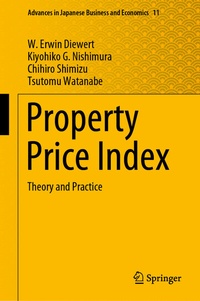
Property Price Index
Description

This book answers the question of how exactly property price indexes should be constructed.
The formation and collapse of property bubbles has had a profound impact on the economic administration of many nations. The property price bubble that began around the mid-1980s in Japan has been called the 20th century's biggest bubble. In its aftermath, the country faced a period of long-term economic stagnation dubbed the "lost decade." Sweden and the United States have also faced collapses of property bubbles in the 20th and early 21st centuries, respectively.
This book provides practical examples of how the theory of property price indexes can be applied to the issues of property as a non-homogenous good and a technological and environmental change.
More details
Other editions
Additional editions
Persons
Content
Part 1 Index Theory for Property Price Indexes.- Chapter 1 International Policy Discussion in Property Price Indices.- Chapter 2 Theoretical Background of Hedonic Measure and Repeat Sales Measure.- Part 2 Empirical Studies for RPPI using Tokyo Data.- Chapter 3 A Comparison of Alternative Approaches to Measuring House Price Inflation.- Chapter 4 Estimation of Property Price Index: Methodology and Data Sources.- Chapter 5 The SNA and Alternative Approaches to the Construction of CPPI.- Part 3. Application to the Official Statistics or Public Policy using RPPI.- Chapter 6 Measuring the Services of Durables and Owner Occupied Housing.- Chapter 7 New Estimates for the Price of Housing in the Japanese CPI.- Chapter 8 Imputed Rent for OOH in National Account.- Index.
