
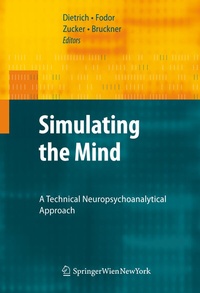
Simulating the Mind
Description
Alles über E-Books | Antworten auf Fragen rund um E-Books, Kopierschutz und Dateiformate finden Sie in unserem Info- & Hilfebereich.
Can psychoanalysis offer a new computer model? Can computer designers help psychoanalysts to understand their theory better?In contemporary publications human psyche is often related to neural networks. Why? The wiring in computers can also be related to application software. But does this really make sense?
Artificial Intelligence has tried to implement functions of human psyche. The reached achievements are remarkable; however, the goal to get a functional model of the mental apparatus was not reached. Was the selected direction incorrect?The editors are convinced: yes, and they try to give answers here. If one accepts that the brain is an information processing system, then one also has to accept that computer theories can be applied to the brain's functions, the human mental apparatus.
The contributors of this book - Solms, Panksepp, Sloman and many others who are all experts in computer design, psychoanalysis and neurology are united in one goal: finding synergy in their interdisciplinary fields.
More details
Other editions
Additional editions

Content
System requirements
File format: PDF
Copy protection: Watermark-DRM (Digital Rights Management)
System requirements:
- Computer (Windows; MacOS X; Linux): Use the free software Adobe Reader, Adobe Digital Editions, or any other PDF viewer of your choice (see eBook Help).
- Tablet/Smartphone (Android; iOS): Install the free app Adobe Digital Editions or another reading app for eBooks, e.g., PocketBook (see eBook Help).
- E-reader: Bookeen, Kobo, Pocketbook, Sony, Tolino and many more (only limited: Kindle).
The file format PDF always displays a book page identically on any hardware. This makes PDF suitable for complex layouts such as those used in textbooks and reference books (images, tables, columns, footnotes). Unfortunately, on the small screens of e-readers or smartphones, PDFs are rather annoying, requiring too much scrolling.
This eBook uses Watermark-DRM, a „soft” copy protection. This means that there are no technical restrictions to prevent illegal distribution. However, there is a personalised watermark embedded in the eBook that can be used to identify the purchaser of the eBook in the event of misuse and to provide evidence for legal purposes.
For more information, see our eBook Help page.