

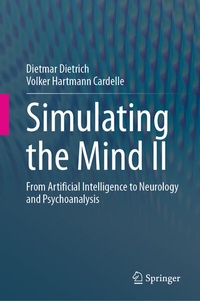
Simulating the Mind II
Description

The declared goal of this book, an extended and revised translation of the German edition (2021), is to show how a unified model of the psyche and body can be developed via insights from psychoanalysis, neurology and computer technology. On the one hand, such a model allows for the testing of psychological and social theories on a scientific basis with the help of simulation experiments. On the other hand, the model developed according to the functional structures of the human brain and psyche provides the basis for artificial intelligence systems. These are systems with cognitive capabilities that can save human lives, save energy, ensure safety at airports, provide support in old-age care and in the medical field; in other words and generally speaking, systems that can simplify our lives in a relevant way and on a broad basis.
A great deal of time and money is invested in genetic engineering and neurology, but research into the mental apparatus in the context of the neurological part, i.e., modeling the brain in a holistic way, is sparse in every respect. However, the results of the scientific project SiMA, of which the first author has been a driving force, show that the research of this organ, which in the authors' understanding includes the mental apparatus, as a whole, is quite feasible today. This is also the main message of the book, which addresses topics such as artificial intelligence, the brain, psychoanalysis, behavioral models, complexity, bionics of the mental, emotions and feelings, consciousness and awareness, preconscious and unconscious, the functional (and not only behavioral) description and modeling of the brain and especially of the mental apparatus, and some more.
In the world of technology, there is generally little interest in psychoanalysis, whereas in the world of psychoanalysis, people usually refuse to deal with mathematics and technology, especially computer technology. Is there an information theory of the brain on the one hand, and of computer technology on the other hand? The authors attempt to answer this question from both sides. With the goal to reach as many readers as possible and to provoke, the authors break with traditions and give space to new forms of thinking and argue that it is crucial to take a new path in automation, in artificial intelligence and in (technical) cognitive science, but also in psychoanalysis and neurology, in order to create a common basis for scientific and technical possibilities that have been previously inaccessible.
More details
Other editions
Additional editions
Persons
Dietmar Dietrich completed his studies in Electrical Engineering in Karlsruhe via the second educational path, after his education as an electronics technician, with the help of the Studienstiftung des Deutschen Volkes (German National Academic Foundation). After his doctorate, he worked in aviation and later in communications engineering. His main topics as a professor of computer technology (Bielefeld and Vienna), after working in industry, were mainly processes of automation and increasingly problems of Artificial Intelligence (AI). He was (co-)organizer of many national and international scientific conferences and worked for decades worldwide in industrial as well as scientific committees. He is the author of six Springer books and conference proceedings, in both English and German, including the titles "Simulating the Mind" (2009) and "Artificial Intelligence: A Bridge Between Psychoanalysis and Neurology - The Psi-Organ in a Nutshell" (2023).
Volker Hartmann Cardelle is a psychoanalyst, psychologist and psychotherapist in the city of Chur (Switzerland). He studied psychology and philosophy at the University of Zurich and graduated in 2017. Parallel to his studies, he spent ten years researching the works of Sigmund Freud, and published on the consequences of modern brain research for Freud's model of the psychic apparatus. He became a psychoanalyst in 2021 and completed his postgraduate training as a psychotherapist in 2024. Since 2022, he has been working on his doctorate in philosophy at the University of Ghent (Belgium) on the subject of the consequences of computer technology for the interpretation of Sigmund Freud's scientific work.
Content
Foreword of two Engineering Scientists.- Foreword of a Medical and Psychoanalytical Scientist.- Prolog.- Acknowledgements.- Preface by Dietmar Dietrich.- Preface by Volker A. Hartmann Cardelle. 1. Motivation.- 2. Philosophy, Consciousness and Axiomatic.- 3. Neurological and Psychoanalytical Models.- 4. Why Do Humans Need Machines with Consciousness?.- 5 Models and Tools of Computer Technology for Bridging Neurology and Psychoanalysis.- 6. Development of the ?-Organ Model (SiMA Model).- 7. Conclusion.- References.- Appendix by Volker Hartmann Cardelle.- Index.
