

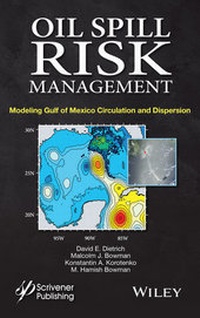
Oil Spill Risk Management
Description

More details
Other editions
Additional editions
Persons
David Dietrich, PhD, is a leading scientist in geophysical fluid dynamics and has over 50 publications in modeling ocean and engineering flows, including applications of his internationally used DieCAST ocean flow model. He has done work all over the world, including a number of projects with the US Navy.
Malcolm Bowman is Professor of Physical Oceanography and Distinguished Service Professor at Stony Brook University's School of Marine and Atmospheric Sciences. He is the Founding Director of the Stony Brook Storm Surge Research Group, President of the Stony Brook Environmental Conservancy, a Distinguished Member of the National Society of Collegiate Scholars and a Director of the Environmental Defence Society (NZ). He served on NY Mayor Bloomberg's Panel on Climate Change, which advises the City on how best to protect the city against the threats of climate change and rising sea levels.
Konstantin A. Korotenko is a Research Professor of Physical Oceanography at the P.P. Shirshov Institute of Oceanology of the Russian Academy of Sciences. He researches ocean dynamics and turbulence and pollution transport in the ocean. His works published in international journals are devoted to circulation and environmental problems of the Adriatic, Baltic, Black, Caspian seas and the Gulf of Mexico. He is an executive board member of the Moscow Physical Society, American Geophysical Union and an expert of the Fulbright Scholarship Program.
Hamish Bowman is a research scientist at the University of Otago in Dunedin, New Zealand, where he runs the Geophysics Research Laboratory and curates its computational computing cluster. He is a core member of the GRASS GIS Development Team, specializing in cartographic programming and the efficient processing of large data arrays.
Content
Preface xiii Part 1: Applied Oil Spill Modeling (with applications to the Deepwater Horizon oil spill) 1 1 The 2010 Deep Water Horizon and 2002 Supertanker Prestige Accidents 3 1.1 Introduction 3 1.2 The Oil Spills Described 5 1.3 How Much Material Remains in the Gulf? 6 1.4 The Role of Ocean Models to Explain what Happened 7 References 8 2 Gulf of Mexico Circulation 9 2.1 General Characteristics 9 2.2 Exchanges at Lateral and Surface Boundaries 11 2.3 Loop Current Eddies 12 2.4 Blocking by the Pycnocline 13 2.5 Fate of the Deepwater Horizon Well Blowout Material 14 2.6 Summary 15 References 16 3 Geophysical Fluid Dynamics and Modeling Challenges 17 3.1 Modeling the Circulation and Mixing of the Gulf Waters 17 3.2 External Boundaries 18 3.3 Addressing the Water Column Contamination and Fluxes 18 3.4 Eff ects of Bottom Dynamics on Accumulated Hydrocarbons 20 3.5 Churning by Extreme Weather Events 20 3.6 Summary 21 References 22 4 Flow and Oil Transport Model Choices, Setup and Testing 23 4.1 The DieCAST Ocean Circulation Model 23 4.2 Korotenko Oil Transport Module KOTM 24 4.3 Gulf Modeling Approach 25 4.4 Model Vertical Eddy Viscosity and Diff usivity 25 4.5 Surface Wind Driving and Open Boundary Conditions 26 4.6 Comments on Modeling Equatorial Dynamics and the Gulf of Mexico 26 4.7 Modeling Multi-Century Gulf Currents 27 References 29 5 Modeling the 2010 DWH Oil Spill 31 5.1 Introduction: the BP/Deepwater Horizon Accident 31 5.2 Deepwater Blowouts: Processes Affecting the Transport and Fate of Oil throughout the Water Column 32 5.3 Oil Spill Model for Gulf of Mexico (GOSM) 57 5.4 Results and Discussion 68 5.5 Summary 82 References 86 Part 2: Special Topics in Oil Spill Modeling 95 6 DieCAST Model Origin and Development 97 6.1 Introduction 97 6.2 Recent Model Attributes 98 6.3 Challenges in Modeling the Gulf of Mexico Circulation 99 6.4 Complications of Modeling near-Equatorial Circulation 99 6.5 Non Hydrostatic Effects 101 6.6 Sponge Layers in the Global Model 101 6.7 Inflow Considerations 101 References 102 7 Brief History of the Community Ocean Modeling System (COMS) 105 7.1 COMS history 105 7.2 Background and motivations 106 7.3 COMS elliptic solver history 107 7.4 Evolution of DieCAST 108 7.5 Outlook 108 References 110 8 DieCAST Model Equations 113 8.1 Model Equations 113 8.2 Model Layer Depths 115 References 116 9 Some Basic Physical, Mathematical and Modeling Concepts 117 9.1 Buoyancy, Density and the Hydrostatic Approximation 117 9.2 Pycnocline Slope: Geopotential Surface as a Natural Vertical Coordinate 119 9.3 Rotation and Coriolis Terms 120 9.4 Pycnocline and the Florida Strait Sill Depth 121 9.5 Surface and Bottom Mixed Layers 121 References 122 10 Modeling Challenges, Validations and Animations 125 10.1 Incompressibility, Geostrophy, Data Assimilation and Initialization Issues 125 10.2 Thermocline Maintenance, Ventilation and Extreme Events 127 10.3 Nesting, Grid Coupling and Open Boundary Conditions 127 10.4 Validation of Simulated Major Current Patterns in the Gulf 127 10.5 Note on Data Assimilation 133 10.6 Gulf Circulation Animations 134 10.7 Animation 1 134 10.8 Animation 2 135 10.9 Animation 3 136 References 136 11 A Five-Century Gulf Simulation using DieCAST 139 11.1 Motivation 139 11.2 Basic Flow Patterns 140 11.3 Some Results Observed during the 5th Century 142 11.4 Internal Waves 143 11.5 Island /Headland Wake Eff ects in the Yucatan Channel 143 11.6 Deeply Suspended and Bottom Deposited Material 144 References 145 12 Extreme Events and Oil Rig Stability 147 12.1 Introduction 147 12.2 An Unusual Northern Gulf Eddy Event 148 12.3 Detailed Discussion of Run A 148 12.4 Some Comments 151 12.5 Other Extreme Events Found during the 500-year simulation 152 References 153 13 Initialization and Data Assimilation; MAM Procedure 155 13.1 Introduction 155 13.2 Preliminary Comment 156 13.3 MAM Procedure 156 13.4 Refinements, Variations, Generalizations and Specializations of the MAM Approach 158 References 160 14 On the Simulation of Density Currents by z-level Models 161 14.1 Motivation 161 14.2 Introduction 162 14.3 Analysis 164 14.4 Summary and Conclusion 167 14.5 Acknowledgements 168 References 168 Appendix I: Notes on Modeling Hurricanes with DieCAST 171 A1.1 Introduction 171 A1.2 Model Setup 172 A1.3 Results and Discussion 174 A1.4 Final Remarks 178 A1.5 Summary 179 A1.6 Acknowledgements 179 References 179 Appendix II: A Model Study of Ventilation of the Mississippi Bight by Baroclinic Eddies: Local Instability and Remote Loop Current Effects 181 A2.1 Abstract 181 A2.2 Introduction 182 A2.3 Model Setup 183 A2.4 Results 184 A2.5 Concluding Remarks 208 References 213 Index 215
Chapter 1
The 2010 Deep Water Horizon and 2002 Supertanker Prestige Accidents
1.1 Introduction
The Gulf of Mexico is a marginal sea forming the southern coast of the United States, bounded on the northeast, north and northwest by the Gulf Coast of the United States, on the southwest and south by Mexico, and on the southeast by Cuba. The Gulf has a surface area of ~ 1.6 million km2 with almost half of the basin being shallow continental shelf waters. However, in the Sigsbee Deep, an irregular trough more than 550 km long, the maximum depth is almost 4,400 m deep.1 The dominant circulation feature is the Loop Current, which flows into the Gulf from the Caribbean Sea through the Yucatan Channel between Mexico’s Yucatan Peninsula and Cuba. The Loop Current subsequently feeds the Gulf Stream as it flows through the Florida Strait that lies between Florida, Cuba and the Bahamas.
The Gulf is a tropical and sub-tropical ocean basin boasting beautiful beaches, coral reefs, productive recreational and commercial fisheries, recreational boating, a unique Cajun heritage and extensive coastal wetlands supporting healthy ecosystems. The Gulf is considered by southern states to be an international treasure as well as a major economic resource for the southeastern United States.
Figure 1.1 Sea surface temperature satellite image of the Gulf of Mexico showing the Loop current, a major Loop Current eddy breaking off and associated small frontal eddies around the perimeter of the Loop Current eddy2.
There are about 3,850 oil rigs active in the Gulf, supporting over 50,000 drilling wells3. The major environmental threats to the Gulf are agricultural runoff and oil drilling accidents. There are also more than 600 natural oil petroleum seeps that are estimated to leak between 80 to 200,000 tonnes yr−14 5. The Gulf contains a large, elongated hypoxic zone south of the Mississippi River delta that runs east-west along the Texas-Louisiana coastline6. There are frequent “red tide” algae blooms that kill fish and marine mammals and cause respiratory problems in humans and some domestic animals when the blooms reach close to shore. In recent years, these have been plaguing the southwest and southern Florida coast, from the Florida Keys to north of Pasco County, Florida.
1.2 The Oil Spills Described
Between the 10th of April and the 15th July, 2010, it is estimated that the Deepwater Horizon/Macondo well released about 780,000 cubic meters of blowout material into the Gulf. The volume of Macondo crude oil that was suspended at depth greater than the Florida Straits7 sill depth may be the most important factor in the end, because the residence time8 of deep Gulf waters is estimated to be about 250 years [1, 2]. Deep Water Horizon oil material residues that are denser than the surface water but less dense than underlying bottom water migrate vertically, due to buoyancy forces, until they reach water having their same material density. This may be called the residue’s equilibrium depth, because water density increases with increasing depth and has much smaller horizontal variability (which also would have little effect because gravitational acceleration totally dominates total acceleration). Details of such vertical migration are not important except during the short migration time; the pressure forces acting on the water are the same as the forces acting on the residue material; thus, after such equilibrium depth is reached, the material simply goes with the flow (of the ambient water) to within exceptionally good approximation. Thus, the suspended oil material deep residues, like their ambient water, has a residence time of up to 250 years unless it is ingested into the deep ecosystem or geochemically modified. The ambient waters experience typically only a few meters vertical displacement, except during short lived, localized violent churning under hurricane eye walls.
Further warning is implied by an event involving the supertanker Prestige running aground off the coast Spain. The ship subsequently sank off the northwest coast of Spain9. It leaked only one tenth of the oil spilled from the BP/Macondo well; yet tar-balls from the Prestige spill were still deposited on far-away beaches. This led to a serious decline in tourism along the Bay of Biscay coast (in both Spain and France). It also gravely damaged local fisheries.
However, unlike the Gulf of Mexico, the Bay of Biscay has no deep basin that can trap suspended materials. Rather, the Bay is open to the Atlantic Ocean. Thus, spilled Prestige oil could eventually be dispersed throughout a significant portion of the world’s oceans.
The Deep Water Horizon oil spill10 in the Gulf of Mexico in 2010 and the sinking of the Prestige supertanker event off the coast of Galatia, northwestern Spain in 200211 both released large amounts of crude oil into the ocean at great depths. Spilled oil fractions surfaced and polluted coastal regions including Gulf wetlands, open shorelands and Bay of Biscay beaches. Both seriously affected fishing and tourism industries. First responders were not adequately prepared to deal with such deep- water disasters as hundreds of workers painstakingly removed beached oil deposits and tar-balls.
The 2010 Deepwater Horizon and the 2002 Prestige supertanker accidents differed in important ways. For example, in the Deep Horizon accident, about 10 times more hydrocarbon source material was leaked into the ambient ocean as compared to the Prestige event. Chemical dispersants were added to the plume in the Deepwater accident; none was added in the Prestige case.
The deep Gulf water and material residence times are estimated to be ~250 years [2, 3]. Unlike the Prestige oil spill, the Deep horizon waters and materials may be confined to the deep Gulf region (up to 3,500 deep) but probably of areal extent ~100 times less than the North Atlantic Ocean basin. Thus, much fewer opportunities are expected to exist for dispersal and dilution in the Gulf deep basins as compared with the North Atlantic Ocean. Eventually, the deep material will slowly decay by biogeochemical processes, or, as mentioned above, be mixed up to the surface by extreme weather events such as hurricanes.
1.3 How Much Material Remains in the Gulf?
Much of the subsurface well material that was not blown ashore or evaporated into the air may still be trapped in sub surface waters within the Gulf. Material suspended at depths greater than the ~700 m Florida Strait sill could possibly remain in the Gulf for centuries [1, 2], unless its density is altered by biogeophysical processes. On the other hand, future hurricanes may churn up deeply suspended materials (often in the form of tar-balls) to the surface and blow these ashore or out of the Gulf through the Florida Strait, as did 2012 Hurricane Isaac12.
Even a weak category 1 hurricane can churn material deeper than a few hundred meters to the surface, as did typhoon Kai-Tak13 [3]. Thus, it is not surprising that category 1 Hurricane Isaac churned up tar-balls and blew them ashore. Stronger hurricanes could churn deeper water to the surface, so the effects of Hurricane Isaac suggest that future hurricanes may lead to more damage from tar-balls, impacting Gulf beaches and wetlands. This would be especially apparent at locations where hurricane eye-wall winds blow toward the coast.
In summary, a hurricane in the Gulf of Mexico may churn up deep cold water and mix it with warmer upper level Gulf waters, thus allowing these waters, with its suspended material, to escape through the Florida Straits and into the western Atlantic Ocean. However, some suspended oil materials do not mix readily with water (see Chapter 5), and thus may re-sink and settle to a new equilibrium depth closer to its depth before the hurricane.
1.4 The Role of Ocean Models to Explain what Happened
Economically important and environmentally sensitive questions can partly be addressed by well-tested and validated circulation and oil spill simulation models. Our contribution is to apply the DieCAST ocean model14 coupled with the Korotenko oil dispersion model (Korotenko et al., 2013) to shed light on probable transport, transformation and fates of oil residues released during the Deepwater Horizon (hereafter DWH) oil platform accident. We name the coupled model GOSM (Gulf Oil Spill Model). We use the DieCAST model to simulate Gulf circulation dynamics and vertical mixing processes and apply this information to investigate what possibly happened to the well blowout material. We also discuss the role of hurricanes over the long-term in churning up deep deposits and flinging them onto coastlines.
Winds, waves, currents, water density and temperature fields all determine the paths of elements of material leaked from the well site. These in turn affect the biogeochemical processes in the evolving element material properties. The Korotenko oil transport model features a Lagrangian particle-tracking method that is a cost-effective approach for the simulation of various events including oil spills [4].
References
1. D. Rivas, A. Badan, J. Ochoa, 2005: The Ventilation of the Deep Gulf of Mexico. J. Phys. Oceanogr., 35(10), 1762–1781. 2005
2. Fratantoni, D.M., R.J. Zantopp, W.E. Johns and J.L. Miller, 1997. Updated bathymetry of the Anegada-Jungfern Passage complex and implications for Atlantic inflow to the abyssal Caribbean Sea. J. Marine Res., 55, 847–860.
3. Tseng, Y.-H., S. Jan, D. Dietrich, I-I Lin, Y.-T. Chang and T.Y. Tang, 2010. Modeled oceanic response and sea surface cooling to typhoon Kai-Tak....
