

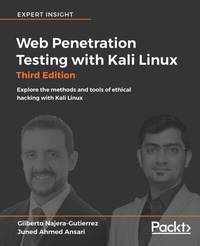
Web Penetration Testing with Kali Linux
Explore the methods and tools of ethical hacking with Kali Linux
3rd Edition
Published on 3. June 2024
426 pages
978-1-78862-380-3 (ISBN)
Description

Build your defense against web attacks with Kali Linux, including command injection flaws, crypto implementation layers, and web application security holesKey Features - [*] Know how to set up your lab with Kali Linux
- [*] Discover the core concepts of web penetration testing
- [*] Get the tools and techniques you need with Kali Linux
Book DescriptionWeb Penetration Testing with Kali Linux - Third Edition shows you how to set up a lab, helps you understand the nature and mechanics of attacking websites, and explains classical attacks in great depth. This edition is heavily updated for the latest Kali Linux changes and the most recent attacks. Kali Linux shines when it comes to client-side attacks and fuzzing in particular. From the start of the book, you'll be given a thorough grounding in the concepts of hacking and penetration testing, and you'll see the tools used in Kali Linux that relate to web application hacking. You'll gain a deep understanding of classicalSQL, command-injection flaws, and the many ways to exploit these flaws. Web penetration testing also needs a general overview of client-side attacks, which is rounded out by a long discussion of scripting and input validation flaws. There is also an important chapter on cryptographic implementation flaws, where we discuss the most recent problems with cryptographic layers in the networking stack. The importance of these attacks cannot be overstated, and defending against them is relevant to most internet users and, of course, penetration testers. At the end of the book, you'll use an automated technique called fuzzing to identify flaws in a web application. Finally, you'll gain an understanding of web application vulnerabilities and the ways they can be exploited using the tools in Kali Linux.What you will learn - Learn how to set up your lab with Kali Linux
- Understand the core concepts of web penetration testing
- Get to know the tools and techniques you need to use with Kali Linux
- Identify the difference between hacking a web application and network hacking
- Expose vulnerabilities present in web servers and their applications using server-side attacks
- Understand the different techniques used to identify the flavor of web applications
- See standard attacks such as exploiting cross-site request forgery and cross-site scripting flaws
- Get an overview of the art of client-side attacks
- Explore automated attacks such as fuzzing web applications
Who this book is forSince this book sets out to cover a large number of tools and security fields, it can work as an introduction to practical security skills for beginners in security. In addition, web programmers and also system administrators would benefit from this rigorous introduction to web penetration testing. Basic system administration skills are necessary, and the ability to read code is a must.
- [*] Discover the core concepts of web penetration testing
- [*] Get the tools and techniques you need with Kali Linux
Book DescriptionWeb Penetration Testing with Kali Linux - Third Edition shows you how to set up a lab, helps you understand the nature and mechanics of attacking websites, and explains classical attacks in great depth. This edition is heavily updated for the latest Kali Linux changes and the most recent attacks. Kali Linux shines when it comes to client-side attacks and fuzzing in particular. From the start of the book, you'll be given a thorough grounding in the concepts of hacking and penetration testing, and you'll see the tools used in Kali Linux that relate to web application hacking. You'll gain a deep understanding of classicalSQL, command-injection flaws, and the many ways to exploit these flaws. Web penetration testing also needs a general overview of client-side attacks, which is rounded out by a long discussion of scripting and input validation flaws. There is also an important chapter on cryptographic implementation flaws, where we discuss the most recent problems with cryptographic layers in the networking stack. The importance of these attacks cannot be overstated, and defending against them is relevant to most internet users and, of course, penetration testers. At the end of the book, you'll use an automated technique called fuzzing to identify flaws in a web application. Finally, you'll gain an understanding of web application vulnerabilities and the ways they can be exploited using the tools in Kali Linux.What you will learn - Learn how to set up your lab with Kali Linux
- Understand the core concepts of web penetration testing
- Get to know the tools and techniques you need to use with Kali Linux
- Identify the difference between hacking a web application and network hacking
- Expose vulnerabilities present in web servers and their applications using server-side attacks
- Understand the different techniques used to identify the flavor of web applications
- See standard attacks such as exploiting cross-site request forgery and cross-site scripting flaws
- Get an overview of the art of client-side attacks
- Explore automated attacks such as fuzzing web applications
Who this book is forSince this book sets out to cover a large number of tools and security fields, it can work as an introduction to practical security skills for beginners in security. In addition, web programmers and also system administrators would benefit from this rigorous introduction to web penetration testing. Basic system administration skills are necessary, and the ability to read code is a must.
More details
Other editions
Additional editions
Gilberto Najera-Gutierrez
Web Penetration Testing with Kali Linux - Third Edition
Book
02/2018
Packt Publishing
€64.10
Shipment within 3-4 weeks
Previous edition
Juned Ahmed Ansari
Web Penetration Testing with Kali Linux 2.0, Second Edition
Build your defense against web attacks with Kali Linux 2.0
E-Book
10/2025
Packt Publishing
from
€40.53
Available for download
Persons
Dieterle Daniel W. :
Daniel W. Dieterle, with over 20 years in IT, has evolved from a system and network support role to a dedicated Computer Security Researcher and Author. His expertise, honed in diverse environments like corporate data centers and Ivy League schools, is reflected in his Kali Linux-based books, widely used globally for security training in universities, government, and private sectors. He has contributed to numerous technical books, articles, and security training classes, and is passionate about mentoring newcomers in the field.Najera-Gutierrez Gilberto :
Gilberto Najera-Gutierrez is an experienced penetration tester currently working for one of the top security testing service providers in Australia. He obtained leading security and penetration testing certifications, namely Offensive Security Certified Professional (OSCP), EC-Council Certified Security Administrator (ECSA), and GIAC Exploit Researcher and Advanced Penetration Tester (GXPN).Ansari Juned Ahmed :
Juned Ahmed Ansari (@junedlive) is a cyber security researcher based out of Mumbai. He currently leads the penetration testing and offensive security team in a prodigious MNC. Juned has worked as a consultant for large private sector enterprises, guiding them on their cyber security program. He has also worked with start-ups, helping them make their final product secure.
Daniel W. Dieterle, with over 20 years in IT, has evolved from a system and network support role to a dedicated Computer Security Researcher and Author. His expertise, honed in diverse environments like corporate data centers and Ivy League schools, is reflected in his Kali Linux-based books, widely used globally for security training in universities, government, and private sectors. He has contributed to numerous technical books, articles, and security training classes, and is passionate about mentoring newcomers in the field.Najera-Gutierrez Gilberto :
Gilberto Najera-Gutierrez is an experienced penetration tester currently working for one of the top security testing service providers in Australia. He obtained leading security and penetration testing certifications, namely Offensive Security Certified Professional (OSCP), EC-Council Certified Security Administrator (ECSA), and GIAC Exploit Researcher and Advanced Penetration Tester (GXPN).Ansari Juned Ahmed :
Juned Ahmed Ansari (@junedlive) is a cyber security researcher based out of Mumbai. He currently leads the penetration testing and offensive security team in a prodigious MNC. Juned has worked as a consultant for large private sector enterprises, guiding them on their cyber security program. He has also worked with start-ups, helping them make their final product secure.
Content
Table of Contents - Introduction to Penetration Testing and Web Applications
- Setting Up Your Lab with Kali Linux
- Reconnaissance and Profiling the Web Server
- Authentication and Session Management Flaws
- Attacking the Server Using Injection-based Flaws
- Finding and Exploiting Cross-Site Scripting (XSS) Vulnerabilities
- Exploiting Cross Site Request Forgery
- Attacking Cryptographic implementation flaws
- AJAX, HTML5 and client side attacks
- Fuzzing Web Applications
- Using Automated Scanners on Web Applications
- Setting Up Your Lab with Kali Linux
- Reconnaissance and Profiling the Web Server
- Authentication and Session Management Flaws
- Attacking the Server Using Injection-based Flaws
- Finding and Exploiting Cross-Site Scripting (XSS) Vulnerabilities
- Exploiting Cross Site Request Forgery
- Attacking Cryptographic implementation flaws
- AJAX, HTML5 and client side attacks
- Fuzzing Web Applications
- Using Automated Scanners on Web Applications
