

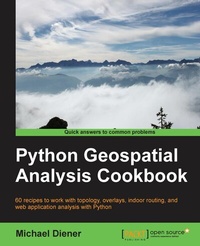
Python Geospatial Analysis Cookbook
Over 60 recipes to work with topology, overlays, indoor routing, and web application analysis with Python
Published on 13. January 2025
310 pages
978-1-78355-508-6 (ISBN)
Description

Key Features
Book DescriptionGeospatial development links your data to places on the Earth's surface. Its analysis is used in almost every industry to answer location type questions. Combined with the power of the Python programming language, which is becoming the de facto spatial scripting choice for developers and analysts worldwide, this technology will help you to solve real-world spatial problems. This book begins by tackling the installation of the necessary software dependencies and libraries needed to perform spatial analysis with Python. From there, the next logical step is to prepare our data for analysis; we will do this by building up our tool box to deal with data preparation, transformations, and projections. Now that our data is ready for analysis, we will tackle the most common analysis methods for vector and raster data. To check or validate our results, we will explore how to use topology checks to ensure top-quality results. This is followed with network routing analysis focused on constructing indoor routes within buildings, over different levels. Finally, we put several recipes together in a GeoDjango web application that demonstrates a working indoor routing spatial analysis application. The round trip will provide you all the pieces you need to accomplish your own spatial analysis application to suit your requirements.What you will learn
Discover the projection and coordinate system information of your data and learn how to transform that data into different projections
Import or export your data into different data formats to prepare it for your application or spatial analysis
Use the power of PostGIS with Python to take advantage of the powerful analysis functions
Execute spatial analysis functions on vector data including clipping, spatial joins, measuring distances, areas, and combining data to new results
Create your own set of topology rules to perform and ensure quality assurance rules in Python
Find the shortest indoor path with network analysis functions in easy, extensible recipes revolving around all kinds of network analysis problems
Visualize your data on a map using the visualization tools and methods available to create visually stunning results
Build an indoor routing web application with GeoDjango to include your spatial analysis tools built from the previous recipes
Who this book is forIf you are a student, teacher, programmer, geospatial or IT administrator, GIS analyst, researcher, or scientist looking to do spatial analysis, then this book is for you. Anyone trying to answer simple to complex spatial analysis questions will get a working demonstration of the power of Python with real-world data. Some of you may be beginners with GIS, but most of you will probably have a basic understanding of geospatial analysis and programming.
Book DescriptionGeospatial development links your data to places on the Earth's surface. Its analysis is used in almost every industry to answer location type questions. Combined with the power of the Python programming language, which is becoming the de facto spatial scripting choice for developers and analysts worldwide, this technology will help you to solve real-world spatial problems. This book begins by tackling the installation of the necessary software dependencies and libraries needed to perform spatial analysis with Python. From there, the next logical step is to prepare our data for analysis; we will do this by building up our tool box to deal with data preparation, transformations, and projections. Now that our data is ready for analysis, we will tackle the most common analysis methods for vector and raster data. To check or validate our results, we will explore how to use topology checks to ensure top-quality results. This is followed with network routing analysis focused on constructing indoor routes within buildings, over different levels. Finally, we put several recipes together in a GeoDjango web application that demonstrates a working indoor routing spatial analysis application. The round trip will provide you all the pieces you need to accomplish your own spatial analysis application to suit your requirements.What you will learn
Discover the projection and coordinate system information of your data and learn how to transform that data into different projections
Import or export your data into different data formats to prepare it for your application or spatial analysis
Use the power of PostGIS with Python to take advantage of the powerful analysis functions
Execute spatial analysis functions on vector data including clipping, spatial joins, measuring distances, areas, and combining data to new results
Create your own set of topology rules to perform and ensure quality assurance rules in Python
Find the shortest indoor path with network analysis functions in easy, extensible recipes revolving around all kinds of network analysis problems
Visualize your data on a map using the visualization tools and methods available to create visually stunning results
Build an indoor routing web application with GeoDjango to include your spatial analysis tools built from the previous recipes
Who this book is forIf you are a student, teacher, programmer, geospatial or IT administrator, GIS analyst, researcher, or scientist looking to do spatial analysis, then this book is for you. Anyone trying to answer simple to complex spatial analysis questions will get a working demonstration of the power of Python with real-world data. Some of you may be beginners with GIS, but most of you will probably have a basic understanding of geospatial analysis and programming.
All prices
More details
Edition
Digital original
Language
English
Place of publication
Birmingham
United Kingdom
Target group
Professional and scholarly
US School Grade: College Graduate Student
Edition type
Digital original
File size
4,94 MB
ISBN-13
978-1-78355-508-6 (9781783555086)
Copyright in bibliographic data and cover images is held by Nielsen Book Services Limited or by the publishers or by their respective licensors: all rights reserved.
Schweitzer Classification
Other editions
Additional editions
Michael Diener
Python Geospatial Analysis Cookbook
Book
11/2015
Packt Publishing
€63.10
Shipment within 3-4 weeks
Person
Michael Diener graduated from Simon Fraser University, British Columbia, Canada, in 2001 with a bachelor of science degree in geography. He began working in 1995 with Environment Canada as a GIS (Geographic Information Systems) analyst and has continued to work with GIS technologies ever since. In 2008, he founded a company called GOMOGI that is focused on building web and mobile GIS application with open source tools. In 2011, the focus changed to indoor wayfinding and navigation solutions and building the indrz platform that Michael had envisioned. From time to time, Michael also holds seminars for organizations wanting to explore or discover the possibilities of how GIS can increase productivity and help better answer spatial questions. He is also the creative head of new product development in his company. His technical skills include working with Python to solve a wide range of spatial problems on a daily basis. Through the years, he has developed many spatial applications with Python, including indrz and golfgis, which are two of the products built by his company, GOMOGI. He is also lecturer of GIS at the Alpen Adria University, Klagenfurt, where he enjoys teaching students the wonderful powers of GIS and explaining how to solve spatial problems with open source GIS and Python.
Content
Table of Contents
Setting up your geo python environment
Working with projections
Moving spatial data from one format to another
Working with spatial databases
Vector analysis
Overlay analysis
Raster analysis
Network routing analysis
Topology checking and data validation
Visualize your analysis data
Web analysis with geo-Django quick reference
Appendix A
Appendix B
Setting up your geo python environment
Working with projections
Moving spatial data from one format to another
Working with spatial databases
Vector analysis
Overlay analysis
Raster analysis
Network routing analysis
Topology checking and data validation
Visualize your analysis data
Web analysis with geo-Django quick reference
Appendix A
Appendix B

