

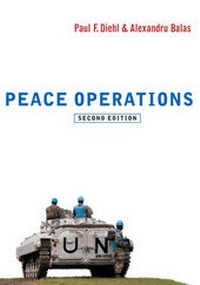
Peace Operations
Description

* Traces the historical development of peace operations from their origins in the early 20th century through the development of modern peacebuilding missions and multiple simultaneous peace operations.
* Tracks changes over time in the size, mission and organization of peace operations.
* Analyses different organizational, financial, and troop provisions for peace operations, as well as assessing alternatives.
* Lays out criteria for evaluating peace operations and details the conditions under which such operations are successful.
Drawing on a wide range of examples from those between Israel and her neighbours to more recent operations in Bosnia, Somalia, Darfur, East Timor, and the Congo, this new edition brings together the body of scholarly research on peace operations to address those concerns. It will be an indispensable guide for students, practitioners and general readers wanting to broaden their knowledge of the possibilities and limits of peace operations today.
More details
Other editions
Additional editions
Persons
Alexandru Balas is Assistant Professor in the International Studies Program and Director of the Clark Center for International Education at the State University of New York College at Cortland.
Content
1 Introduction 1
2 The Historical Evolution and Record of Peace Operations 28
3 The Organization of Peace Operations 81
4 The Success and Failure of Peace Operations 141
5 Ten Challenges for Future Peace Operations 189
Appendix: Peace Operations 1948-2012 220
Notes 227
References and Suggested Readings 230
Index 242
CHAPTER TWO
The Historical Evolution and Record of Peace Operations
The origin and development of peace operations largely parallel those of international organizations in general. Yet, the traditional peacekeeping strategy evolved specifically out of experience with peace observation missions and the failure of collective security under the League of Nations and the United Nations. This chapter traces the historical development of peace operations from their earliest manifestations to the emergence of post-Cold War peacebuilding.1 The chapter concludes with an overview of peace operations since 1945.
Early International Efforts
Whereas war and other organized violence have a long history, actions by the international community to promote peace are far more recent. The earliest incidence of collective military action at the international level might be the Crusades. In that instance, several states banded together, with the encouragement of the Vatican, to save the Holy Land from the scourges of those who were regarded as pagans. Yet, unlike their modern-day successors, these actions were hardly designed to restore peace and security, and one also could argue that they were not coordinated under provisions set up by a global or regional intergovernmental organization.
The Crusades proved not to set a precedent. In the fourteenth century came a proposal, never actualized, for a world government that included arrangements for an international army. After the Napoleonic Wars in the nineteenth century, the major powers acted together (the Concert of Europe) to preserve the status quo, and this embraced collective (broadly construed) military action that, again, only faintly resembled the organized and internationally sanctioned operations that would occur in the next century. The closest analogue to peace operations before the establishment of the League of Nations occurred in 1849–50, when a Norwegian–Swedish force of 3,800 troops was deployed in Schleswig as part of an armistice that was agreed upon in July 1849 between Denmark and Prussia during the First Schleswig War. “The task was to maintain law, order, and justice in northern Schleswig under observance of the strictest neutrality between Danes and Germans” (Gäfvert, 1995: 31). This international force, which “might not take part in the hostilities” (ibid.) if the armistice were to be cancelled, remained deployed until peace was agreed in July 1850.
Early international efforts at collective military action shared a number of characteristics. First, they operated on an ad hoc basis, organizing and disbanding as the need arose and according to the crisis at hand. This attribute persists in international peace operations to this day. Second, beyond the ad hoc arrangements, these early actions had little precedent to follow. Thus, they operated without specific guidelines, often with little coordination between national units. This circumstance would change in the twentieth century, when peace operations relied heavily on guidelines established by previous operations in terms of personnel, deployment, and conduct. Finally, early efforts went forward in most cases largely without the approval or the direction of an international body, because international organizations as we know them today did not exist. The protection of international peace and security was largely indistinguishable from the interests of the major powers in the world – a condition that would change, at least organizationally, with the creation of an appropriate international mechanism for authorizing and coordinating global security actions.2
The League of Nations Experience: Collective Security
The end of World War I and the desire by the global community to make that truly “the war to end all wars” led to the formation of the first general-purpose, universal membership organization – the League of Nations. Although that organization had economic and social functions as well, its primary purpose was to ensure international peace and security through collective consultation and action. In the course of drafting the League of Nations Covenant, France proposed that military sanctions be executed by an international force. The British and US delegations objected to this provision, and accordingly it is absent from Articles 10 and 16 of that document. Nevertheless, those articles do outline, in broad form, collective security procedures. Article 10 states: “The Members of the League undertake to respect and preserve as against external aggression the territorial integrity and existing political independence of all Members of the League. In case of any such aggression … the Council shall advise upon the means by which this obligation shall be fulfilled.”
The provisions of that article are a far cry from installing discretionary power in an international police force to meet threats to international security. Yet Article 16 is less equivocal in outlining the possible international military response to aggression:
Should any Member resort to war … it shall ipso facto be deemed to have committed an act of war against all other Members. … It shall be the duty of the Council in such case to recommend to the several Governments concerned what effective military, naval, or air force the Members of the League shall severally contribute to the armed forces to be used to protect the covenants of the League.
These provisions supplied the legal authority for the League to take collective military action, only one option at the disposal of the Council. Furthermore, the operations were to be organized on an ad hoc basis, much as were their historical predecessors. Finally, military operations would probably be neither under the control of the League nor involve truly international forces. There is enough ambiguity in the language of the articles and sufficient political reasons to believe that the military actions would be loosely coordinated national efforts undertaken by the major powers with the approval of the League.
The collective security procedures of the League of Nations were not tested until more than a decade after the inception of the organization. In 1931, Japan attacked Manchuria and occupied the capital city; China appealed to the Council of the League for assistance. Over the objections of Japan, the Council recommended withdrawal of the Japanese troops; yet stronger actions under Article 11 of the League Covenant would necessitate a unanimous vote, a result unlikely because of the potential Japanese veto. This state of affairs all but precluded forceful action against any of the members, a problem that foreshadowed similar difficulties with the superpowers in the United Nations.
Rather than stiff economic sanctions or an international military action against Japan, the League was able to authorize only a fact-finding mission to the area. During the long process of inquiry, Japan set up the puppet state of Manchukuo and directed its aggressive eye toward the rest of China. By the time the fact-finding report was presented to the League, Japanese aggression had borne its full fruits, and it was impossible to undo the harvest. Japan added insult to this ineffectiveness by withdrawing from the organization.
The next major test of the League’s collective action mechanisms would yield only slightly better results. Italy attacked Ethiopia in 1935 and ultimately conquered that country, for which the League instituted economic sanctions against Italy. Yet, many of the League members, as well as the United States, either failed to institute those sanctions fully or blatantly ignored them. The major downfall of the League’s actions against Italy was the British and French willingness to recognize Italian domination over parts of North Africa. Britain and France mistakenly thought that appeasing Italy would lead that country to recognize British and French interests on the African continent and perhaps secure them an ally against rising Nazi power in Germany. The willingness of major powers to place their own interests ahead of those of the international community again foreshadowed Cold War tensions and the paralysis of the United Nations in coming decades.
The League of Nations Experience: Peace Observation and Inquiry
Despite the failure of its collective security arrangements, the League of Nations was active in several disputes and crises. During these disputes, it began to perform some peace observation functions that were to evolve into the traditional peacekeeping strategy in later years. The League Covenant makes no mention of peace observation, yet Article 11, authorizing the League to “take any action that may be deemed wise and effectual to safeguard the peace of nations,” opened the door to actions not specifically mentioned in the Covenant or envisioned by its authors. Furthermore, Article 15 provided for the Council to report on the facts of disputes and make recommendations on how those disputes might be settled peacefully. These two articles would form the basis for League actions that combined the missions of fact finding and observation.
The first League action came very early in the life of the organization. A dispute between Sweden and Finland over the Aaland Islands led the League to create a commission of inquiry to investigate the situation and recommend solutions. At first glance, a fact-finding mission would seem to offer few precedents for future peace observation. Indeed, this dispute was not so severe as...
