

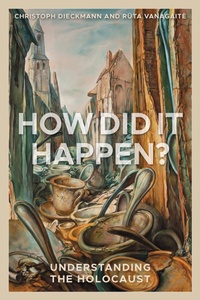
How Did It Happen?
Understanding the Holocaust
1st Edition
Published on 15. October 2021
416 pages
978-1-5381-5032-0 (ISBN)
Description

In this compelling book, Lithuanian author Ruta Vanagaite holds an extended conversation with noted historian Christoph Dieckmann. His exploration of the causes and consequences of the
Holocaust in Lithuania provides the first overview for general readers that considers the perspectives of all the central groups involved-Jews, Lithuanians, and Germans. Drawing on a rich array of sources in all the key languages-Yiddish, Ivrit, Lithuanian, and German-Dieckmann considers not only the Berlin-based orientation of the German perpetrators but also the space where the Shoah took place-Lithuanian society with its Jewish minority under German occupation. He contends that this "space" of mass crimes is always linked with warfare and occupation. The Holocaust was unprecedented, but he makes a powerful case it cannot be isolated from the other mass crimes that took place at the same time in the same space against thousands of Soviet prisoners of war and forced refugees from the Soviet territories.
Dieckmann shows that the Holocaust could not have unfolded throughout German-dominated Europe without the conditional cooperation of non-Germans in each occupied country. Existing antisemitism was radicalized from the 1930s onward, turning Jews, under the enormous stress of unrelenting warfare and often instable conditions of occupation, into what were perceived as deadly enemies. The Holocaust, its history and memory, can only be understood through this broader context. The authors' searching exchanges illuminate the most profound questions we have as we struggle to understand the Holocaust.
Holocaust in Lithuania provides the first overview for general readers that considers the perspectives of all the central groups involved-Jews, Lithuanians, and Germans. Drawing on a rich array of sources in all the key languages-Yiddish, Ivrit, Lithuanian, and German-Dieckmann considers not only the Berlin-based orientation of the German perpetrators but also the space where the Shoah took place-Lithuanian society with its Jewish minority under German occupation. He contends that this "space" of mass crimes is always linked with warfare and occupation. The Holocaust was unprecedented, but he makes a powerful case it cannot be isolated from the other mass crimes that took place at the same time in the same space against thousands of Soviet prisoners of war and forced refugees from the Soviet territories.
Dieckmann shows that the Holocaust could not have unfolded throughout German-dominated Europe without the conditional cooperation of non-Germans in each occupied country. Existing antisemitism was radicalized from the 1930s onward, turning Jews, under the enormous stress of unrelenting warfare and often instable conditions of occupation, into what were perceived as deadly enemies. The Holocaust, its history and memory, can only be understood through this broader context. The authors' searching exchanges illuminate the most profound questions we have as we struggle to understand the Holocaust.
More details
Edition
1. Auflage
Language
English
Place of publication
New York
United States
Publishing group
Bloomsbury Publishing Plc
ISBN-13
978-1-5381-5032-0 (9781538150320)
Copyright in bibliographic data and cover images is held by Nielsen Book Services Limited or by the publishers or by their respective licensors: all rights reserved.
Schweitzer Classification
Other editions
Additional editions
Book
10/2021
Rowman & Littlefield Publishers
€57.14
Shipment within 3-4 weeks
Persons
Christoph Dieckmann is a German historian who hdirects a sound-history study, Sounds of Anti-Jewish Persecution, at the University of Bern. His book Deutsche Besatzungspolitik in Litauen 1941-1944 (German Occupation Policy in Lithuania 1941-1944) was awarded the Yad Vashem International Book Prize for Holocaust Research.
Ruta Vanagaiteis a Lithuanian writer and journalist. Her books include Our People: Discovering Lithuania's Hidden Holocaust, coauthored with Efraim Zuroff.
Ruta Vanagaiteis a Lithuanian writer and journalist. Her books include Our People: Discovering Lithuania's Hidden Holocaust, coauthored with Efraim Zuroff.
Content
Prologue
Ruta Vanagaite
1 Why This Book?
2 People Had a Choice
3 Germany's Trauma
4 Lithuania's Trauma
5 The Jew Is the Devil
6 Small and Radical
7 Plans for Mass Murder
8 "Blitzkrieg": Local Helpers Needed!
9 Lithuania's Dream of Independence
10 An Easy Occupation
11 Controversies of the Uprising
12 Enter the SS
13 Jews in Panic
14 Lithuanian Border Strip: The First Shootings
15 Pogroms
16 The First Mass Shooting of Jews in Kaunas
17 The Road to Ponar
18 Vigilante Lithuanian Courts
19 Ghettoization in the Provinces
20 Robbing the Living
21 Lithuanian Fascists Take Over
22 "Kill Them All!"
23 The "Final Solution" in the Provinces
24 The Oral Orders
25 The Lithuanian Road Killers
26 100,000 Trapped City Jews
27 Life in the Ghettos: Hunger, Poetry, Death
28 Choiceless Choices
29 The Accidental Death of European Jews
30 Forgotten Victims: Soviet POWs
31 Forgotten Victims: The Soviet Evacuees
31 Slavery
33 No to the SS Legion
34 To Die as Free Fighters
35 Survival and Terror
36 The End: Vilnius
37 The End: siauliai
38 The End: Kaunas
39 The Murdered "Others"
40 Burning the Bodies
41 To Save a Jew
42 The Silence of the Church
43 The Brief Story of Lithuanian Resistance
Epilogue
Selected Bibliography
About the Authors
Ruta Vanagaite
1 Why This Book?
2 People Had a Choice
3 Germany's Trauma
4 Lithuania's Trauma
5 The Jew Is the Devil
6 Small and Radical
7 Plans for Mass Murder
8 "Blitzkrieg": Local Helpers Needed!
9 Lithuania's Dream of Independence
10 An Easy Occupation
11 Controversies of the Uprising
12 Enter the SS
13 Jews in Panic
14 Lithuanian Border Strip: The First Shootings
15 Pogroms
16 The First Mass Shooting of Jews in Kaunas
17 The Road to Ponar
18 Vigilante Lithuanian Courts
19 Ghettoization in the Provinces
20 Robbing the Living
21 Lithuanian Fascists Take Over
22 "Kill Them All!"
23 The "Final Solution" in the Provinces
24 The Oral Orders
25 The Lithuanian Road Killers
26 100,000 Trapped City Jews
27 Life in the Ghettos: Hunger, Poetry, Death
28 Choiceless Choices
29 The Accidental Death of European Jews
30 Forgotten Victims: Soviet POWs
31 Forgotten Victims: The Soviet Evacuees
31 Slavery
33 No to the SS Legion
34 To Die as Free Fighters
35 Survival and Terror
36 The End: Vilnius
37 The End: siauliai
38 The End: Kaunas
39 The Murdered "Others"
40 Burning the Bodies
41 To Save a Jew
42 The Silence of the Church
43 The Brief Story of Lithuanian Resistance
Epilogue
Selected Bibliography
About the Authors
