

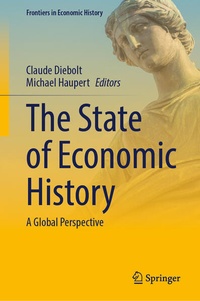
The State of Economic History
Description

This volume examines the state of the economic history discipline around the globe. It raises and answers questions such as: What are its roots, how did it evolve, and what is the current state of the discipline in each country or region presented?
Transcending traditional Western paradigms, the book gathers renowned economic historians from around the globe to engage in a comprehensive dialogue about economic history's global standing. Investigating its role in shaping future economists, addressing pivotal questions, and its symbiotic relationship with economics, contributors analyze economic history's resonance across continents. By doing so, the chapters are not intended to be a survey of the research on each country, but rather an overview of the discipline: its practice, training, and position within the broader economics discipline.
Addressing an academic audience, this book further analyzes the interplay of human capital scarcity and its profound impact on academia, spotlighting the evolution of economic history in diverse cultural and regional contexts. Scrutinizing historical milestones, such as Schumpeter's paradigm-shifting pillars and Romer's reflections, the book discusses the need to redefine economic history's role and takes readers on a journey through economic history from its pivotal role to its integration into the broader discipline.
More details
Other editions
Additional editions
Persons
Claude Diebolt is a CNRS Research Professor of Economics at the University of Strasbourg (France). He is the founder and editor-in-chief of the journal Cliometrica.
Michael Haupert is a Professor of Economics at the University of Wisconsin-La Crosse (USA) and the Executive Director of the Economic History Association. Previously he served as the Executive Director of the Cliometric Society for eight years.
Content
Chapter 1. American Made: The Role of Economic History in the Training of PhD Candidates.- Chapter 2. Economic History in Western Europe: Bridging Verstehen and Erklären.- Chapter 3. Cliometric approaches to Central, East and South-East Europe, 2019-2022.- Chapter 4. The State of Economic History: Credible or Incredible?.- Chapter 5. New Perspectives of Economic History of South and Southeast Asia and the Middle-East.- Chapter 6. The State of Economic History in Japan.- Chapter 7. The Rise and Fall and Rise (?) of Economic History in Australia.- Chapter 8. Opportunities and challenges in African economic history.- Chapter 9. FROM DEPENDENCIA BACK TO THE ORIGINAL SIN: ECONOMIC HISTORY IN SOUTH AMERICA IN THE 21st CENTURY.- Chapter 10. Recent trends in economic history in Mexico.
