

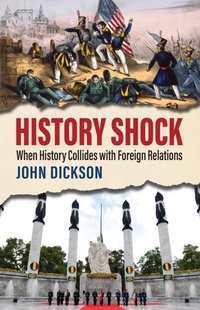
History Shock
Description

For over twenty-five years John Dickson served the United States as a Foreign Service officer in North America, South America, the Caribbean, and Africa. In History Shock: When History Collides with Foreign Relations Dickson offers valuable insights into the daily life of a Foreign Service officer and the work of representing the United States. Dickson organizes History Shock around a country-by-country series of lively personal experience vignettes followed by compelling historical analyses of the ways in which his inadequate understanding of the host country's history, particularly its prior history with the United States, combined with his lack of knowledge of his own nation's history led to history shock: where dramatically different interpretations of history blocked diplomatic understanding and cooperation.
John Dickson offers these ?stories with a history? to highlight the interaction between history and foreign relations and to underscore the costs of not knowing the history of our partners and adversaries, much less our own. In both Mexico and Canada in particular we see how our lack of knowledge and understanding of how our long history of military interventions continues to complicate our efforts at developing mutually beneficial relationships with our two closest neighbors. In Nigeria and South Africa, Dickson experienced firsthand how the history of racism in the United States plays out on a world stage and clouds our ability to effectively work with key African nations. Perhaps the starkest example of history shock, of two nations with deeply conflicted views of their own histories and their shared history, is another country near at hand, Cuba. Not all of the gaps are too wide for bridge building; in Peru, Dickson provides an example of how history can be deployed to mutual advantage.
The Foreign Service has long sought to improve its training, to provide some form of ?playbook? or ?operating manual? with systematic case studies for its officers. In History Shock Dickson provides not only a model for such case studies but also a unique contribution of an interpretive framework for how to remedy this deficit, including recommendations for strengthening historical literacy in the Foreign Service.
More details
Other editions
Additional editions
Person
Content
Preface and Acknowledgments
1. The Past Is a Foreign Country
2. Mexico: The Impact of the Forgotten War
3. Canada: The Other Forgotten War
4. Nigeria and South Africa: Whose Civil Rights?
5. Summit of the Americas: Trapped in Our Past
6. Haiti: Recovering the Heritage
7. Peru: Getting It Right
8. Mexico: Coming Home
9. Cuba: Our Neighbor Doesn't Know Us
10. Choosing to Remember: Laying a Wreath
11. Connecting the Dots: Preliminary Conclusions
Notes
Index
