

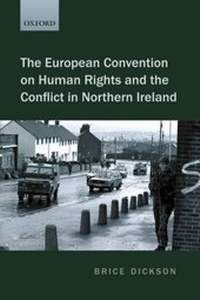
European Convention on Human Rights and the Conflict in Northern Ireland
1st Edition
Published on 15. March 2012
486 pages
978-0-19-163026-2 (ISBN)
Description

This book provides the first comprehensive account of the role played by the European Convention on Human Rights during the conflict in Northern Ireland from 1968. Brice Dickson studies the effectiveness of the Convention in protecting human rights in a society wracked by terrorism and deep political conflict, detailing the numerous applications lodged at Strasbourg relating to the conflict and considering how they were dealt with by the enforcement bodies. The book illustrates the limitations inherent in the Convention system but also demonstrates how the European Commission and Court of Human Rights gradually developed a more interventionist approach to the applications emanating from Northern Ireland. In turn this allowed the Convention to become a more secure guarantor of basic rights and freedoms during times of extreme civil unrest and political turmoil elsewhere in Europe. The topics examined include the right to life, the right not to be ill-treated, the right to liberty, the right to a fair trial, the right to a private life, the right to freedom of belief, the right to freedom of expression, the right to freedom of assembly, and the right not to be discriminated against. The book argues that, while eventually the European Court did use the applications from Northern Ireland to establish important human rights principles, their development was slow and arduous and some gaps in protection still remain. The book illustrates the limits of the European Convention as a tool for protecting human rights in times of crisis.
More details
Other editions
Additional editions
Book
03/2012
Oxford University Press
€69.33
Shipment within 15-20 days
Book
03/2010
1st Edition
Oxford University Press
€95.32
Article exhausted; check different version
Content
- Intro
- Contents
- Table of Cases
- Tables of Legislation
- List of Abbreviations
- 1. Introduction
- 2. The Background to the Conflict and the Rights Discourse
- Competing nationalisms
- The partition of Ireland
- Northern Ireland and the Special Powers Act
- Direct rule
- Human rights discourse in Northern Ireland
- Early calls for a Bill of Rights
- The Standing Advisory Commission on Human Rights
- Conclusion
- 3. Early Fumblings with the Convention
- The Convention's origin and content
- The Convention's limitations
- The situation in Northern Ireland when the Convention became binding
- The Republic of Ireland's emergency legislation
- The IRA and internment in the Republic
- Lawless v Ireland
- Was there a public emergency in Ireland?
- Were the measures taken in Ireland strictly required?
- Access by individuals to the European Court
- Complaints of religious discrimination
- Bernadette Devlin v United Kingdom
- Miscellaneous complaints
- Conclusion
- 4. Internment and Restrictions on Movement
- The practice of internment in Northern Ireland
- The Diplock Commission and the EPA 1973
- The Gardiner Committee and the EPA 1975
- The criminalization policy
- Ireland v United Kingdom
- The European Court's decision
- Further derogations
- Internment in the twenty-first century
- Port powers
- McVeigh, O'Neill and Evans v United Kingdom
- The Shackleton and Jellicoe reviews
- Powers to stop and question
- Exclusion orders
- Attempts to challenge exclusion orders in the courts
- Criticisms of the power to exclude
- Conclusion
- 5. Powers of Arrest
- The scope of Article 5 of the Convention
- The right to security
- Arrests in connection with criminal offences
- 'Ordinary' and 'special' arrest powers
- Special army arrest powers
- The Baker Review and the EPA 1987
- Margaret Murray v United Kingdom
- Special police arrest powers
- Challenging arrests in domestic courts
- Fox, Campbell and Hartley v United Kingdom
- O'Hara v United Kingdom
- Conclusion
- 6. Detention Pending Charge or Trial
- The right of detainees to be brought before a judge
- Brogan v United Kingdom
- Further challenges to the derogation notice
- The right of detainees to be charged or released
- The right of detainees to be released pending trial
- General rules on bail
- Conclusion
- 7. The Right Not to be Ill-treated
- Article 3 of the Convention
- Donnelly v United Kingdom
- Ireland v United Kingdom
- Diplock, the EPA, and the Bennett Inquiry
- The holding centres
- Developments since 1989
- Punishment attacks
- Conclusion
- 8. The Right to a Fair Trial
- Access to a solicitor
- The right of immediate access
- The right of access during police interviews
- Judicial review of prosecutorial decisions
- The presumption of innocence and the burden of proof
- Proof of membership of unlawful organizations
- The admissibility of evidence
- The right to remain silent
- The use of informers
- The right to jury trial
- The right to trial within a reasonable time
- The right to no punishment without law
- Extradition
- Conclusion
- 9. The Right to Life
- The wording of Article 2 of the Convention
- The death penalty
- The right to be protected against risks to life
- Post-Osman cases relating to Northern Ireland
- The Key Persons Protection Scheme
- Claims by witnesses to anonymity
- The right not to be killed
- Rubber and plastic bullets
- The use of potentially lethal force today
- The right to a thorough investigation
- Inquests
- Conclusion
- 10. The Right to a Private and Family Life
- Prison conditions
- Strip-searches
- Transfer of prisoners
- Other prison issues
- Searches of property
- Sexual issues
- Conclusion
- 11. Freedom of Expression, Belief, and Assembly
- Bans on broadcasting and reporting
- Freedom of expression and elections
- Freedom of expression and parliamentary processes
- Treason, sedition, and incitement to disaffection
- Prisoners and journalists
- Belief and identity issues
- Recruitment to the police
- Parades
- Conclusion
- 12 Freedom from Discrimination
- Religious and political discrimination
- The relevance of the European Convention
- Tinnelly & Son Ltd and McElduff v United Kingdom
- Other grounds of discrimination
- Housing and education issues
- Conclusion
- 13 The Final Picture
- The contribution of the Convention in Northern Ireland
- A Bill of Rights for Northern Ireland?
- The Convention and conflicts in other European societies
- The future
- Appendix: Applications lodged in Strasbourg relating to the conflict in Northern Ireland
- Bibliography
- Index
- A
- B
- C
- D
- E
- F
- G
- H
- I
- J
- K
- L
- M
- N
- O
- P
- R
- S
- T
- U
- V
- W
- Y
- Z
