
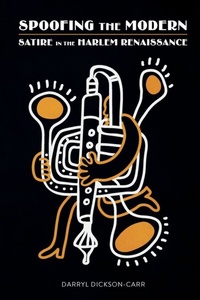
Spoofing the Modern
Description
Alles über E-Books | Antworten auf Fragen rund um E-Books, Kopierschutz und Dateiformate finden Sie in unserem Info- & Hilfebereich.
Spoofing the Modern is the first book devoted solely to studying the role satire played in the movement known as the "New Negro," or Harlem, Renaissance from 1919 to 1940. As the first era in which African American writers and artists enjoyed frequent access to and publicity from major New York-based presses, the Harlem Renaissance helped the talents, concerns, and criticisms of African Americans to reach a wider audience in the 1920s and 1930s. These writers and artists joined a growing chorus of modernity that frequently resonated in the caustic timbre of biting satire and parody.
The Harlem Renaissance was simultaneously the first major African American literary movement of the twentieth century and the first major blooming of satire by African Americans. Such authors as folklorist and anthropologist Zora Neale Hurston, poet Langston Hughes, journalist George S. Schuyler, writer-editor-poet Wallace Thurman, physician Rudolph Fisher, and artist Richard Bruce Nugent found satire an attractive means to criticize not only American racism, but also the trials of American culture careening toward modernity. Frequently, they directed their satiric barbs toward each other, lampooning the painful processes through which African American artists struggled with modernity, often defined by fads and superficial understandings of culture.
Dickson-Carr argues that these satirists provided the Harlem Renaissance with much of its most incisive cultural criticism. The book opens by analyzing the historical, political, and cultural circumstances that allowed for the "New Negro" in general and African American satire in particular to flourish in the 1920s. Each subsequent chapter then introduces the major satirists within the larger movement by placing each author's career in a broader cultural context, including those authors who shared similar views. Spoofing the Modern concludes with an overview that demonstrates how Harlem Renaissance authors influenced later cultural and literary movements.
All prices
More details
Other editions
Additional editions
Person
Darryl Dickson-Carr, an associate professor of English at Southern Methodist University, is the author of The Columbia Guide to Contemporary African American Fiction, which won a 2006 American Book Award, and African American Satire: The Sacredly Profane Novel.
Content
- Cover
- Spoofing the Modern
- Title
- Copyright
- Dedication
- Contents
- Acknowledgments
- 1 Toward a Revision of the Harlem Renaissance
- 2 The Importance of Being Iconoclastic: George S. Schuyler, the Messenger, and the Black Menckenites
- 3 Wallace Thurman, Richard Bruce Nugent, and the Reification of "Race," Aesthetics, and Sexuality
- 4 Dickties vs. Rats: Class and Regional Differences within the New Negro Movement
- 5 Punchlines
- Notes
- Bibliography
- Index

System requirements
File format: ePUB
Copy protection: Adobe-DRM (Digital Rights Management)
System requirements:
- Computer (Windows; MacOS X; Linux): Install the free reader Adobe Digital Editions prior to download (see eBook Help).
- Tablet/smartphone (Android; iOS): Install the free app Adobe Digital Editions or the app PocketBook before downloading (see eBook Help).
- E-reader: Bookeen, Kobo, Pocketbook, Sony, Tolino and many more (not Kindle).
The file format ePub works well for novels and non-fiction books – i.e., „flowing” text without complex layout. On an e-reader or smartphone, line and page breaks automatically adjust to fit the small displays.
This eBook uses Adobe-DRM, a „hard” copy protection. If the necessary requirements are not met, unfortunately you will not be able to open the eBook. You will therefore need to prepare your reading hardware before downloading.
Please note: We strongly recommend that you authorise using your personal Adobe ID after installation of any reading software.
For more information, see our ebook Help page.
File format: PDF
Copy-Protection: Adobe-DRM (Digital Rights Management)
System requirements:
- Computer (Windows; MacOS X; Linux): Install the free reader Adobe Digital Editions prior to download (see eBook Help).
- Tablet/smartphone (Android; iOS): Install the free app Adobe Digital Editions or the app PocketBook before downloading (see eBook Help).
- E-reader: Bookeen, Kobo, Pocketbook, Sony, Tolino and many more (only limited: Kindle).
The file format PDF always displays a book page identically on any hardware. This makes PDF suitable for complex layouts such as those used in textbooks and reference books (images, tables, columns, footnotes). Unfortunately, on the small screens of e-readers or smartphones, PDFs are rather annoying, requiring too much scrolling.
This eBook uses Adobe-DRM, a „hard” copy protection. If the necessary requirements are not met, unfortunately you will not be able to open the eBook. You will therefore need to prepare your reading hardware before downloading.
Please note: We strongly recommend that you authorise using your personal Adobe ID after installation of any reading software.
For more information, see our eBook Help page.
File format: ePUB
Copy protection: Watermark-DRM (Digital Rights Management)
System requirements:
- Computer (Windows; MacOS X; Linux): Use a reading software that can process the file format ePUB: e.g., Adobe Digital Editions or FBReader – both free (see eBook Help).
- Tablet/Smartphone (Android; iOS): Before downloading, install the free app Adobe Digital Editions (see eBook Help).
- E-reader: Bookeen, Kobo, Pocketbook, Sony, Tolino and many more (not Kindle).
The file format ePUB works well for novels and non-fiction books – i.e., „flowing” text without complex layout. On an e-reader or smartphone, line and page breaks automatically adjust to fit the small displays.
This eBook uses Watermark-DRM, a „soft” copy protection. This means that there are no technical restrictions to prevent illegal distribution. However, there is a personalised watermark embedded in the eBook that can be used to identify the purchaser of the eBook in the event of misuse and to provide evidence for legal purposes.
For more information, see our eBook Help page.
